



Friday, August 10, 2018
Per Capita Income, Consumption Patters, and CO2 emission
From a new working paper by Justin Caron and Thibault Fally:
“This paper investigates the role of income-driven differences in consumption patterns in explaining and projecting energy demand and CO2 emissions. We develop and estimate a general-equilibrium model with non-homothetic preferences across a large set of countries and sectors, and trace embodied energy consumption through intermediate use and trade linkages. Consumption of energy goods is less than proportional to income in rich countries, and more income-elastic in low-income countries. While income effects are weaker for embodied energy, we nd a signi cant negative relationship between income elasticity and CO2 intensity across all goods. These income-driven differences in consumption choices can partially explain the observed inverted-U relationship between income and emissions across countries, the so-called environmental Kuznet curve. Relative to standard models with homothetic preferences, simulations suggest that income growth leads to lower emissions in high-income countries and higher emissions in some low-income countries, with only modest reductions in world emissions on aggregate.”
From a new working paper by Justin Caron and Thibault Fally:
“This paper investigates the role of income-driven differences in consumption patterns in explaining and projecting energy demand and CO2 emissions. We develop and estimate a general-equilibrium model with non-homothetic preferences across a large set of countries and sectors, and trace embodied energy consumption through intermediate use and trade linkages. Consumption of energy goods is less than proportional to income in rich countries,
Posted by at 10:49 AM
Labels: Energy & Climate Change
Housing View – August 10, 2018
On cross-country:
- Housing Policy and the Changing Tenure Mix – National Institute of Economic Review
- A Tale of Two Countries: Comparing the US and Chinese Housing Markets – The Journal of Real Estate Finance and Economics
On the US:
- Both renters and homeowners could benefit from better housing policy – Brookings
- Will The Mortgage Market Impact The Midterm Elections? – Forbes
- Pricey Housing Markets in West Are Cooling Off Most Quickly – Wall Street Journal
- America’s Housing Crisis Is Forcing More People To Live In Vehicles – Huffington Post
On other countries:
- [Canada] Housing market dynamics and macroprudential policies – Bank of Canada
- [India] Too slow for the urban march: Litigations and real estate market in Mumbai – Brookings
- [Netherlands] The Big Problem With Investing in Amsterdam’s Hot Housing Market – Bloomberg
- [United Arab Emirates] Dubai Builder Sees Property Slump Lasting for Years – Bloomberg
- [United Kingdom] History dependence in the housing market – Bank of England

Photo by Aliis Sinisalu
On cross-country:
- Housing Policy and the Changing Tenure Mix – National Institute of Economic Review
- A Tale of Two Countries: Comparing the US and Chinese Housing Markets – The Journal of Real Estate Finance and Economics
On the US:
- Both renters and homeowners could benefit from better housing policy – Brookings
- Will The Mortgage Market Impact The Midterm Elections?
Posted by at 5:00 AM
Labels: Global Housing Watch
Thursday, August 9, 2018
Housing Market in Hungary
From the IMF’s latest report on Hungary:
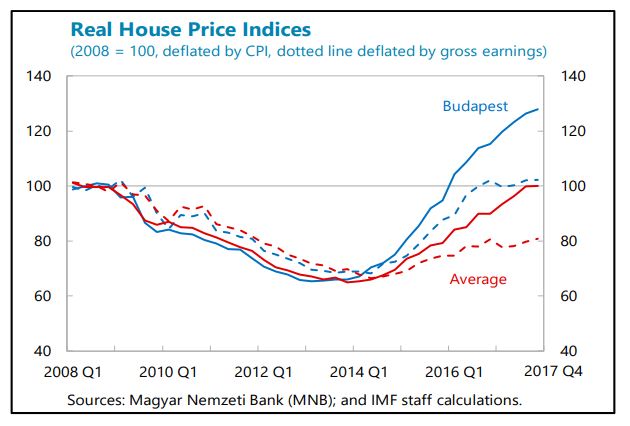
“Hungarian housing prices have increased rapidly since 2014, but from a low level. House prices began to increase in the Budapest area, but have spread to other cities and more recently to municipalities. According to the MNB’s and European Systemic Risk Board’s (data for the latter are as of Q3 2017) estimates, average prices are not yet excessively overpriced compared to fundamentals. The number of transactions has begun to stabilize, possibly due to labor shortages and increasing construction costs, which, according to market observers, frequently delay the completion of new dwellings by 6–12 months.
The housing boom has been driven by many factors other than credit. Delayed purchases following the global financial crisis as well as fiscal initiatives have contributed to the boom. For instance, (i) young families committed to have three or more children can receive a grant and a subsidized loan to purchase a home; and (ii) the VAT rate on sales of certain new dwellings has been temporarily reduced from 27 to 5 percent during the 2016–2019 period. Moreover, low interest rates have made real estate investments more attractive. The MNB’s mortgage bond purchase program may have further supported the market. Finally, the MNB-certified consumer friendly housing loans introduced in 2017, has helped level the playing field, lowered borrowing costs, and encouraged fixed-rate lending. The stock of loans for house purchases increased by 6.8 percent (y-o-y) in May 2018. Nevertheless, according to market observers, only about 45 percent of transactions involve borrowings. Moreover, household debt in Hungary remains low compared to peers. It is also almost completely denominated in local currency, but a substantial share remains variable-rate loans.
The MNB has preventatively tightened macroprudential policies, but the booming housing market needs to be closely monitored. The various macroprudential measures seem to be working, as only about 20 percent of new lending have variable-rates or a fixed rate up to one year. Already in 2016, the calculation of the payment-to-income (PTI) ratio was changed to not discourage fixed-rate borrowing. In April 2017, the mortgage funding adequacy ratio (MFAR) was introduced to encourage banks to issue longer mortgage bonds. These ratios will be further refined to discourage interest rate risk for households in October 2018, while there are no plans thus far to change the loan-to-value ratios. However, given the fact that the boom thus far has mostly been driven by strong disposable income and fiscal incentives rather than credit and low interest rates, there is also a need to review these fiscal incentives as well as supply constraints that appear to be contributing to the boom.”

From the IMF’s latest report on Hungary:
“Hungarian housing prices have increased rapidly since 2014, but from a low level. House prices began to increase in the Budapest area, but have spread to other cities and more recently to municipalities. According to the MNB’s and European Systemic Risk Board’s (data for the latter are as of Q3 2017) estimates, average prices are not yet excessively overpriced compared to fundamentals. The number of transactions has begun to stabilize,
Posted by at 10:08 AM
Labels: Global Housing Watch
The Impact of Higher Temperatures on Economic Growth
From Federal Reserve Bank of Richmond:
“June 2018 was the third-warmest on average across the contiguous forty-eight states since record keeping began in 1895, according to the National Oceanic and Atmospheric Administration (NOAA). Only 1933 and 2016 saw hotter starts to the summer.
Climate scientists project that average global temperatures will rise over the coming decades, which could have a variety of environmental impacts. But what impact would higher temperatures have on the economy? To date, studies of this question have largely focused on developing countries, under the assumption that those countries are more exposed to the effects of higher temperatures. The economy in developing countries is often more reliant on agriculture or other outdoor activities, and those countries have fewer resources to devote to mitigating the effects of heat through technologies such as air conditioning. Indeed, researchers have found that higher temperatures have significant negative effects on the economic growth of developing nations.1
In the case of developed countries, such as the United States, researchers have focused largely on measuring the impact of warming on outdoor economic activities, such as agriculture.2 Since these sectors make up a relatively small share of the U.S. economy, it has generally been assumed that the economic effects of global warming for the United States would be relatively small. As Nobel prize winning economist Thomas Schelling observed in a 1992 article, “Today very little of our gross domestic product is produced outdoors, susceptible to climate.”3
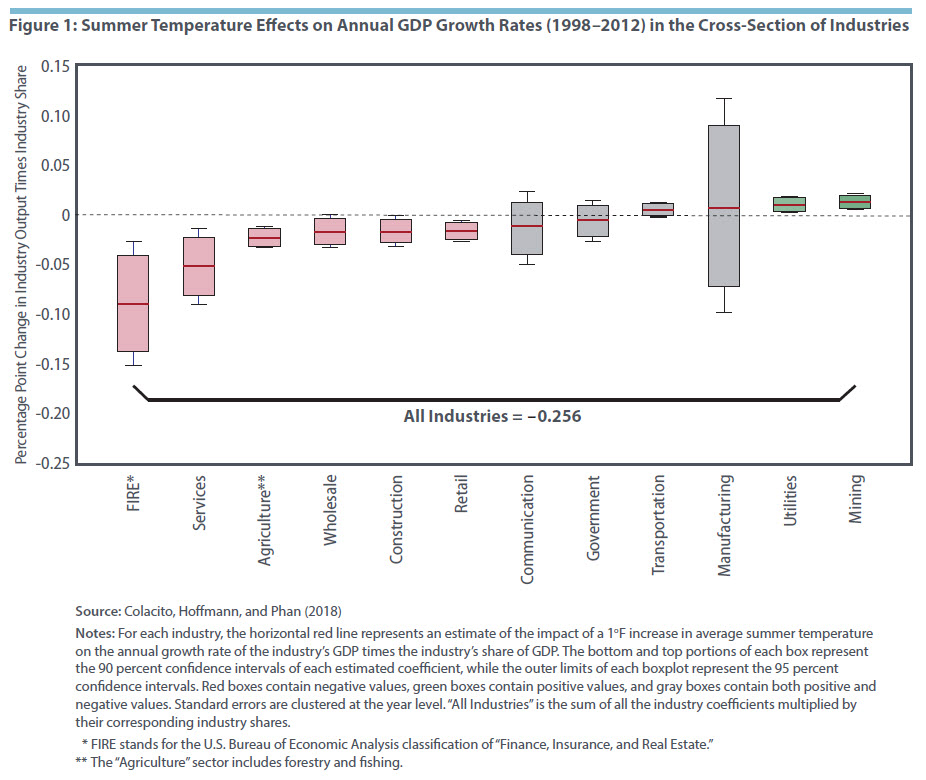
However, research by three authors of this Economic Brief (Colacito, Hoffmann, and Phan) finds that the consequences of higher temperatures on the U.S. economy may be more widespread than previously thought. By examining changes in temperature by season and across states, they find evidence that rising temperatures could reduce overall growth of U.S. economic output by as much as one-third by 2100.”4
Continue reading here.
From Federal Reserve Bank of Richmond:
“June 2018 was the third-warmest on average across the contiguous forty-eight states since record keeping began in 1895, according to the National Oceanic and Atmospheric Administration (NOAA). Only 1933 and 2016 saw hotter starts to the summer.
Climate scientists project that average global temperatures will rise over the coming decades, which could have a variety of environmental impacts. But what impact would higher temperatures have on the economy?
Posted by at 9:55 AM
Labels: Energy & Climate Change
Saturday, August 4, 2018
Twin Deficits in Developing Economies
A new IMF working paper by Davide Furceri and Aleksandra Zdzienicka provides “new evidence on the existence and magnitude of the “twin deficits” in developing economies. It finds that a one percent of GDP unanticipated increase in the government budget balance improves, on average, the current account balance by 0.8 percentage point of GDP. This effect is substantially larger than that obtained using standard measures of fiscal impulse, such as the cyclically-adjusted budget balance. The results point to heterogeneity across countries and over time. The effect tends to be larger: (i) during recessions; in countries (ii) that are more open to trade; (iii) that have less flexible exchange rate regimes; and (iv) with lower initial public debt-to-GDP ratios.”

A new IMF working paper by Davide Furceri and Aleksandra Zdzienicka provides “new evidence on the existence and magnitude of the “twin deficits” in developing economies. It finds that a one percent of GDP unanticipated increase in the government budget balance improves, on average, the current account balance by 0.8 percentage point of GDP. This effect is substantially larger than that obtained using standard measures of fiscal impulse, such as the cyclically-adjusted budget balance.
Posted by at 5:47 PM
Labels: Macro Demystified
Subscribe to: Posts