



Tuesday, October 9, 2018
Georgia: Residential Property Price Index
From the IMF’s latest report on Georgia:
“The compilation of an RPPI will facilitate the assessment of developments and risks in property markets. It will therefore be useful for monetary policy as it will improve the understanding of the linkages between property asset prices and financial assets. The National Bank of Georgia compiles a rudimentary index that tracks residential and commercial property prices in two districts of Tbilisi—one is known for expensive properties and the other for modestly priced properties. The index is therefore quite limited and is not disseminated.
On the RPPI, the mission proposed that, as a start, the index be restricted to the capital city and cover all transactions in new apartments and houses. Initially, the index will not include transactions in existing dwellings because of the complexity in covering these dwellings. Existing dwellings may be covered at a later stage when the RPPI methodology is stabilized and the staff gain the experience and skills in compiling the index.
Geostat should be able to compile the RPPI on a quarterly basis and disseminate the first index for the first quarter of 2021, in mid-May 2021. The RPPI will be developed by the same staff compiling the CPI; however, the production schedule for the RPPI can be arranged around the production and release schedule for the CPI to accommodate the available staff
resources. Based on the current CPI production schedule and the proposed RPPI development plan, additional staff would not be required.The most suitable data source for the RPPI may be the National Agency of Public Registry of Ministry of Justice (NAPR). Geostat informed the mission that it is compulsory to
register all transactions in dwellings with the NAPR. Therefore, the NAPR may collect information on transaction value, transactors, dwelling specifications, and location. An alternative source would be the two main websites for real estate transactions.”
From the IMF’s latest report on Georgia:
“The compilation of an RPPI will facilitate the assessment of developments and risks in property markets. It will therefore be useful for monetary policy as it will improve the understanding of the linkages between property asset prices and financial assets. The National Bank of Georgia compiles a rudimentary index that tracks residential and commercial property prices in two districts of Tbilisi—one is known for expensive properties and the other for modestly priced properties.
Posted by at 1:37 PM
Labels: Global Housing Watch
Gender, Technology, and the Future of Work
From a new IMF Staff Discussion Note:
“Opportunities and challenges. Women are underrepresented in science, technology, engineering, and mathematics (STEM) sectors anticipating jobs growth, where technological change can be complementary to human skills. There are some bright spots: job growth in traditionally female-dominated sectors, such as education and health services, will likely expand. The ongoing digital transformation is also likely to confer greater flexibility in work, benefitting women. But, breaking the “glass-ceiling” will be critical. Across sectors and occupations, underrepresentation of women in professional and managerial positions places them at high risk of displacement by technology.
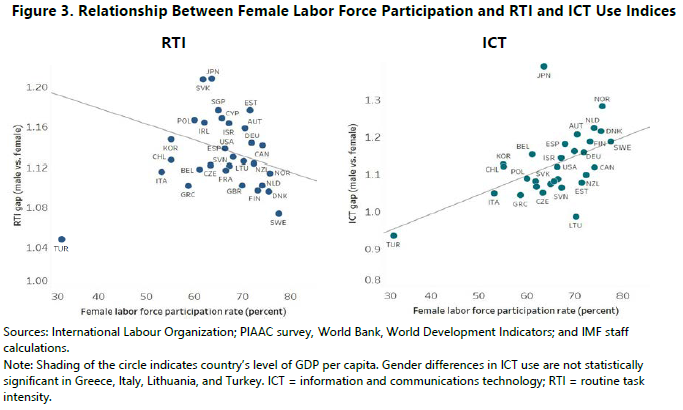
Crucial role for policy. Fostering gender equality and gender empowerment in the changing landscape of work remains an imperative across countries.
- Endowing women with the requisite skills. Early investment in women in STEM fields, along with peer mentoring, can help break down gender stereotypes and increase retention. Fiscal instruments for those already in the workforce (e.g., tax deductions for training, portable individual learning accounts) can remove barriers to lifelong learning.
- Closing gender gaps in leadership positions. Family-friendly policies can play an important role in boosting women’s retention and career progression, but setting relevant recruitment and retention targets for organizations, promotion quotas, as well as mentorship and training programs to promote female talent into managerial positions should be considered.
- Bridging the digital divide. When it comes to the use of new technologies and access to them, countries must close gender gaps to improve women’s labor market prospects in the new world of work. Governments have a role to play through public investment in capital infrastructure and ensuring equal access to finance and connectivity.
- Easing transitions for workers. Ensuring gender equality in support for displaced workers through active labor market policies will be essential, given the high risk of automation faced by women. Ensuring that training and benefits are linked to individuals rather than jobs can help improve their reemployment prospects. Social protection systems will need to adapt to the new forms of work.”
From a new IMF Staff Discussion Note:
“Opportunities and challenges. Women are underrepresented in science, technology, engineering, and mathematics (STEM) sectors anticipating jobs growth, where technological change can be complementary to human skills. There are some bright spots: job growth in traditionally female-dominated sectors, such as education and health services, will likely expand. The ongoing digital transformation is also likely to confer greater flexibility in work, benefitting women. But, breaking the “glass-ceiling” will be critical.
Posted by at 10:49 AM
Labels: Inclusive Growth
Economic Gains from Gender Inclusion: New Mechanisms, New Evidence
From a new IMF Staff Discussion Note:
“While progress has been made in increasing female labor force participation (FLFP) in the past 20 years, the pace has been uneven, and large gaps remain. FLFP was 54 percent for the median Organisation for Economic Co-operation and Development (OECD) country in 2014, 14 percentage points below male labor force participation (MLFP); for the median middle-income country, FLFP was only 49 percent, 26 percentage points below MLFP; and for the median low-income country, FLFP was 64 percent, 13 points below MLFP.
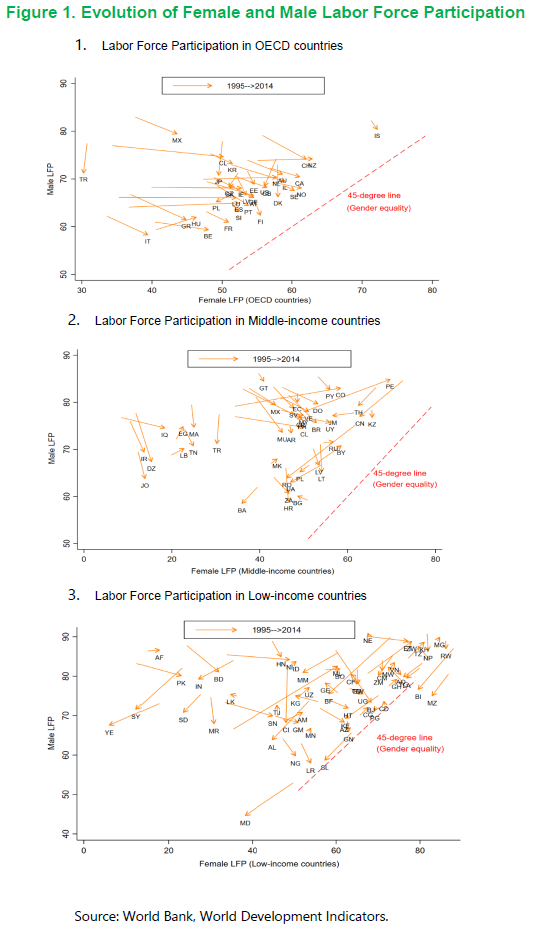
Narrowing participation gaps between women and men is likely to engender large economic gains, with two mechanisms pointing to larger gains than previously thought:
- Gender diversity: Women bring new skills to the workplace. This may reflect social norms and their impact on upbringing, social interactions, as well as differences in risk preference and response to incentives, for example. As such, there is an economic benefit from diversity—that is, from bringing women into the labor force—over and above the benefit resulting from simply having more workers. This hypothesis finds support in the data—both cross-country macro data and firm-level data. This paper finds that male and female labor are complementary in production. The results also imply that standard models, which do not differentiate between genders in their analysis, understate the favorable impact of gender inclusion on growth, and misattribute to technology a part of growth that is actually caused by women’s participation. The results further suggest that narrowing gender gaps benefits both men and women, because of a boost to male wages from higher FLFP.
- Sectoral reallocation: As households get richer during the process of economic development, demand for services rises, and labor is reallocated to the growing sector. Because services are more gender equal in employment than other sectors, developing economies naturally become more inclusive. But barriers to FLFP (which include tax distortions, discrimination, and social/cultural factors) slow this process, reducing output and welfare. This paper estimates that these barriers can depress FLFP by as much as a tax of up to 50 percent on female labor, depending on the region. Barriers not only hold back gender parity, they have a direct cost: welfare gains from their removal would exceed 20 percent in India, Pakistan and other countries in the Middle East and North Africa, for example.
These mechanisms imply that reducing female underemployment should yield greater gains than an equivalent increase in male employment: gender diversity brings benefits all its own.”
From a new IMF Staff Discussion Note:
“While progress has been made in increasing female labor force participation (FLFP) in the past 20 years, the pace has been uneven, and large gaps remain. FLFP was 54 percent for the median Organisation for Economic Co-operation and Development (OECD) country in 2014, 14 percentage points below male labor force participation (MLFP); for the median middle-income country, FLFP was only 49 percent, 26 percentage points below MLFP;
Posted by at 10:43 AM
Labels: Inclusive Growth
Monday, October 8, 2018
Fun Facts about the Nobel Prize
Mark J. Perry summarizes the 10 fun facts about the Nobel Prize:
1. Western Countries Dominate Nobel Awards. […] a) the US and Canada (403 awards) and b) Western Europe (495 awards) together represent the vast majority of the 1,107 country affiliations associated with Nobel laureates, and more than 81% of the total number of laureates since 1901.
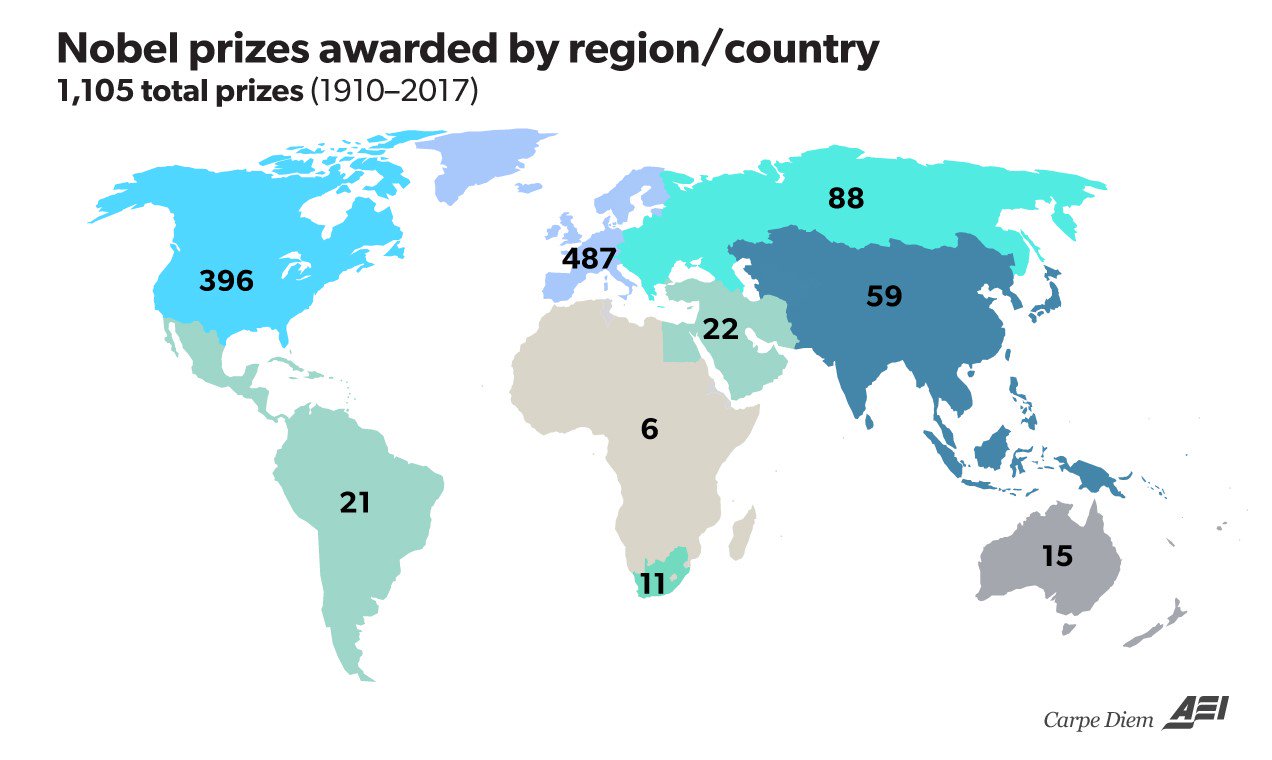
2. Top Ten Nobel-Winning Countries. […] The United States is by far the world’s leading country for receiving Nobel Prizes with an astonishing 377 individual laureates over the last 118 years (and 41.7% of all 904 awards), which is almost three times more than the second-highest ranked country — the United Kingdom, with 130 awards (see table above).
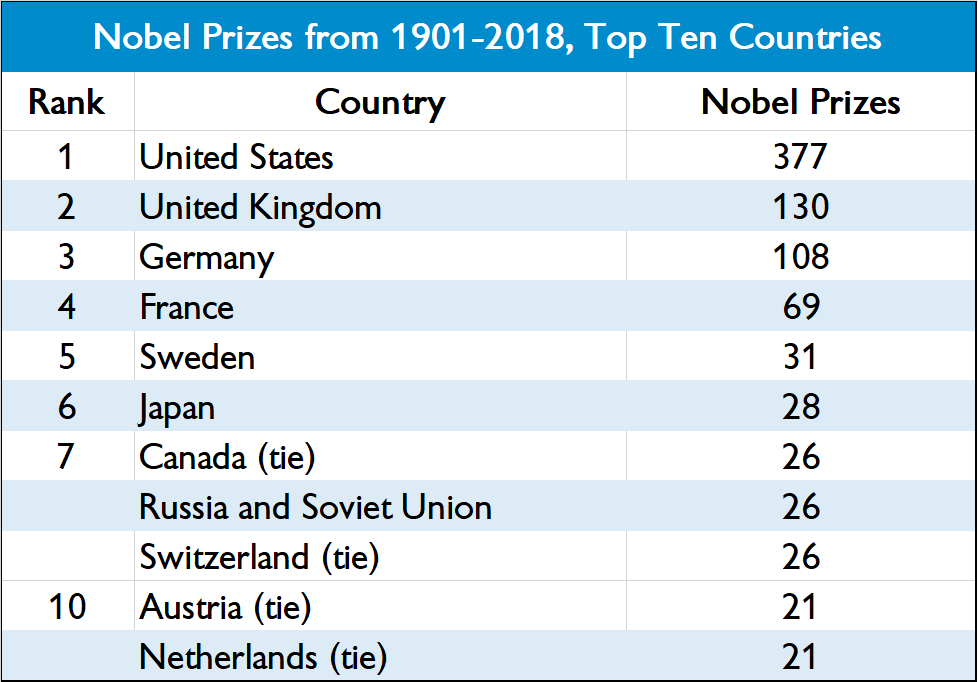
3. Latin America, Asia, Africa, and the Middle East together account for only 116 Nobel Prizes by country in total (10.5% of the 1,107 total), even though those areas together represent about 85% of the world’s population.
4. Asia. Laureates in Asia alone have been awarded 57 Nobel prizes, or 5.1% of the total prizes by country affiliation with nearly 55% of the world’s population. Nobel Prizes for Japanese laureates (28) represent close to half of all Asian awards, followed by India (1o) and China (8).
5. Middle East. Countries in the Middle East have received 22 Nobel Prizes, with more than half (12) of the awards going to Israeli laureates.
6. Africa is the region of the world with the fewest Nobel Prizes – only 17 in total, and only 7 outside of South Africa, even though Africa has a population of about 1 billion.
7. Jewish Nobel Laureates. Interestingly, Jews and people of Jewish descent represent less than 0.20% of the world’s population, but they represent more than 22% of all Nobel laureates (203 out of 904).
8. Nobel Laureates by Gender. Men have been awarded 847 Nobel Prizes compared to only 51 prizes awarded to female laureates.
9. Research Affiliations of Nobel Laureates. The table [below] shows the top ten research affiliations of Nobel laureates at the time of the announcement.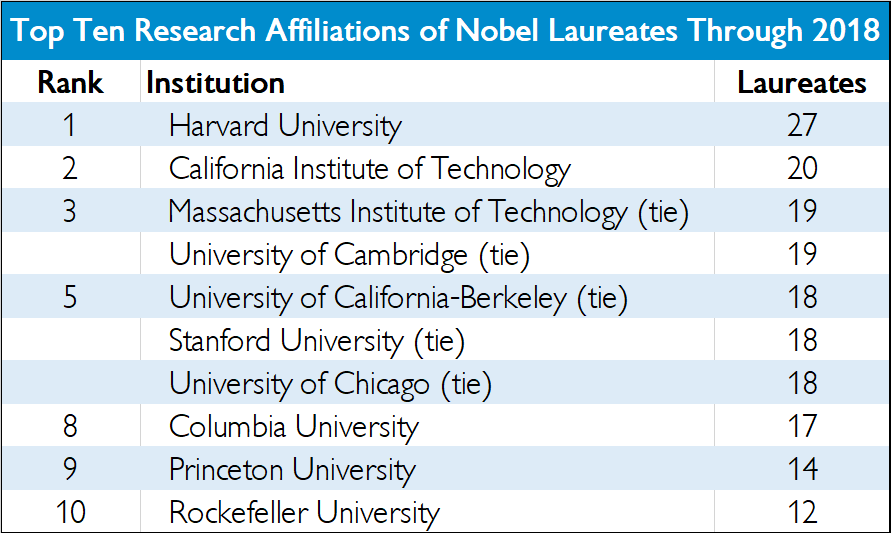
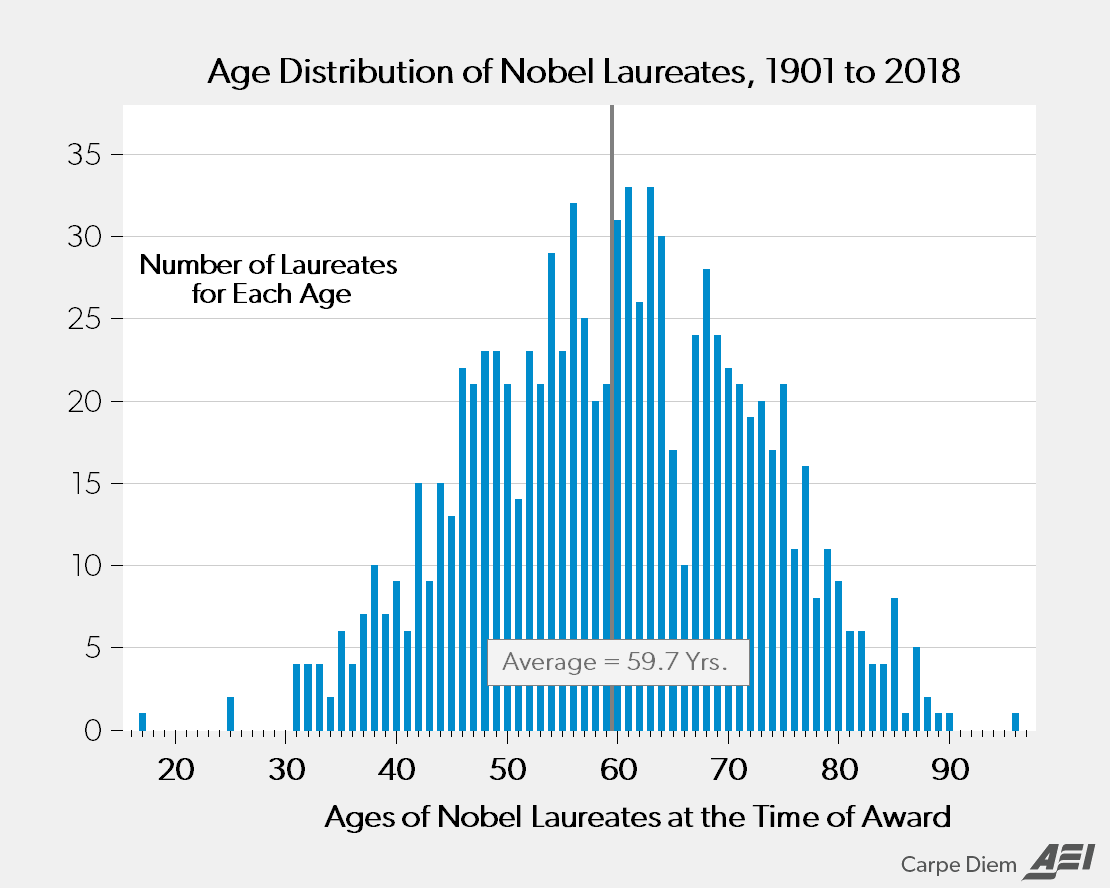
10. Nobel Prizes by Age. […] The chart below shows the age distribution of the 904 Nobel laureates, whose average age was 58.7 years old when the prize was awarded. By individual age, there are more laureates who received a Nobel Prize at age 61 or 63 years (33 individuals for each age) than any other age, followed by ages 56 years (32 laureates) and 60 years (31 laureates).
Mark J. Perry summarizes the 10 fun facts about the Nobel Prize:
1. Western Countries Dominate Nobel Awards. […] a) the US and Canada (403 awards) and b) Western Europe (495 awards) together represent the vast majority of the 1,107 country affiliations associated with Nobel laureates, and more than 81% of the total number of laureates since 1901.
2. Top Ten Nobel-Winning Countries.
Posted by at 10:00 PM
Labels: Profiles of Economists
Friday, October 5, 2018
Finance and pollution
From VOXEU:
“The environmental Kuznets hypothesis predicts that pollution will increase at early stages of development but then decline once a country surpasses a certain income level. This column examines how banks and stock markets affect the mechanisms behind this hypothesis. Industries which pollute relatively more for technological reasons generate relatively more carbon dioxide in countries with expanding credit markets, whereas stock markets have the exact opposite effect. For middle-income countries in particular, where carbon dioxide emissions may have increased linearly during the development process, stock markets could play an important role in making future growth greener.”
From VOXEU:
“The environmental Kuznets hypothesis predicts that pollution will increase at early stages of development but then decline once a country surpasses a certain income level. This column examines how banks and stock markets affect the mechanisms behind this hypothesis. Industries which pollute relatively more for technological reasons generate relatively more carbon dioxide in countries with expanding credit markets, whereas stock markets have the exact opposite effect. For middle-income countries in particular,
Posted by at 9:02 AM
Labels: Energy & Climate Change
Subscribe to: Posts