



Wednesday, April 3, 2019
The missing link between income inequality and economic growth: Inequality of opportunity
From a VoxEU post by Shekhar Aiyar and Christian Ebeke:
“There are contrasting theories on the relationship between income inequality and growth, and the empirical evidence is similarly mixed. This column highlights the neglected role of equality of opportunity in mediating this relationship. Using the World Bank’s new Global Database on Intergenerational Mobility, it shows that in societies where opportunities are unequally distributed, income inequality exerts a greater drag on growth.
Despite the firm consensus that income inequality is intrinsically undesirable, its impact on economic growth is much disputed. Simon Kuznets famously argued that inequality is beneficial for economic growth at an early stage of development, since a moneyed capitalist class can undertake more investment, but is harmful at a later stage. Others have pointed to inequality as a necessary, even desirable outcome of rewards to innovation and risk-taking. But there are also numerous theories about how income inequality can reduce investment and hinder the full realisation of human potential. As a canonical example, Galor and Zeira (1993) show that if poor families are constrained to under-invest in education, aggregate growth falls.
The empirical evidence is similarly mixed. Barro (2000) finds that for developed economies income inequality raises growth. On the other hand, Berg et al. (2012, 2018) find that income inequality tends to reduce the duration of growth spells. Forbes (2000) and Panizza (2002) find no systematic effect.
The missing link: Inequality of opportunity
In recent work (Aiyar and Ebeke 2018), we point to the neglected role of equality of opportunity in mediating this relationship. Our hypothesis is simple. In societies where opportunities are unequally distributed – where the material circumstances of parents act as binding constraints on the opportunities available to their children – income inequality exerts a greater drag on growth. Any increase in income inequality tends to become entrenched, limiting the investment opportunities – broadly defined to include investment in children – available to low-income earners, thereby retarding long-term aggregate growth. On the other hand, in societies with a more equal distribution of opportunities, an increase in income inequality can be more easily reversed and need not constrain investment opportunities and growth. To the extent that inequality of opportunity matters in this way, its omission from standard regressions of growth on income inequality leads to misspecification, which can help explain the inconclusive nature of the empirical literature to date.
We measure a society’s distribution of opportunity by the economic mobility of its people across generations. The World Bank’s new Global Database on Intergenerational Mobility (GDIM) compiles cross-country estimates of the elasticity of a son’s income (or education level) with respect to the income (or education level) of their father (Narayan et al. 2018). The higher this elasticity, the lower the degree of intergenerational mobility, which we take to signal a less equal distribution of opportunity. Because each observation requires a comparison of life-cycle income over two generations, this is a slow-moving variable whose latest value says something about societal conditions over a period of several decades. For the purpose of our study and due to data availability constraints, we take this variable to be time-invariant.”
Continue reading here.
From a VoxEU post by Shekhar Aiyar and Christian Ebeke:
“There are contrasting theories on the relationship between income inequality and growth, and the empirical evidence is similarly mixed. This column highlights the neglected role of equality of opportunity in mediating this relationship. Using the World Bank’s new Global Database on Intergenerational Mobility, it shows that in societies where opportunities are unequally distributed, income inequality exerts a greater drag on growth.
Posted by at 8:43 AM
Labels: Inclusive Growth
Housing Market in Kuwait
From the IMF’s latest report on Kuwait:
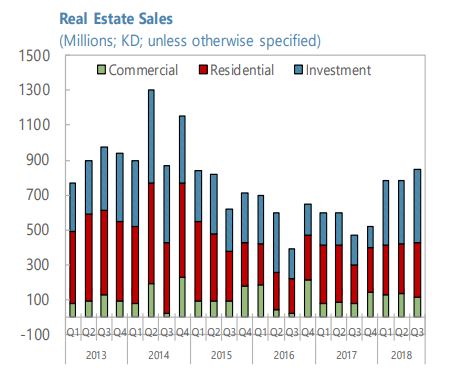
“Real estate is recovering, and equity markets have outperformed regional peers. The sales of investment and residential properties rebounded since mid-2018. Kuwaiti stocks outperformed other Gulf Cooperation Council (GCC) markets, and market capitalization rose, especially following the March 2018 announcement of Kuwait’s inclusion in the FTSE Russell Emerging Market Index.”
From the IMF’s latest report on Kuwait:
“Real estate is recovering, and equity markets have outperformed regional peers. The sales of investment and residential properties rebounded since mid-2018. Kuwaiti stocks outperformed other Gulf Cooperation Council (GCC) markets, and market capitalization rose, especially following the March 2018 announcement of Kuwait’s inclusion in the FTSE Russell Emerging Market Index.”
Posted by at 8:40 AM
Labels: Global Housing Watch
Tuesday, April 2, 2019
Monetary Policy, Growth and Employment in Developing Areas: A Review of the Literature
From a paper by P.N. (Raja) Junankar at University of Technology Sydney;
“In this paper we review the literature on the impact that monetary policy has on growth and employment in developing countries. Much of the literature focusses on the impact of monetary policy on inflation levels and inflation volatility, and sometimes on output (GDP) levels and volatility of output. This survey of the literature on Monetary policy and growth shows that money plays a small role in developing countries and that monetary policy is not a very important influence on growth but may have some impact on inflation. Although there is much discussion about the merits of keeping inflation levels and volatility low, there is very little literature on studying the impact of low rates of steady inflation on the levels of private investment and technological change and hence on economic growth and on employment. There is very little research about the direct links between monetary policy and employment. The impact of growth on employment depends on what are the main drivers of economic growth and the initial state of the economy. Although growth may lead to increasing employment (formal and informal) there is little evidence showing that growth leads to an increase in “decent employment”.”
From a paper by P.N. (Raja) Junankar at University of Technology Sydney;
“In this paper we review the literature on the impact that monetary policy has on growth and employment in developing countries. Much of the literature focusses on the impact of monetary policy on inflation levels and inflation volatility, and sometimes on output (GDP) levels and volatility of output. This survey of the literature on Monetary policy and growth shows that money plays a small role in developing countries and that monetary policy is not a very important influence on growth but may have some impact on inflation.
Posted by at 11:07 AM
Labels: Inclusive Growth
Monday, April 1, 2019
Some US Social Indicators Since 1960
From a new post by Timothy Taylor
“Economic
- Real GDP per person has more than tripled since 1960, rising from $18,036 in 1960 to $55,373 in 2017 (as measured in constant 2012 dollars).
- Inflation has reduced the buying power of the dollar over time such that $1 in 2016 had about the same buying power as 12.3 cents back in 1960, according to the Consumer Price Index.
- The employment/population ratio rose from 56.1% in 1960 to 64.4% by 2000, then dropped to 58.5% in 2012, before rebounding a bit to 62.9% in 2018.
- The share of the population receiving Social Security disabled worker benefits was 0.9% in 1960 and 5.5% in 2018.
- The net national savings rate was 10.9% of GDP in 1960, 7.1% in 1980, and 6.0% in 2000. It actually was slightly negative at -0.5 in 2010, but was back to 2.9% in 2017.
- Research and development spending has barely budged over time: it was 2.52% of GDP in 1960 and 2.78% of GDP in 2017, and hasn’t varied much in between.
Demographic
- The foreign-born population of the US was 9.6 million out of a total of 204 million in 1970, and was 44.5 million out of at total of 325.7 million in 2017.
- In 1960, 78% of the over-15 population had ever been married; in 2018, it was 67.7%.
- Average family size was 3.7 people in 1960, and 3.1 people in 2018.
- Single parent households were 4.4% of households in 1960, and 9.1% of all households in 2010, but slightly down to 8.3% of all households in 2018.
Socioeconomic
- The share of 25-34 year-olds who are high school graduates was 58.1% in 1960, 84.2% in 1980, and 90.9% in 2018.
- The share of 25-34 year-olds who are college graduates was 11% in 1960, 27.5% in 2000, and 35.6% in 2017.
- The average math achievement score for a 17 year-old on the National Assessment of Educational Progress was 304 in 1970, and 306 in 2010.
- The average reading achievement score for a 17 year-old was 285 in 1970 and 286 in 2010.
Health
- Life expectancy at birth was 69.7 years in 1960, and 78.7 years in 2010, and 78.6 years in 2017.
- Infant mortality was 26 per 1,000 births in 1960, and 5.8 per 1,000 births in 2017.
- In 1960, 13.4% of the population age 20-74 was obese (as measured by having a Body Mass Index above 30). In 2016, 40% of the population was obese.
- In 1970, 37.1% of those age 18 and older were cigarette smokers. By 2017, this has fallen to 14.1%.
- Total national health expenditures were 5.0% of GDP in 1960, and 17.9% of GDP in 2017.
Security and Safety
- The murder rate was 5.1 per 100,000 people in 1960, rose to 10.2 per 100,000 by 1980, but had fallen back to 4.9 per 100,000 in 2015, before nudging up to 5.3 per 100,000 in 2017..
- The prison incarceration rate in federal and state institutions was 118 per 100,000 in 1960, 144 per 100,000 in 1980, 519 per 100,000 by 2010, and then down to 464 per 100,000 in 2016.
- Highway fatalities rose from 37,000 in 1960 to 51,000 in 1980, and then fell to 33,000 in 2010, before nudging up to 37,000 in 2017.
Energy
- Energy consumption per capita was 250 million BTUs in 1960, rose to 350 million BTUs per person in 2000, but since then has fallen to 300 BTUs per person in 2017.
- Energy consumption per dollar of real GDP (measured in constant 2009 dollars) was 14,500 BTUs in 1960 vs. 5,700 in 2017.
- Electricity net generation on a per person basis was 4.202 kWh in 1960, had more than tripled to 13,475 kWh by 2000, but since then has declined to 12,326 kWh in 2017.
- The share of electricity generation from renewable sources was 19.7% of the total in 1960, fell to 8.8% by 2005, and since then rose to 17.1% of the total in 2017.
Numbers and comparisons like these are a substantial part of how a head-in-the-clouds academic like me perceives economic and social reality. If you like this kind of stuff, you would probably also enjoy my post from a few years back, “The Life of US Workers 100 Years Ago” (February, 5, 2016).”
From a new post by Timothy Taylor
“Economic
- Real GDP per person has more than tripled since 1960, rising from $18,036 in 1960 to $55,373 in 2017 (as measured in constant 2012 dollars).
- Inflation has reduced the buying power of the dollar over time such that $1 in 2016 had about the same buying power as 12.3 cents back in 1960, according to the Consumer Price Index.
Posted by at 2:41 PM
Labels: Inclusive Growth
As income pie shrinks, Ottawa and business community talk past each other
From Financial Post:
“While economies work better when entrepreneurs and others are allowed to satisfy their greed, big gaps between the richest and the rest can cause chronic problems
Our collective share of the pie shrunk last year.
You might have seen reports that the trade deficit remained an expanse of misery in January. The same day that Statistics Canada released those dreary numbers, it also published its annual report on the distribution of household wealth, or, if you prefer, “Distributions of household economic accounts for income, consumption, saving and wealth of Canadian households, 2018.”
The net worth of households was $10.7 trillion in 2018, compared with $10.9 trillion in 2017; the first decrease since at least 2010, which is when Statistics Canada began publishing this particular set of data.
Collectively, we’re 60 per cent richer than we were a decade ago, so keep that in mind before you take to Twitter to vent about Stephen Harper’s austerity or Justin Trudeau’s taxing of the rich. Still, the good times rolled a little slower last year. That’s partly because the housing bubbles in Toronto and Vancouver started to deflate. But it’s also because a group of wealth creators on which the country has relied since the Great Recession had a tough time in 2018.
Statistics Canada diced household wealth into five income segments. It also divided the aggregate data into five regions. There wasn’t a lot of change in distribution. Nationally, the richest 20 per cent of households controlled about 55 per cent of total wealth, roughly the same as 2010. One shift stood out, however.
(…) “Inequality and fragile growth may be two sides of the same coin,” Ostry, a Canadian who trained at Oxford, the London School of Economics, and the University of Chicago, says in Confronting Inequality: How Societies Can Choose Inclusive Growth, along with co-writers Prakash Loungani and Andrew Berg.
(…) The Trudeau government and the business community keep talking past each other. The latter should recognize that the federal government’s coddling of the middle class isn’t entirely about electioneering. And Trudeau and Morneau should be wary of taking the leaders of the country’s biggest companies for granted. As David Lipton, one of Ostry’s bosses at the IMF once said, “a larger slice of the pie for everyone calls for a bigger pie.”
From Financial Post:
“While economies work better when entrepreneurs and others are allowed to satisfy their greed, big gaps between the richest and the rest can cause chronic problems
Our collective share of the pie shrunk last year.
You might have seen reports that the trade deficit remained an expanse of misery in January. The same day that Statistics Canada released those dreary numbers,
Posted by at 8:50 AM
Labels: Inclusive Growth
Subscribe to: Posts