



Monday, July 22, 2019
Decoupling-Debunked
From the European Environmental Bureau:
“Is it possible to enjoy both economic growth and environmental sustainability? This question is a matter of fierce political debate between green growth and post-growth advocates. Over the past decade, green growth clearly dominated policy making with policy agendas at the United Nations, European Union, and in numerous countries building on the assumption that decoupling environmental pressures from gross domestic product (GDP) could allow future economic growth without end.
Considering what is at stake, a careful assessment to determine whether the scientific foundations behind this “decoupling hypothesis” are robust or not is needed. This report reviews the empirical and theoretical literature to assess the validity of this hypothesis. The conclusion is both overwhelmingly clear and sobering: not only is there no empirical evidence supporting the existence of a decoupling of economic growth from environmental pressures on anywhere near the scale needed to deal with environmental breakdown, but also, and perhaps more importantly, such decoupling appears unlikely to happen in the future.
It is urgent to chart the consequences of these findings in terms of policy-making and prudently move away from the continuous pursuit of economic growth in high-consumption countries. More precisely, existing policy strategies aiming to increase efficiency have to be complemented by the pursuit of sufficiency, that is the direct downscaling of economic production in many sectors and parallel reduction of consumption that together will enable the good life within the planet’s ecological limits. In the view of the authors of this report and based on the best available scientific evidence, only such strategies respect the EU’s ‘precautionary principle,’ the principle that when the stakes are high and the outcomes uncertain, one should err on the side of caution.
The fact that decoupling on its own, i.e. without addressing the issue of economic growth, has not been and will not be sufficient to reduce environmental pressures to the required extent is not a reason to oppose decoupling (in the literal sense of separating the environmental pressures curve from the GDP curve) or the measures that achieve decoupling – on the contrary, without many such measures the situation would be far worse. It is a reason to have major concerns about the predominant focus of policymakers on green growth, this focus being based on the flawed assumption that sufficient decoupling can be achieved through increased efficiency without limiting economic production and consumption.”
From the European Environmental Bureau:
“Is it possible to enjoy both economic growth and environmental sustainability? This question is a matter of fierce political debate between green growth and post-growth advocates. Over the past decade, green growth clearly dominated policy making with policy agendas at the United Nations, European Union, and in numerous countries building on the assumption that decoupling environmental pressures from gross domestic product (GDP) could allow future economic growth without end.
Posted by at 9:51 AM
Labels: Energy & Climate Change
Friday, July 19, 2019
Recession Forecasts Are So Bad, They’re Good
From Bloomberg:
“Economists, notoriously terrible at predicting downturns, may be inadvertently providing a useful service.
It’s no secret that economists are terrible at predicting recessions: a host of studies, along with a raft of anecdotal evidence, reveals a track record that is astonishingly bad. This has prompted a growing number of market watchers to conclude that forecasting recessions is a fool’s game.
But there’s another way to look at this dismal record. What if economists are so bad at predicting recessions that they’re actually good? What if a profession that consistently, almost universally, gets something wrong is inadvertently getting something right?
Prakash Loungani and his colleagues at the International Monetary Fund conducted the most sophisticated studies of economic forecasting, assessing the accuracy of economists in 63 countries between the years of 1992 and 2014. The results, as my colleagues at Bloomberg have noted (see here and here) are mind-blowingly awful. In fact, every single country displayed the exact same bad track record of predicting recessions. Moreover, as Loungani and his co-authors noted, “the forecasts of the private sector and public sector are virtually identical; thus, both are equally good at missing recessions.”
Good at missing recessions. Think about that for a moment. Economic forecasts consistently miss the onset of recessions.
This means that their failure to predict is a problem altogether different from the failures emphasized by the random-walk hypothesis and other critiques of prognostication. Economists predict the future incorrectly, but their failures are, well, predictable. Does that mean they may be telling us something important after all?
To understand the implications of this question, consider the typical progression of erroneous forecasts over the course of a recession’s first year. Loungani found that forecasts made on the eve of a recession (when almost no one imagines there’s trouble brewing) are more or less in line with the previous year’s predictions.”
Continue reading here.
From Bloomberg:
“Economists, notoriously terrible at predicting downturns, may be inadvertently providing a useful service.
It’s no secret that economists are terrible at predicting recessions: a host of studies, along with a raft of anecdotal evidence, reveals a track record that is astonishingly bad. This has prompted a growing number of market watchers to conclude that forecasting recessions is a fool’s game.
But there’s another way to look at this dismal record.
Posted by at 11:20 AM
Labels: Forecasting Forum
Intergenerational mobility in Italy: Income distribution and regional analysis
An interesting new piece in VoxEu by Paolo Acciari, Alberto Polo and Gianluca Violante on inter-generational mobility in Italy:
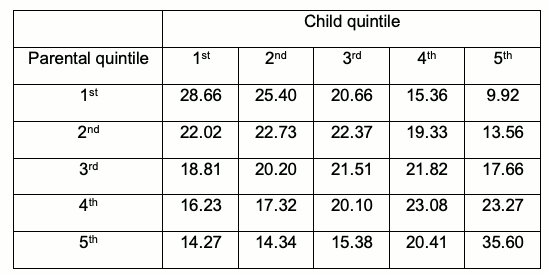
“In a new paper (Acciari et al. 2019), we add to this recent wave of studies and introduce a new dataset that allows us to develop the first systematic investigation of intergenerational income mobility for the Italian economy. Our starting point is the administrative electronic database on individual tax returns maintained by the Italian Ministry of Economy and Finance. From this data source, we extracted a sample of two cohorts of Italians born between 1942-1963 and 1972-1983. We matched parents and children through their social security numbers. Our final dataset contains nearly 650,000 parent–child pairs with detailed income information for three years in each cohort.”
Table 1 National quintile transition matrix (%)
“We follow up on this last finding by exploring the geographical differences in inter-generational upward mobility across the 110 Italian provinces. We document a staggering amount of variation, with a steep south-north gradient, as depicted in Figure 2. Relative to the south of Italy, provinces in the north (especially the regions in the northeast), are both more egalitarian – i.e. they display higher relative mobility – and more upward-mobile – i.e. they display higher absolute mobility. In the north, children from parents with unequal background are more similar in their economic outcomes when adults, and children from poor parents fare better when adults. The level of upward mobility in northern Italy exceeds that of Scandinavian countries”
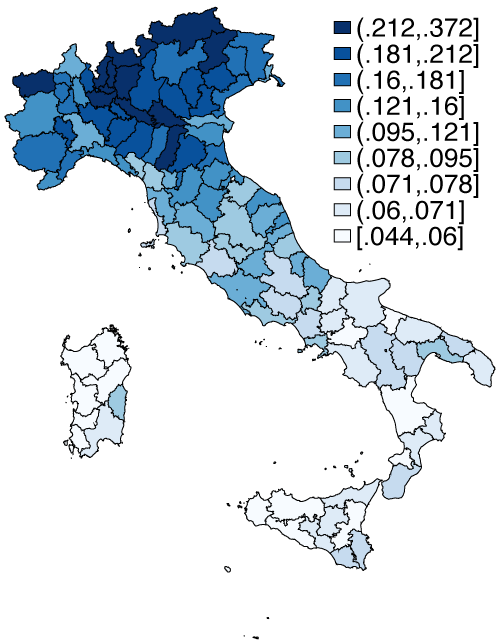
Figure 2: Estimated transition probability from bottom to top 20% of income distribution across provinces
An interesting new piece in VoxEu by Paolo Acciari, Alberto Polo and Gianluca Violante on inter-generational mobility in Italy:
“In a new paper (Acciari et al. 2019), we add to this recent wave of studies and introduce a new dataset that allows us to develop the first systematic investigation of intergenerational income mobility for the Italian economy. Our starting point is the administrative electronic database on individual tax returns maintained by the Italian Ministry of Economy and Finance.
Posted by at 10:33 AM
Labels: Inclusive Growth
Housing View – July 19, 2019
On cross-country:
- House prices up by 4.0% in both the euro area and the EU – Eurostat
On the US:
- Is rent control making a comeback? – Brookings
- Tackling zoning to help the middle class: 5 policy approaches – Brookings
- Survey Shows Decline in Foreign Investment in U.S. Residential Real Estate – National Association of Realtors
- 5 Lessons from Cities On Affordable Housing – Politico
- Can Robots Solve the Affordable Housing Crisis? – Politico
- Only Washington Can Solve the Nation’s Housing Crisis – New York Times
- Amazon HQ2 Is Upending Northern Virginia’s Already Unstable Housing Market – New York Times
- Property taxes stunt Chicago’s house price growth – Financial Times
- Is California’s apartment market broken? – Brookings
- Housing Affordability and Zoning Reform – Cato
- Wave of Hispanic Buyers Boosts U.S. Housing Market – Wall Street Journal
- A Home Builder Perspective on Housing Affordability and Construction Innovation – Harvard Joint Center for Housing Studies
- Gentrification ‘benefits local residents’, research finds – Financial Times
- Housing’s ‘Missing Middle’ Keeps Shrinking – Bloomberg
- Steep Slowdown Projected in Home Improvements – Harvard Joint Center for Housing Studies
On other countries:
- [China] When Affordable Housing in Shanghai Is a Bed in the Kitchen – Citylab
- [Netherlands] “Mortgage Interest Tax Deduction in the Netherlands: A Welcome Relief” – Netherlands Bank
- [Puerto Rico] Puerto Rico’s housing market improving – Global Property Guide
- [Qatar] Qatar’s housing market is recovering – Global Property Guide
- [United Arab Emirates] UAE’s property prices fall further – Global Property Guide
- [United States]S. housing market gradually cooling – Global Property Guide
*Please note that the Housing View will be on hiatus until September 8.
On cross-country:
- House prices up by 4.0% in both the euro area and the EU – Eurostat
On the US:
- Is rent control making a comeback? – Brookings
- Tackling zoning to help the middle class: 5 policy approaches – Brookings
- Survey Shows Decline in Foreign Investment in U.S. Residential Real Estate – National Association of Realtors
- 5 Lessons from Cities On Affordable Housing – Politico
- Can Robots Solve the Affordable Housing Crisis?
Posted by at 5:00 AM
Labels: Global Housing Watch
Thursday, July 18, 2019
Why Is Inflation Low Globally?
From the Federal Reserve Bank of San Francisco:
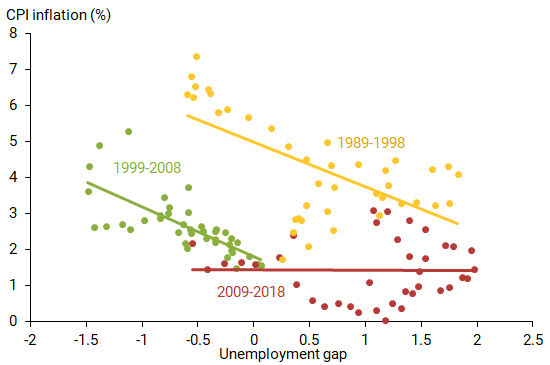
“A hot economy eventually boosts inflation. Such is the simple wisdom of the Phillips curve. Yet inflation across developed countries has been remarkably weak since the 2008 global financial crisis, even though unemployment rates are near historical lows. What is behind this recent disconnect between inflation and unemployment? Contrasting the experiences of developed and developing economies before and after the financial crisis shows that broader factors than monetary policy are at play. Inflation has declined globally, and this trend preceded the financial crisis.
The world economies have mostly recovered from the 2008 financial crisis. In the United States, United Kingdom, and Germany, for example, the unemployment rate is now below 4%, lower than it has been in decades. Tight labor markets are usually a symptom of a healthy economy and thus a rising demand for goods and services. To satisfy such demand, businesses usually raise prices—the basic mechanism underlying the standard economic relationship known as the Phillips curve. Yet, 10 years after the financial crisis, inflation has held remarkably steady. Some researchers therefore argue that the Phillips curve is no longer a useful descriptor of inflation dynamics (Coibion and Gorodnichenko 2015).
In this Economic Letter, we investigate whether the financial crisis has changed the long-standing inner workings of the Phillips curve. We extend the analysis in our previous Economic Letter (Jordà et al. 2019) to include developing economies and analyze three components of the Phillips curve to assess where the links appear to be broken.
Our analysis suggests that news of the death of the Phillips curve in developed economies appears premature. Fluctuations in labor market conditions have been largely offset with appropriate interest rate changes by central banks. Under such conditions, the influence of past inflation has faded, and expectations for future inflation have gravitated toward the central bank’s stated target. On the surface, inflation appears stable at all levels of labor market slack, and the Phillips curve link appears broken. Underneath, however, the Phillips curve could still be at work. The inflation dynamics that we observe could also be explained by a central bank that successfully offsets fluctuations in slack to keep inflation at the target. In less developed economies, central banks often operate under constraints that prevent full monetary policy offsets, which has given a bigger role to feedback from past inflation. That said, inflation has been trending down for the past two decades across developed and developing economies alike. The inevitable conclusion is that there are global forces putting downward pressure on inflation, and it is not just the result of better monetary policy.”
Figure 1
Phillips curve across OECD countries by decade
Continue reading here.
From the Federal Reserve Bank of San Francisco:
“A hot economy eventually boosts inflation. Such is the simple wisdom of the Phillips curve. Yet inflation across developed countries has been remarkably weak since the 2008 global financial crisis, even though unemployment rates are near historical lows. What is behind this recent disconnect between inflation and unemployment? Contrasting the experiences of developed and developing economies before and after the financial crisis shows that broader factors than monetary policy are at play.
Posted by at 10:37 AM
Labels: Macro Demystified
Subscribe to: Posts