



Friday, September 13, 2019
House Prices in Namibia
From the IMF’s latest report on Namibia:
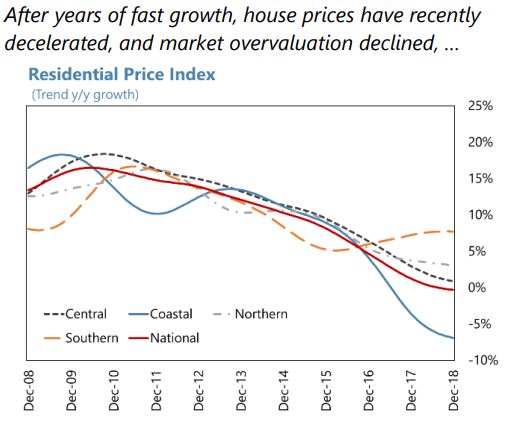
Private sector credit and house prices growth decelerated, while private sector indebtedness remained elevated. After years of double digit increases, nominal credit growth to the private sector sharply declined in 2017 and stabilized at around 6.8 percent in 2018.6 With liquidity easing, the deceleration was mostly driven by weak demand from a highly-leveraged private sector and the implementation of some macroprudential measures (…). Weak credit and economic conditions contributed reducing the growth rate in residential house prices to 1.7 percent (9¾ percent average over the past five years). The economic slowdown began affecting the banking sector’s asset quality. Over the last two years, NPLs more than doubled, although from very low levels. More recently, banks have started tightening lending conditions. With government’s financing needs still high, banks’ direct exposures to the public sector continued rising and reached about 10 percent of banks’ total assets (7 percent in 2016).”
From the IMF’s latest report on Namibia:
Private sector credit and house prices growth decelerated, while private sector indebtedness remained elevated. After years of double digit increases, nominal credit growth to the private sector sharply declined in 2017 and stabilized at around 6.8 percent in 2018.6 With liquidity easing, the deceleration was mostly driven by weak demand from a highly-leveraged private sector and the implementation of some macroprudential measures (…). Weak credit and economic conditions contributed reducing the growth rate in residential house prices to 1.7 percent (9¾ percent average over the past five years).
Posted by at 10:31 AM
Labels: Global Housing Watch
Housing View – September 13, 2019
On the US:
- First Reactions: The Treasury Plan for GSE Reform by Administrative Means – Joint Center for Housing Studies
- The Trump administration’s new plan to privatize Fannie Mae and Freddie Mac, explained – VOX
- Trump’s housing finance plan will make mortgages more expensive, especially for black borrowers, housing groups say – Washington Post
- Subduing the Housing Godzillas – Wall Street Journal
- The fall housing market expected to be more of the same – Washington Post
- Housing Sentiment Inches Higher, Driven by Mortgage Rate Outlook – Fannie Mae
- Campaign 2020: How to fix America’s housing policies – Brookings
- Housing finance reform battle lines drawn in Senate hearing – Market Watch
- The Share Economy Can Help Lower Housing Prices If We Let It – Forbes
- California Rent Control Bill Advances, Fueled by Housing Crisis – New York Times
- How State and Local Governments are Responding to the Affordability Crisis – Harvard Joint Center for Housing Studies
- A Real Housing Economist Speaks – Forbes
- California lawmakers move to reinstate, revamp local affordable housing program – Los Angeles Times
- California Approves Statewide Rent Control to Ease Housing Crisis – New York Times
On other countries:
- [Australia] Australia mortgage lending surges on relaxation of rules – Financial Times
- [Russia] Russia’s housing market improving – Global Property Guide
- [Singapore] Singapore Unveils Changes to Make Public Housing More Affordable – Bloomberg
- [South Korea] South Korea’s housing market remains sluggish – Global Property Guide
- [Thailand] Thailand’s modest house price rises – Global Property Guide
- [United Kingdom] Tackling the UK housing crisis: is supply the answer? – UK Collaborative Centre for Housing Evidence
- [Ukraine] Ukraine’s housing market remains depressed – Global Property Guide
On the US:
- First Reactions: The Treasury Plan for GSE Reform by Administrative Means – Joint Center for Housing Studies
- The Trump administration’s new plan to privatize Fannie Mae and Freddie Mac, explained – VOX
- Trump’s housing finance plan will make mortgages more expensive, especially for black borrowers, housing groups say – Washington Post
- Subduing the Housing Godzillas – Wall Street Journal
- The fall housing market expected to be more of the same – Washington Post
- Housing Sentiment Inches Higher,
Posted by at 5:00 AM
Labels: Global Housing Watch
Thursday, September 12, 2019
Reallocating Public Spending to Reduce Income Inequality: Can It Work?
A new IMF paper by Djeneba Doumbia and Tidiane Kinda:
“Can a government reduce income inequality by changing the composition of public spending while keeping the total level of expenditure fixed? Using newly assembled data on spending composition for 83 countries across all income groups, this paper shows that reallocating spending toward social protection and infrastructure is associated with reduced income inequality, particularly when it is financed through cuts in defense spending. However, the political and security situation matters. The analysis does not find evidence that lowering defense spending to finance infrastructure and social outlays improves income distribution in countries with weak institutions and at higher risk of conflict. Reallocating social protection and infrastructure spending towards other types of spending tends to increase income inequality. Accounting for the long-term impact of health spending, and particularly education spending, helps to better capture the equalizing effects of these expenditures. The paper includes a discussion of the implications of the findings for Indonesia, a major emerging market where income inequality is at the center of policy issues”
A new IMF paper by Djeneba Doumbia and Tidiane Kinda:
“Can a government reduce income inequality by changing the composition of public spending while keeping the total level of expenditure fixed? Using newly assembled data on spending composition for 83 countries across all income groups, this paper shows that reallocating spending toward social protection and infrastructure is associated with reduced income inequality, particularly when it is financed through cuts in defense spending.
Posted by at 12:11 PM
Labels: Inclusive Growth
Monday, September 9, 2019
Fixing Capitalism
From the IMF’s Finance & Development magazine:
“Markets and the state have long competed to control what Lenin called the commanding heights of the economy. After the Berlin Wall fell, markets seemed to reign supreme. Even many on the left, traditional supporters of a strong state, became champions of free markets. The brilliant economist Larry Summers professed “grudging admiration” for Milton Friedman and, while at the US Treasury in the 1990s, pushed for financial globalization, the free flow of capital across national borders.
Raghu Rajan never succumbed to the euphoria. While a firm believer in free markets and their benefits, he has been vocal about their costs. In Saving Capitalism from the Capitalists he wrote that the victims of competition should get help to ease their pain and secure their future: “Markets need a heart for their own good.” In 2005, in a now-famous speech, he warned that the excesses of financial globalization raised the odds of a “catastrophic meltdown,” earning a rebuke from Summers that Rajan was “slightly Luddite” and “largely misguided.”
The global financial crisis and recent discontent with globalization have proved Rajan prescient. His latest book attempts to go beyond warning of the dangers of unfettered capitalism to what can be done to fix it. Rajan suggests restoring the third pillar of society, the community, which he defines as a social group residing in a specific area that shares government and often a common heritage. Markets and the state remain indispensable, but “when the three pillars of society are appropriately balanced” … “society has the best chance for providing for its people,” particularly those who lose out from the effects of trade and technology.
Rajan points up the damage from international trade. US job loss from increased foreign competition, for instance, has contributed to lowering the life expectancy of middle-aged non-Hispanic white males. “It is as if ten Vietnam wars were simultaneously taking place, not in some faraway land, but in homes in small-town and rural America,” Rajan writes. Yet these communities’ fate was largely neglected by the mainstream establishment parties, who Rajan laments “do not even admit to the need for change” and tend to castigate losers from the effects of trade and technology as belonging to a basket of deplorables.
Rajan of course knows that communities too can pose dangers. The book contains a fascinating account of how markets and the state overcame the shortcomings of feudal communities, which provided stability but did little to spare most from abject poverty. Modern communities also erect walls, and overemphasis on tradition and fear of strangers and new ideas can leave people “trapped by the past.”
Still, Rajan argues, markets and the state have usurped communities’ power, and the balance needs to be reset. Power must devolve from global and national levels to the community. Rajan notes that as machines and robots begin to produce more of our goods and services, human work “will center once again around inter-personal relationships.” Communities could well be the workplace of tomorrow.”
From the IMF’s Finance & Development magazine:
“Markets and the state have long competed to control what Lenin called the commanding heights of the economy. After the Berlin Wall fell, markets seemed to reign supreme. Even many on the left, traditional supporters of a strong state, became champions of free markets. The brilliant economist Larry Summers professed “grudging admiration” for Milton Friedman and, while at the US Treasury in the 1990s,
Posted by at 2:21 PM
Labels: Uncategorized
Understanding what works for active labour market policies
From VOX post by Eduardo Levy Yeyati, Martín Montané, and Luca Sartorio:
“Governments around the world spend a large portion of their budgets on active labour market policies aimed at improving access to new jobs and higher wages. This column presents the first systematic review of 102 experimental interventions comprising a total of 652 estimated impacts. It finds that programmes are more likely to yield positive results when GDP growth is higher and unemployment lower, and that programmes aimed at building human capital show significant positive impact.”
Continue reading here.
From VOX post by Eduardo Levy Yeyati, Martín Montané, and Luca Sartorio:
“Governments around the world spend a large portion of their budgets on active labour market policies aimed at improving access to new jobs and higher wages. This column presents the first systematic review of 102 experimental interventions comprising a total of 652 estimated impacts. It finds that programmes are more likely to yield positive results when GDP growth is higher and unemployment lower,
Posted by at 2:19 PM
Labels: Inclusive Growth
Subscribe to: Posts