


Tuesday, July 23, 2019
Costs of Recessions
From Stumbling and Mumbling:
“The Resolution Foundation’s James Smith has written a nice paper on the likelihood of recession and the fact that, with monetary less able to support the economy, we need to think about alternative ways of tackling recessions. I just want to amplify what he says in two ways.
First, there’s increasing evidence that recessions can do long-term damage, even if the economy appears to bounce back in the short-term. There are at least three mechanisms here:
– Education. Bryan Stuart shows that the 1980-82 recession in the US “generated sizable long-run reductions in education and income.” Parents who suffer a drop in income spend less on children’s books and educational trips, and this makes them less likely to go to college a few years later. Such effects are magnified if bad macro policy causes restraints upon public spending on schools and libraries.
– Productivity. Recessions increase uncertainty, which depresses investment in both capital and R&D, leading to lower productivity growth. The Bank of England’s Dario Bonciani and Joonseok Jason Oh say:
Shocks increasing macroeconomic uncertainty can lead to very persistent negative effects on economic activity that last well beyond the business cycle frequency.
– Scarring. A recent paper by Erin McGuire shows that people who grow up in hard times “invest less in risky assets throughout their lives, invest more in property, and are less likely to be self-employed.” This corroborates research (pdf) by Ulrike Malmendier and Stefan Nagel. Through this channel, recessions can reduce entrepreneurship and increase the cost of capital even decades later.
Against all this, it is theoretically possible that recessions have a beneficial “cleansing” (pdf) effect: in driving inefficient firms out of business, they make it easier for more efficient ones to expand, and this raises productivity growth.”
Continue reading here.
From Stumbling and Mumbling:
“The Resolution Foundation’s James Smith has written a nice paper on the likelihood of recession and the fact that, with monetary less able to support the economy, we need to think about alternative ways of tackling recessions. I just want to amplify what he says in two ways.
First, there’s increasing evidence that recessions can do long-term damage, even if the economy appears to bounce back in the short-term.
Posted by at 11:16 AM
Labels: Inclusive Growth
Monday, July 22, 2019
Mapped: The Countries With the Highest Housing Bubble Risks
From Visual Capitalist:
“With a decade-long bull market and an ultra low interest rate environment globally, it’s not surprising to see capital flock to housing assets.
For many investors, real estate is considered as good of a place as any to park money—but what happens when things get a little too frothy, and the fundamentals begin to slip away?
In recent years, experts have been closely watching several indicators that point to rising bubble risks in some housing markets. Further, they are also warning that countries like Canada and New Zealand may be overdue for a correction in housing prices.
Key Housing Market Indicators
Earlier this week, Bloomberg published results from a new study by economist Niraj Shah as he aimed to build a housing bubble dashboard.
It tracks four key metrics:
- House Price-Rent Ratio
The ratio of house prices to the annualized cost of rent- House Price-Income Ratio
The ratio of house prices to household income- Real House Prices
Housing prices adjusted for inflation- Credit to Households (% of GDP)
Amount of debt held by households, compared to total economic outputRanking high on just one of these metrics is a warning sign for a country’s housing market, while ranking high on multiple measures signals even greater fragility.”
Continue reading here.
From Visual Capitalist:
“With a decade-long bull market and an ultra low interest rate environment globally, it’s not surprising to see capital flock to housing assets.
For many investors, real estate is considered as good of a place as any to park money—but what happens when things get a little too frothy, and the fundamentals begin to slip away?
In recent years, experts have been closely watching several indicators that point to rising bubble risks in some housing markets.
Posted by at 9:54 AM
Labels: Global Housing Watch
Decoupling-Debunked
From the European Environmental Bureau:
“Is it possible to enjoy both economic growth and environmental sustainability? This question is a matter of fierce political debate between green growth and post-growth advocates. Over the past decade, green growth clearly dominated policy making with policy agendas at the United Nations, European Union, and in numerous countries building on the assumption that decoupling environmental pressures from gross domestic product (GDP) could allow future economic growth without end.
Considering what is at stake, a careful assessment to determine whether the scientific foundations behind this “decoupling hypothesis” are robust or not is needed. This report reviews the empirical and theoretical literature to assess the validity of this hypothesis. The conclusion is both overwhelmingly clear and sobering: not only is there no empirical evidence supporting the existence of a decoupling of economic growth from environmental pressures on anywhere near the scale needed to deal with environmental breakdown, but also, and perhaps more importantly, such decoupling appears unlikely to happen in the future.
It is urgent to chart the consequences of these findings in terms of policy-making and prudently move away from the continuous pursuit of economic growth in high-consumption countries. More precisely, existing policy strategies aiming to increase efficiency have to be complemented by the pursuit of sufficiency, that is the direct downscaling of economic production in many sectors and parallel reduction of consumption that together will enable the good life within the planet’s ecological limits. In the view of the authors of this report and based on the best available scientific evidence, only such strategies respect the EU’s ‘precautionary principle,’ the principle that when the stakes are high and the outcomes uncertain, one should err on the side of caution.
The fact that decoupling on its own, i.e. without addressing the issue of economic growth, has not been and will not be sufficient to reduce environmental pressures to the required extent is not a reason to oppose decoupling (in the literal sense of separating the environmental pressures curve from the GDP curve) or the measures that achieve decoupling – on the contrary, without many such measures the situation would be far worse. It is a reason to have major concerns about the predominant focus of policymakers on green growth, this focus being based on the flawed assumption that sufficient decoupling can be achieved through increased efficiency without limiting economic production and consumption.”
From the European Environmental Bureau:
“Is it possible to enjoy both economic growth and environmental sustainability? This question is a matter of fierce political debate between green growth and post-growth advocates. Over the past decade, green growth clearly dominated policy making with policy agendas at the United Nations, European Union, and in numerous countries building on the assumption that decoupling environmental pressures from gross domestic product (GDP) could allow future economic growth without end.
Posted by at 9:51 AM
Labels: Energy & Climate Change
Friday, July 19, 2019
Recession Forecasts Are So Bad, They’re Good
From Bloomberg:
“Economists, notoriously terrible at predicting downturns, may be inadvertently providing a useful service.
It’s no secret that economists are terrible at predicting recessions: a host of studies, along with a raft of anecdotal evidence, reveals a track record that is astonishingly bad. This has prompted a growing number of market watchers to conclude that forecasting recessions is a fool’s game.
But there’s another way to look at this dismal record. What if economists are so bad at predicting recessions that they’re actually good? What if a profession that consistently, almost universally, gets something wrong is inadvertently getting something right?
Prakash Loungani and his colleagues at the International Monetary Fund conducted the most sophisticated studies of economic forecasting, assessing the accuracy of economists in 63 countries between the years of 1992 and 2014. The results, as my colleagues at Bloomberg have noted (see here and here) are mind-blowingly awful. In fact, every single country displayed the exact same bad track record of predicting recessions. Moreover, as Loungani and his co-authors noted, “the forecasts of the private sector and public sector are virtually identical; thus, both are equally good at missing recessions.”
Good at missing recessions. Think about that for a moment. Economic forecasts consistently miss the onset of recessions.
This means that their failure to predict is a problem altogether different from the failures emphasized by the random-walk hypothesis and other critiques of prognostication. Economists predict the future incorrectly, but their failures are, well, predictable. Does that mean they may be telling us something important after all?
To understand the implications of this question, consider the typical progression of erroneous forecasts over the course of a recession’s first year. Loungani found that forecasts made on the eve of a recession (when almost no one imagines there’s trouble brewing) are more or less in line with the previous year’s predictions.”
Continue reading here.
From Bloomberg:
“Economists, notoriously terrible at predicting downturns, may be inadvertently providing a useful service.
It’s no secret that economists are terrible at predicting recessions: a host of studies, along with a raft of anecdotal evidence, reveals a track record that is astonishingly bad. This has prompted a growing number of market watchers to conclude that forecasting recessions is a fool’s game.
But there’s another way to look at this dismal record.
Posted by at 11:20 AM
Labels: Forecasting Forum
Intergenerational mobility in Italy: Income distribution and regional analysis
An interesting new piece in VoxEu by Paolo Acciari, Alberto Polo and Gianluca Violante on inter-generational mobility in Italy:
“In a new paper (Acciari et al. 2019), we add to this recent wave of studies and introduce a new dataset that allows us to develop the first systematic investigation of intergenerational income mobility for the Italian economy. Our starting point is the administrative electronic database on individual tax returns maintained by the Italian Ministry of Economy and Finance. From this data source, we extracted a sample of two cohorts of Italians born between 1942-1963 and 1972-1983. We matched parents and children through their social security numbers. Our final dataset contains nearly 650,000 parent–child pairs with detailed income information for three years in each cohort.”
Table 1 National quintile transition matrix (%)
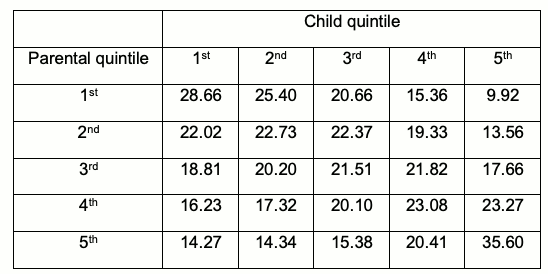
“We follow up on this last finding by exploring the geographical differences in inter-generational upward mobility across the 110 Italian provinces. We document a staggering amount of variation, with a steep south-north gradient, as depicted in Figure 2. Relative to the south of Italy, provinces in the north (especially the regions in the northeast), are both more egalitarian – i.e. they display higher relative mobility – and more upward-mobile – i.e. they display higher absolute mobility. In the north, children from parents with unequal background are more similar in their economic outcomes when adults, and children from poor parents fare better when adults. The level of upward mobility in northern Italy exceeds that of Scandinavian countries”
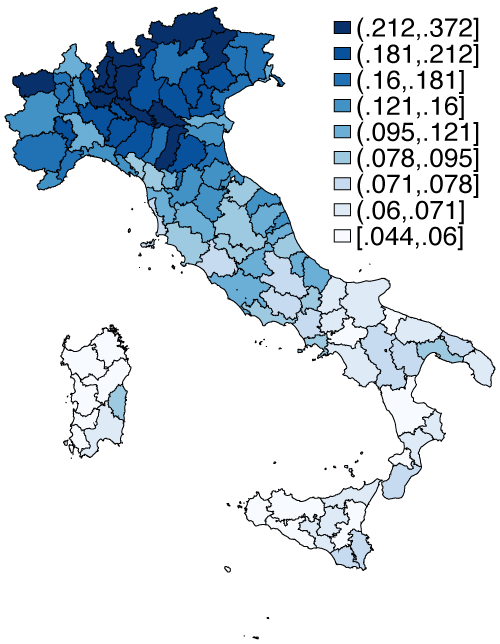
Figure 2: Estimated transition probability from bottom to top 20% of income distribution across provinces
An interesting new piece in VoxEu by Paolo Acciari, Alberto Polo and Gianluca Violante on inter-generational mobility in Italy:
“In a new paper (Acciari et al. 2019), we add to this recent wave of studies and introduce a new dataset that allows us to develop the first systematic investigation of intergenerational income mobility for the Italian economy. Our starting point is the administrative electronic database on individual tax returns maintained by the Italian Ministry of Economy and Finance.
Posted by at 10:33 AM
Labels: Inclusive Growth
Subscribe to: Posts