


Saturday, October 16, 2021
Natural experiments in labour economics and beyond: The 2021 Nobel laureates David Card, Joshua Angrist, and Guido Imbens
From a VoxEU post by Jörn-Steffen Pischke:
“The 2021 Nobel Prize in Economic Sciences has been awarded to David Card of the University of California, Berkeley, “for his empirical contributions to labour economics”, and to Joshua Angrist of MIT and Guido Imbens of Stanford University “for their methodological contributions to the analysis of causal relationships”. This column explains how the use of natural experiments in empirical economics has ushered in much progress in the analysis of causal relationships. The ensuing ‘credibility revolution’ over the past three decades has been transformational for the study of key policy challenges, including education, immigration and the minimum wage.
I once, naively, asked the late Alan Krueger about the pioneers of natural experiments in economics. His somewhat sheepish answer was that that’s like asking about the pioneers of rock music. It didn’t take much research on my part to reveal the numerous protagonists of a movement in labour economics in the 1980s and 1990s that transformed the way empirical work is done in the field and in many areas of economics beyond. Yet, like rock music, natural experiments have their Fab Four, and they are the 2021 Nobel laureates David Card, Joshua Angrist and Guido Imbens, plus the late Alan Krueger. I hope many will agree with me that this prize honours Krueger as well.
The important questions in economics are causal questions. How does immigration affect the labour market prospects of natives? What is the payoff to an additional year spent in school or to attending university? What are the effects of minimum wages on the employment prospects of low-skilled workers? But these questions are difficult to answer because we lack the right counterfactuals.”
Continue reading here.
From a VoxEU post by Jörn-Steffen Pischke:
“The 2021 Nobel Prize in Economic Sciences has been awarded to David Card of the University of California, Berkeley, “for his empirical contributions to labour economics”, and to Joshua Angrist of MIT and Guido Imbens of Stanford University “for their methodological contributions to the analysis of causal relationships”. This column explains how the use of natural experiments in empirical economics has ushered in much progress in the analysis of causal relationships.
Posted by at 7:40 AM
Labels: Profiles of Economists
Friday, October 15, 2021
Housing View – October 15, 2021
On cross-country:
- Euro Area Housing Markets: Trends, Challenges & Policy Responses – European Commission
- Do Foreign Buyer Taxes Affect House Prices? – SSRN
On the US:
- 10th Annual Housing Conference – American Enterprise Institute
- Why the U.S. Housing Boom Isn’t a Bubble – Wharton
- Borrower Expectations and Mortgage Performance: Evidence from the COVID-19 Pandemic – FHFA
- This Year, Half as Many Metro Areas Are Affordable to Low-Income Homebuyers as Last Year – Harvard Joint Center for Housing Studies
- Maxine Waters ready to battle over potential cuts to housing aid. Waters, who proposed the funding as chair of the House Financial Services Committee, said in an interview that “I’m going to fight as hard as I can to keep as much housing as I can in the reconciliation bill.” – Politco
- Millennials Team Up to Fulfill the Dream of Homeownership. Burdened by debt and facing soaring home prices, first-time home buyers are pooling their finances with partners, friends or roommates – Wall Street Journal
- Is There a Relationship Between Regional Unemployment Rates and Older Adult Housing Stability? – Harvard Joint Center for Housing Studies
On other countries:
- [Australia] RBA Says Risks Remain for Excessive Borrowing, House Prices – Bloomberg
- [Australia] RBA Sees Financial Stability Risks From Record-Low Rates, Housing Boom – Wall Street Journal
- China’s Harbin lends hand to property firms; Morgan Stanley upgrades sector view – Reuters
- [United Kingdom] Return of the renters: price hikes, bidding wars and bribes. As cities relax pandemic restrictions and workers move back, competition for rented property is fierce – FT
- [United Kingdom] Boris Johnson’s Housing Headaches Aren’t Over Yet. His Conservative government has signaled it won’t be obsessed with building homes. That’s fine, but Britain still needs more affordable housing. – Bloomberg
- [United Kingdom] Michael Gove urged to address loss of half a million social homes in England. Campaigners challenge new housing secretary to help more than 1m families on waiting list – FT

On cross-country:
- Euro Area Housing Markets: Trends, Challenges & Policy Responses – European Commission
- Do Foreign Buyer Taxes Affect House Prices? – SSRN
On the US:
- 10th Annual Housing Conference – American Enterprise Institute
- Why the U.S. Housing Boom Isn’t a Bubble – Wharton
- Borrower Expectations and Mortgage Performance: Evidence from the COVID-19 Pandemic – FHFA
- This Year,
Posted by at 5:00 AM
Labels: Global Housing Watch
Wednesday, October 13, 2021
Why the U.S. Housing Boom Isn’t a Bubble
Wharton’s Benjamin Keys explains why the red-hot U.S. real estate market isn’t a bubble that’s ready to burst. Home prices are likely to stay high for years to come:
“In Philadelphia, the median home price has risen 48% in the last decade. In Atlanta, the median sale price of a metro home hit an all-time high in June of $372,500. Not to be outdone by big cities, Boise, Idaho, recently ranked as the nation’s most overvalued market, where homes are selling for nearly 81% more than they should.
While the red-hot real estate market is finally showing signs of cooling, its meteoric rise has many Americans wondering if housing prices are a bubble that is about to burst, much like the collapse that triggered the Great Recession.
Wharton real estate and finance professor Benjamin Keys says that’s not the case.
“I come down very strongly against that view. I don’t think that it’s likely that we’re going to see a bubble burst in the way that we saw in 2008, 2009, and 2010,” he said during an interview with Wharton Business Daily on SiriusXM. (Listen to the podcast above.)
Although the frenzied buying and inflated prices are reminiscent of the run-up to the recession, Keys said there are several factors that make the current market different. First, loan standards that were loosened during the bubble are much tighter now, with stringent requirements for good credit, complete documentation, and a sizeable down payment. In contrast, the pre-recession years were pocked with subprime mortgages, low teaser interest rates that ballooned, weak underwriting, negatively amortized construction, and other questionable practices.
Second, the boom of the early 2000s was also driven by a surge in home construction that led to abundant supply. But there’s been a building shortage over the last 10 years, especially in cities with high demand. The result is a supply-demand mismatch that can’t be resolved quickly or easily.
“I think there was a bit of a hangover coming out of that 2000 boom and bust, and we’re underbuilt in a lot of cities where there’s demand for jobs, where there’s demand for housing,” Keys said.”
Continue reading here.
Wharton’s Benjamin Keys explains why the red-hot U.S. real estate market isn’t a bubble that’s ready to burst. Home prices are likely to stay high for years to come:
“In Philadelphia, the median home price has risen 48% in the last decade. In Atlanta, the median sale price of a metro home hit an all-time high in June of $372,500. Not to be outdone by big cities, Boise, Idaho, recently ranked as the nation’s most overvalued market,
Posted by at 10:03 AM
Labels: Global Housing Watch
Tuesday, October 12, 2021
Do Foreign Buyer Taxes Affect House Prices?
From a new paper by Jonathan S. Hartley, Li Ma, Susan Wachter and Albert Alex Zevelev:
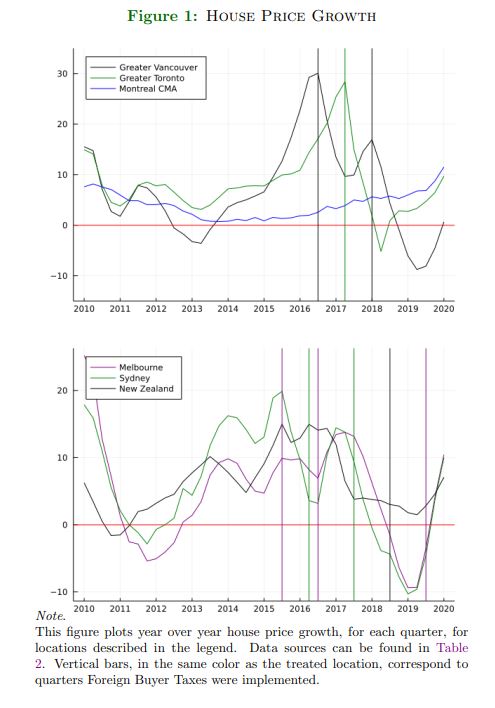
“This paper studies the impact of foreign buyer taxes on house prices using recent law changes in Canada, Australia, and New Zealand. Counterfactual house prices are estimated for each treated location combining prediction techniques from machine learning with inference methods from the Synthetic Control Method literature. In general, foreign buyer taxes have negative, large, and persistent effects on house price growth. We find bigger effects in locations with bigger taxes and with higher immigrant shares. Alternative outcome variables, including population growth, GDP growth, and unemployment rates were either unaffected or slightly affected in ways that do not confound our results.”
From a new paper by Jonathan S. Hartley, Li Ma, Susan Wachter and Albert Alex Zevelev:
“This paper studies the impact of foreign buyer taxes on house prices using recent law changes in Canada, Australia, and New Zealand. Counterfactual house prices are estimated for each treated location combining prediction techniques from machine learning with inference methods from the Synthetic Control Method literature. In general, foreign buyer taxes have negative, large, and persistent effects on house price growth.
Posted by at 8:19 PM
Labels: Global Housing Watch
House Prices and Consumer Price Inflation
From new work by IMF Colleagues (Nina Biljanovska, Chenxu Fu, and Deniz Igan):
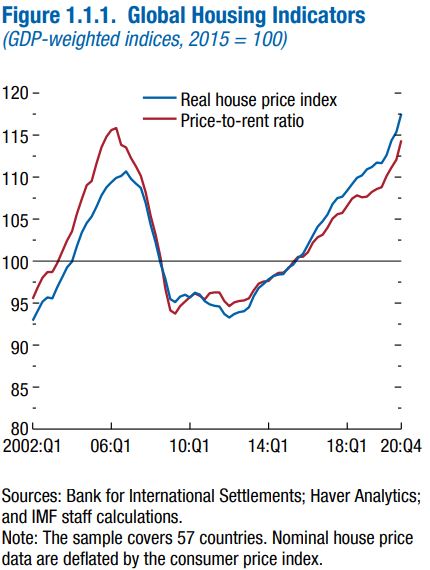
“Contrary to the expectation that house prices would decline during recessions (Igan and others 2011; Duca, Muellbauer, and Murphy, forthcoming), real house prices rose by 5.3 percent, on average, globally in 2020 as the pandemic-induced economic downturn took hold. Perhaps more strikingly, this was the highest annual growth rate observed in the past 15 years (Figure 1.1.1). While house price growth has breezed ahead, residential rents have grown at a slower rate, rising by 1.8 percent, on average, across countries over the same period.
Implications of a hot housing market for consumer prices
The house price surge comes at a time when questions are mounting over post-pandemic inflation dynamics (see Chapter 2). House prices matter for inflation because—through an asset pricing equation—they are linked to two measures of housing costs that could enter the CPI. One is the actual rent paid by tenants. The other is the imputed rent, or owner’s equivalent rent, which is an estimate of how much homeowners would need to pay were they to rent their own house. Overall, the rent component accounts, on average, for about 20 percent of the CPI.
How much of an increase in inflation is expected?“
Continue reading here.
From new work by IMF Colleagues (Nina Biljanovska, Chenxu Fu, and Deniz Igan):
“Contrary to the expectation that house prices would decline during recessions (Igan and others 2011; Duca, Muellbauer, and Murphy, forthcoming), real house prices rose by 5.3 percent, on average, globally in 2020 as the pandemic-induced economic downturn took hold. Perhaps more strikingly, this was the highest annual growth rate observed in the past 15 years (Figure 1.1.1). While house price growth has breezed ahead,
Posted by at 2:14 PM
Labels: Global Housing Watch
Subscribe to: Posts