



Saturday, December 11, 2021
The Economic Success of East Asia: Industrial Policy or Sound Fundamentals?
In the latest blog for The Conversable Economist, author Timothy Taylor examines the merits of the statement whether the US needs a sound industrial policy to fuel economic growth like its counterparts like China or not. While the modern version of this argument states that the US needs to subsidize key industries to counterbalance China’s growing economic influence in the world, he also discusses the historical context to this backed by strong macroeconomic fundamentals. The author quotes excerpts from a report by the Peterson Institute of International Affairs:
“The World Bank’s acclaimed volume, East Asian Miracle: Economic Growth and Public Policy (Birdsall et al. 1993), while acknowledging industrial policies, emphasized sound macroeconomic policies (later labeled the “Washington Consensus”), together with superior education and land reform, as drivers of remarkable growth in Hong Kong, Japan, South Korea, Singapore, and Taiwan. A decade earlier, Chalmers Johnson (1982) had published MITI and the Japanese Miracle: The Growth of Industrial Policy, 1925-1975, giving outsized credit for Japan’s spectacular postwar economic growth to government support for specific firms and industries. These two volumes set the stage for prolonged debate, still underway, on the role of industrial policy in East Asian economic prosperity. Numerous academic articles and books have dissected contributing factors. This brief section merely skims the surface of a substantial literature.”
Click here to read the full blog.
In the latest blog for The Conversable Economist, author Timothy Taylor examines the merits of the statement whether the US needs a sound industrial policy to fuel economic growth like its counterparts like China or not. While the modern version of this argument states that the US needs to subsidize key industries to counterbalance China’s growing economic influence in the world, he also discusses the historical context to this backed by strong macroeconomic fundamentals. The author quotes excerpts from a report by the Peterson Institute of International Affairs:
“The World Bank’s acclaimed volume,
Posted by at 10:43 AM
Labels: Inclusive Growth
The laws of attraction: Economic drivers of inter-regional migration, the role of housing, and public policies
From a VoxEU post by Orsetta Causa, Maria Chiara Cavalleri, Michael Abendschein, and Nhung Luu:
“The capacity of workers to move regions in response to local economic shocks is a key dimension of labour market dynamism that could contribute to recovery from the COVID-19 crisis and support the green transition. This column presents new empirical evidence on how policies can shape the responsiveness of inter-regional migration to regional economic conditions, with a particular focus on housing markets, social policies, and business regulations. It highlights the need for articulating place-based policies to help prospective movers as well as stayers
Inter-regional migration can contribute to the smooth and inclusive recovery from the COVID-19 crisis (for instance, by helping to match workers and jobs) as well to the green transition (for instance, by helping labour reallocation towards low-carbon activities). Mobility across regions can also contribute to upward social mobility, for instance by allowing workers to move out of disadvantaged areas or declining sectors. While promoting mobility is not an end in itself, managing mobility is an important policy challenge, especially in countries with large and persistent spatial disparities between regions.
Recent work by the OECD (Causa et al. 2021, Cavalleri et al. 2021, OECD 2021a) examines the levels and trends of inter-regional migration within and across OECD countries. It presents novel cross-country and country-specific empirical evidence on economic and housing-related factors affecting people’s decisions to move to a different region within the same country. This work shows how policies influence the responsiveness of regional migration to regional economic conditions and shocks. It also contributes to the renewed interest in regional inequalities and placed-based policies (Siegloch et al. 2021, Ku et al. 2020, Iammarino et al. 2019).
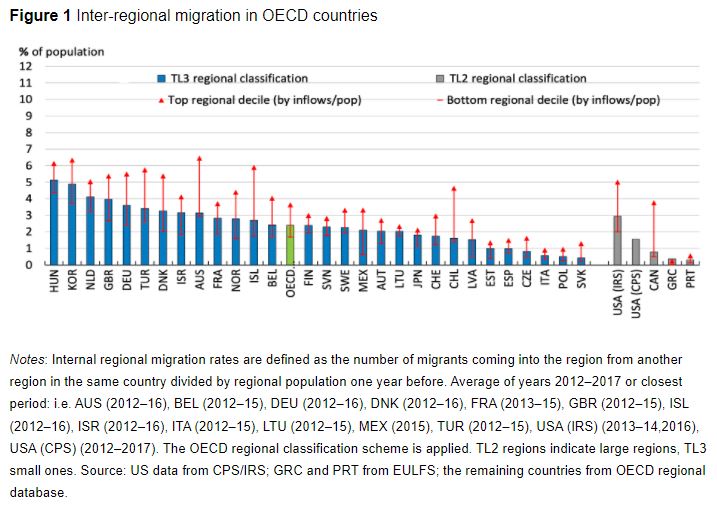
We find that inter-regional migration varies significantly across OECD countries (Figure 1). In high-mobility countries, such as Hungary and Korea, around 5% of the population moves to another region each year. By contrast, mobility rates are below 1% in some Eastern and Southern European countries, such as Slovakia, Poland and Italy.”
Continue reading here.
From a VoxEU post by Orsetta Causa, Maria Chiara Cavalleri, Michael Abendschein, and Nhung Luu:
“The capacity of workers to move regions in response to local economic shocks is a key dimension of labour market dynamism that could contribute to recovery from the COVID-19 crisis and support the green transition. This column presents new empirical evidence on how policies can shape the responsiveness of inter-regional migration to regional economic conditions,
Posted by at 7:29 AM
Labels: Global Housing Watch
Friday, December 10, 2021
A Better Deal for the World’s Workers
In a recent column (2021) for Project Syndicate, Professor Dani Rodrik (Harvard Kennedy School of Government) writes that strengthening workers’ bargaining power and increasing the supply of good jobs for those who most need them is the way for boosting workers’ incomes and ensuring a fairer share of the prosperity pie for them.
“In advanced economies, earnings for those with less education often stagnated despite gains in overall labor productivity. In developing countries, where standard economic theory predicted that workers would be the main beneficiary of the expanding global division of labor, corporations, and capital again reaped the biggest gains.”
The article then moves on to discuss strategies that can counteract this problem such as firms’ investment in the happiness and productivity of their workers, increasing organizational power of workers, expansionary macroeconomic policies that can generate derived demand for labor, etc.
Click here to read the full article.
In a recent column (2021) for Project Syndicate, Professor Dani Rodrik (Harvard Kennedy School of Government) writes that strengthening workers’ bargaining power and increasing the supply of good jobs for those who most need them is the way for boosting workers’ incomes and ensuring a fairer share of the prosperity pie for them.
“In advanced economies, earnings for those with less education often stagnated despite gains in overall labor productivity. In developing countries,
Posted by at 2:17 PM
Labels: Inclusive Growth
Paul Krugman on Inflation: The ‘Team Transitory’ View: Transcript of Nov. 30 Webinar
On Nov. 30, Paul Krugman gave a very lucid exposition of why he was on “Team Transitory”. Will today’s release of the US CPI lead to a change in his position on inflation? Here’s a link to the video of the Nov. 30 webinar.
On Nov. 30, Paul Krugman gave a very lucid exposition of why he was on “Team Transitory”. Will today’s release of the US CPI lead to a change in his position on inflation? Here’s a link to the video of the Nov. 30 webinar.
Posted by at 8:42 AM
Labels: Uncategorized
Housing View – December 10, 2021
On cross-country:
- Interest rate hikes will not dim the allure of property. Whatever the gyrations of the markets, most of us seem to have an innate fondness for real assets – FT
- Gentrification and Affordable Housing Policies – CEPA
On the US:
- Rise in U.S. house prices to halve next year, affordability to worsen – Reuters poll – Reuters
- Top Housing Markets for 2022 – Realtor.com
- Zillow’s Hot Housing Takes for 2022 – Zillow
- Despite low mortgage rates, America’s housing market keeps many first-time buyers on the sidelines – Market Watch
- Black and Hispanic renters experience discrimination in almost every major American city. A new study finds that property managers in Chicago, Los Angeles, Louisville, Houston, and Providence are least likely to answer prospective Black and Hispanic tenants – Vox
- Is the Chance to Turn Hotels Into Affordable Housing Slipping Away? As many of the city’s hotels sat empty during the pandemic and homelessness continued to rise, some saw an opportunity to solve both problems. So what happened? – New York Times
- Housing Affordability in the Wake of COVID-19. Regional Solutions for Southern California – Berkeley
- Why is the Biden administration increasing the cost of building houses? – NPR
- Playing Catch-up: Putting the Recent Home Building “Boom” in Context. – Zillow
- You Won’t be My Neighbor: Opposition to High Density Development – Sage Journals
- Biden administration to target money laundering in US real estate market. Anti-corruption drive could raise scrutiny of all-cash commercial and residential property transactions – FT
- It Took More Than Fannie and Freddie to Set Off the Housing Crash. Don’t let the other actors off the hook. – Wall Street Journal
- I changed my mind on rent control. Rent control won’t fix the housing crisis. It’s still a good idea. – Vox
- The FHFA’s Equitable Housing Finance Plans for Fannie Mae and Freddie Mac – Urban Institute
- Assessment Frequency and Equity of the Real Property Tax: Latest Evidence from Philadelphia – Philadelphia Fed
- What can a mortgage market crisis in Ireland teach the U.S.? Boston Fed paper looks at results of approach that gave banks more freedom to modify loans – Boston Fed
On China
- Amid Evergrande crisis, more Chinese developers to issue ABS – Reuters
- China property debt crisis puts founders on spot – Reuters
On other countries:
- [Australia] Booming house prices driving massive increase in size of inheritances to $120bn a year. Report finds that despite helping the rich Australians get richer, inheritances are also shrinking relative inequality by giving a boost to poorer households – The Guardian
- [Australia] Australian house prices will keep rising and it’s truly depressing for those hoping to get into the market. Property prices look set to continue to grow for many more months to come – and certainly at a rate faster than wages – The Guardian
- [Canada] Toronto Home Prices Rise 22% to Record With Supply Vanishing – Bloomberg
- [Canada] Red-hot Canadian property market to lose some steam in 2022: Reuters poll – Reuters
- [Denmark] Claudia Buch: A decade of macroprudential policy – Central Bank of Denmark
- [India] Indian house prices to lag inflation; affordability to improve – Reuters
- [Ireland] An Overview of the Irish Housing Market and Policy – Government of Ireland
- [New Zealand] New Zealand central bank says low net migration could cool housing prices. Easing of soaring property costs may affect RBNZ rate rise forecast next year, says deputy governor – FT
- [United Arab Emirates] Dubai property prices to get boost next year from foreign demand – Reuters
- [United Kingdom] London developers target old offices at risk of becoming stranded assets. Tighter efficiency rules leave owners of older buildings with choice of costly refurbishment or selling at a discount – FT
- [United Kingdom] UK house prices rise at fastest pace in 15 years. Record property values driven by limited housing stock and low lending rates as London market lags – FT
- [United Kingdom] British housing boom created £3tn ‘unearned’ and ‘unequal’ windfall. Resolution Foundation calls for review of tax treatment of main residences to tackle disparities caused by untaxed gains – FT
- [United Kingdom] U.K. House Prices Keep Rising on a Dearth of Supply – Bloomberg
On cross-country:
- Interest rate hikes will not dim the allure of property. Whatever the gyrations of the markets, most of us seem to have an innate fondness for real assets – FT
- Gentrification and Affordable Housing Policies – CEPA
On the US:
- Rise in U.S. house prices to halve next year, affordability to worsen – Reuters poll – Reuters
- Top Housing Markets for 2022 – Realtor.com
- Zillow’s Hot Housing Takes for 2022 – Zillow
Posted by at 5:00 AM
Labels: Global Housing Watch
Subscribe to: Posts