



Monday, January 26, 2026
Forbes ranks Johns Hopkins as #1: the best online master’s in Economics
Johns Hopkins University offers an online Master of Science program in applied economics that typically takes students one to two years to complete.
The university scored well in our methodology primarily thanks to a high graduation rate (95%) and high median annual earnings among alumni 10 years after graduation ($87,555). Johns Hopkins also maintains the lowest student-to-faculty ratio (6-to-1) out of the 10 schools ranked here.
See the link here: https://www.forbes.com/advisor/education/science/best-online-masters-in-economics/
Johns Hopkins University offers an online Master of Science program in applied economics that typically takes students one to two years to complete.
The university scored well in our methodology primarily thanks to a high graduation rate (95%) and high median annual earnings among alumni 10 years after graduation ($87,555). Johns Hopkins also maintains the lowest student-to-faculty ratio (6-to-1) out of the 10 schools ranked here.
See the link here: https://www.forbes.com/advisor/education/science/best-online-masters-in-economics/
Posted by at 6:59 PM
Labels: Uncategorized
Taking Stock: My 2019 book on Confronting Inequality.
This is the second in a special series of posts in which I take stock of some of the main activities of my long 40-year career. In the first one, I shared some reflections on my profiles of famous economists. A convenient link to all my profiles and interviews can be found here. In this post, I discuss the performance to date of my 2019 book, “Confronting inequality: How Societies Can Achieve inclusive Growth” (Columbia University Press).
- The book was published in January 2019, just before the annual meeting of economists in Atlanta. the IMF did an impromptu book launch as part of the party that many institutions organize at the annual meetings. Later that month, thanks to Adam Posen, there was a major launch event at the Peterson Institute. The discussants were Heather Boushey (the link is to her excellent presentation) and Jason Furman. Jason’s thought-provoking PowerPoint from the event is available too. Two other memorable presentations were at Florida State University and at the New School for Social Research, organized by Willi Semmler and featuring a discussion of the book by the great Dani Rodrik. For personal reasons, I then took a break from book launch events and only resumed them in 2020, when invited by James Foster of GW’s International Institute of Economic Policy. The book has nearly 150 citations on Google Scholar.
- In additional to the praise and recognition in these professional settings, it has been gratifying to get praise from lay readers on Goodreads and on Amazon. In 2024, I watched as the book climbed the ranks on Amazon , going all the way to #14 in the Income Inequality category.
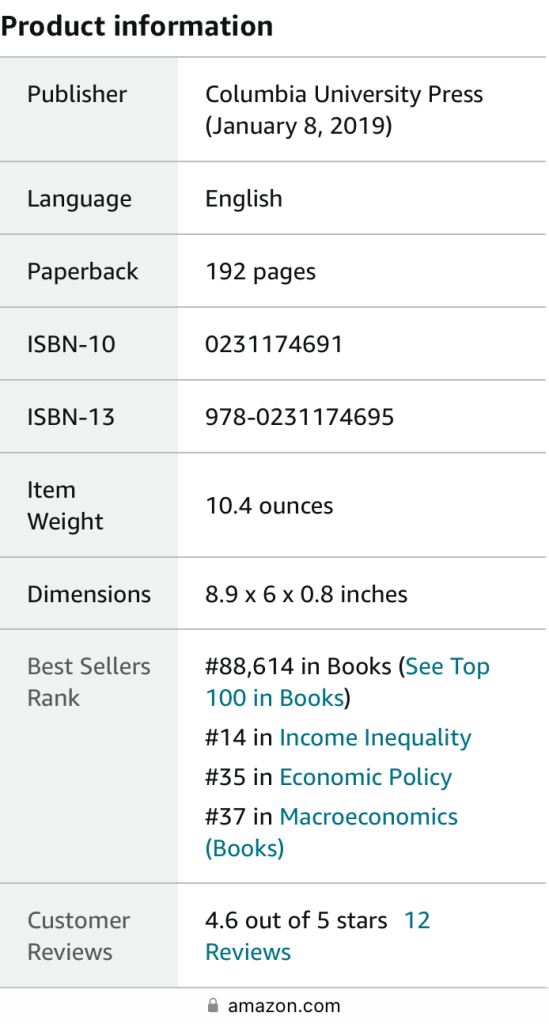
- The book has been successful as a textbook (complemented by a more standard text like Jones and Vollrath) in courses on Economic Growth at a couple of institutions. And according to World Cat, more than 300 copies are sitting at institutional libraries around the world.
This is the second in a special series of posts in which I take stock of some of the main activities of my long 40-year career. In the first one, I shared some reflections on my profiles of famous economists. A convenient link to all my profiles and interviews can be found here. In this post, I discuss the performance to date of my 2019 book, “Confronting inequality: How Societies Can Achieve inclusive Growth” (Columbia University Press).
Posted by at 2:59 PM
Labels: Uncategorized
Does Repeated Cross-section Data Help Explain Consumer Inflation Expectations Revisions?
From a paper by Harold Glenn A. Valera, Cymon Kayle Lubangco, and Mark J. Holmes:
“We propose a new measure of revisions to consumer inflation expectations using repeated cross-sections rather than requiring panel data. We calculate the value of group average expectations in a prior period as a proxy for what an individual’s expectations might have been using micro data in the Philippines for Q1 2010 to Q2 2024. In contrast to existing mixed evidence, the resulting revisions show sensitivity to price changes in 14 food and energy goods. The equivalence testing finds that the group-based coefficients are valid, as they are: (a) different from an overall sample average-based revision results with Philippine data and (b) similar to rotating panel-based revision results using data from the Michigan Survey of US households. Using Philippine data, we also provide new evidence of significant effects of a firm’s frequency of price changes on expectation revisions.”
From a paper by Harold Glenn A. Valera, Cymon Kayle Lubangco, and Mark J. Holmes:
“We propose a new measure of revisions to consumer inflation expectations using repeated cross-sections rather than requiring panel data. We calculate the value of group average expectations in a prior period as a proxy for what an individual’s expectations might have been using micro data in the Philippines for Q1 2010 to Q2 2024. In contrast to existing mixed evidence,
Posted by at 9:50 AM
Labels: Forecasting Forum
Econometric Analysis of the Impact of Inflation Targeting on Macroeconomic Variables: New Keynesian Model
From a paper by Borivoje D. Krušković:
“Many central banks adopted inflation targeting under pressure from the IMF. Adoption of inflation targeting happened on pretty favourable macroeconomic terms whose distinctive features were the absence of supply shocks, low budget deficit and foreign currency access. It was a ‘period conducive to price stability’ with inflation on a downward trajectory in many countries, especially developed ones, even before the introduction of inflation targeting. That could have contributed to efficiency of inflation targeting considering other monetary strategies. The most widely used model in designinig monetary policy under inflation targeting is a macroeconomic model of a small open economy from the group New Keynesian model. The results of the econometric analysis in this paper show that inflation targeting is an inefficient monetary strategy in the face of negative supply shocks (financial crises, pandemic, rising energy prices, tariffs), as it leads to rising interest rates, falling GDP, and rising unemployment. The results of the econometric analysis in this paper show that inflation targeting is an inefficient monetary strategy in the face of negative supply shocks (financial crisis, pandemic, rising energy prices, tariffs, etc.), which leads to rising interest rates, falling GDP, rising unemployment, and ultimately to an “inflationary pandemic”.
From a paper by Borivoje D. Krušković:
“Many central banks adopted inflation targeting under pressure from the IMF. Adoption of inflation targeting happened on pretty favourable macroeconomic terms whose distinctive features were the absence of supply shocks, low budget deficit and foreign currency access. It was a ‘period conducive to price stability’ with inflation on a downward trajectory in many countries, especially developed ones, even before the introduction of inflation targeting.
Posted by at 9:48 AM
Labels: Forecasting Forum
Saturday, January 24, 2026
Global Housing Watch
On cross-country:
- How to Solve the Global Housing Crisis: Liberate Supply Not Subsidise Demand – The Times of Israel
Working papers and conferences:
- What About the Close Calls? In the Mortgage Market, the Behavior of One Group of Loan Applicants Is Particularly Enlightening – Philadelphia Fed
- What Is My Home Worth? – Philadelphia Fed
- Property Tax PassThrough to Renters A Quasi-Experimental Approach – Philadelphia Fed
- Real-time house price model shows U.S. housing market firming – Dallas Fed
- SI 2026 Real Estate – NBER
- Building costs aren’t to blame for high home prices. The link between construction costs and real estate prices has weakened in recent decades, finds research from UChicago Booth – University of Chicago
- Pricing Residential Mortgage Credit Risk in the Post-GFC Era – NBER
- Mapping Crowding, Tenure, Rents and Segregation in the Neighborhoods of Major European Cities around 1900 and Today – International Journal of Urban and Regional Research
On China:
- Real Estate Crash Weighs on China’s Economic Growth. Falling apartment prices have erased the savings of millions of Chinese households, but exports lifted the economy to 5 percent growth last year. – New York Times
On Australia and New Zealand:
- [Australia] Improving productivity growth and housing affordability would support Australia’s high living standards – OECD
- [Australia] OECD calls on Australia to raise GST and increase affordable housing amid budget deficit. Survey by organisation, which is led by former Liberal senator Mathias Cormann, says economy is ‘now normalising’, after post-pandemic struggle – The Guardian
On other countries:
- [Canada] Canadian Housing Market in Winter Freeze as Prices, Sales Decline – Bloomberg
- [Canada] Out of Reach: Unlocking Canada’s housing affordability crisis. Many Canadian housing markets face a troubling paradox: homes remain unaffordable for buyers even as construction and land costs have receded, leaving many — especially younger Canadians — feeling that homeownership is out of reach. – Senate of Canada
- [Denmark] Denmark should continue to improve public finances, housing affordability and family policies to sustain growth and living standards – OECD
- [Korea] Seoul Housing Rally Gathers Pace, Deepening BOK’s Policy Dilemma – Bloomberg
- [Nigeria] Lagos Town Demolitions Leave Thousands of Nigerians Homeless – Bloomberg
- [United Kingdom] What’s next for the UK housing market in 2026? – Lloyds Banking Group
- [United Kingdom] UK lenders cut mortgage rates in race for new year buyers. December fall in base rate and relatively benign Budget triggers swath of cheaper deals – FT
- [United Kingdom] House prices jump across Britain as sentiment rebounds after Budget. January increase reverses sharp contractions in previous months – FT
- [United Kingdom] U.K. House Prices See Record January Jump as Post-Budget Uncertainty Fades. The 2.8% gain represents the largest January increase in the 25-year history of Rightmove’s House Price Index – Wall Street Journal
- [United Kingdom] Inner London house prices fall at fastest rate since global financial crisis. Sharp annual decline in most expensive boroughs underscores impact of Budget uncertainty – FT
- [United Kingdom] London House Building Collapses 84% in a Decade as Sales Plunge – Bloomberg
- [United Kingdom] London House Prices End Longest Losing Streak Since 2009 – Bloomberg
On cross-country:
- How to Solve the Global Housing Crisis: Liberate Supply Not Subsidise Demand – The Times of Israel
Working papers and conferences:
- What About the Close Calls? In the Mortgage Market, the Behavior of One Group of Loan Applicants Is Particularly Enlightening – Philadelphia Fed
- What Is My Home Worth? – Philadelphia Fed
- Property Tax PassThrough to Renters A Quasi-Experimental Approach – Philadelphia Fed
- Real-time house price model shows U.S.
Posted by at 5:00 AM
Labels: Global Housing Watch
Subscribe to: Posts