Showing posts with label Inclusive Growth. Show all posts
Monday, September 12, 2011
Whom Will it Hurt? The Short-Run Impacts of Fiscal Consolidation
WHEN British Prime Minister David Cameron announced his government’s deficit reduction plans earlier this year he said, “Those who argue that dealing with our deficit and promoting growth are somehow alternatives are wrong. You cannot put off the first in order to promote the second” (Cameron, 2011).
The challenge facing the United Kingdom and many advanced economies is how to bring debt down to safer levels in the face of a weak recovery. Will deficit reduction lead to stronger growth and job creation in the short run?
Recent IMF research provides an answer to this question. Evidence from data over the past 30 years shows that consolidation lowers incomes in the short term, with wage-earners taking more of a hit than others; it also raises unemployment, particularly long-term unemployment.
For the advanced economies, there is an unmistakable need to restore fiscal sustainability through credible consolidation plans. At the same time, we know that slamming on the brakes too quickly will hurt the recovery and worsen job prospects. Hence the potential longer-run benefits of fiscal consolidation must be balanced against the short- and medium-run adverse impacts on growth and jobs.
Read full article on the IMF website.

WHEN British Prime Minister David Cameron announced his government’s deficit reduction plans earlier this year he said, “Those who argue that dealing with our deficit and promoting growth are somehow alternatives are wrong. You cannot put off the first in order to promote the second” (Cameron, 2011).
The challenge facing the United Kingdom and many advanced economies is how to bring debt down to safer levels in the face of a weak recovery.
Posted by at 10:42 PM
Labels: Inclusive Growth
Tuesday, August 2, 2011
Presentation video on “Long-Term Unemployment- Causes, Costs, Cures”
See my presentation video on where do the industrialized nations stand in regard to the effect of long-term unemployment after the Great Recession of 2009-2011? And trends related to the effects of long-term unemployment on western industrialized nations.
See my presentation video on where do the industrialized nations stand in regard to the effect of long-term unemployment after the Great Recession of 2009-2011? And trends related to the effects of long-term unemployment on western industrialized nations.
Posted by at 4:03 PM
Labels: Inclusive Growth
Tuesday, July 12, 2011
More on Structural Unemployment: Manufacturers Struggling to Find Skilled Workers
At the Joint Economic Committee (JEC) hearing, Georgetown University public policy professor Harry Holzer said that “the ratio of job vacancies to new hires in manufacturing is higher than we find in any other major industry group, suggesting that employers are having some difficulty filling their newly created jobs (…) On its own, our system of higher education will not produce enough skills needed by American workers to prosper. Our education and work force systems largely operate in isolation from one another.” Indeed, BTE Technologies President Chuck Wetherington concurred with Holzer who said that “my job is getting a bit more technical. There are some micro and macroeconomic issues. Occasionally we have to recruit from abroad. There is a mismatch between skills and workers.” See the full article on the New York Times website. Also, a webcast of the hearing is available at the Joint Economic Committee site.
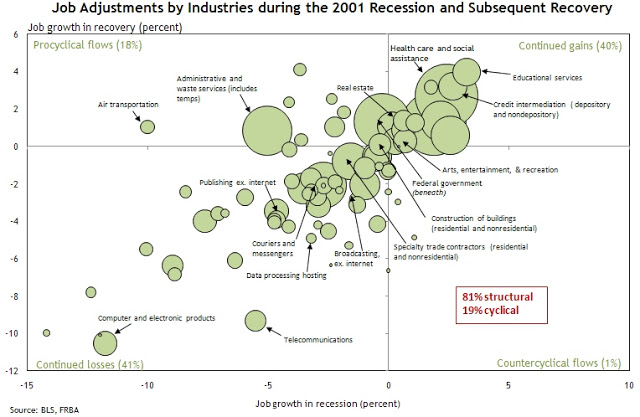
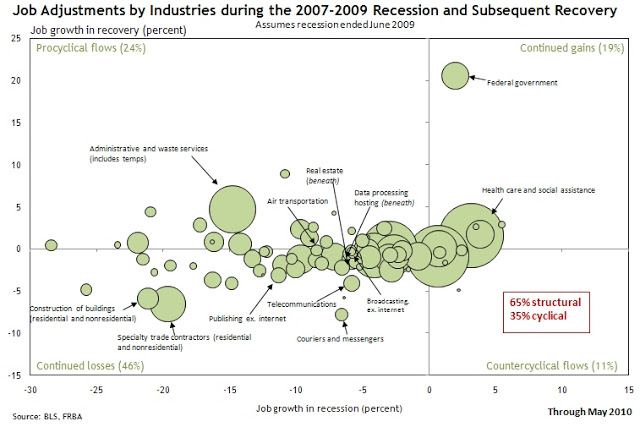
At the Joint Economic Committee (JEC) hearing, Georgetown University public policy professor Harry Holzer said that “the ratio of job vacancies to new hires in manufacturing is higher than we find in any other major industry group, suggesting that employers are having some difficulty filling their newly created jobs (…) On its own, our system of higher education will not produce enough skills needed by American workers to prosper. Our education and work force systems largely operate in isolation from one another.” Indeed,
Posted by at 11:22 PM
Labels: Inclusive Growth
Overhaul Career and Technical Education
In an article for the Atlantic, Frederick Hess of the American Enterprise Institute links the problem of structural unemployment with the lack of quality job training/workforce development. He writes “economist Prakash Loungani of the International Monetary Fund has estimated that 25 percent of the unemployed are out of work today due to skill-job mismatches. Georgetown’s Harry Holzer has calculated that today’s unemployment rate of 9.1 percent would be nearer to 8 percent if a majority of these jobs were filled (…) Fact is, America’s community colleges, job training, and workforce development are a mess. Community colleges suck up nearly $36 billion in taxpayer subsidies to provide training of uncertain quality, retain a balky and inconvenient academic calendar, and frequently do a lousy job of linking their instruction to local workforce needs (…) it can be hard for workers seeking retraining to find convenient, cost-effective, high-quality options (..) Absent high-quality retraining, it’s easy for workers in dying industries to get stuck, for their skills to atrophy, and for their networks and work habits to erode.”
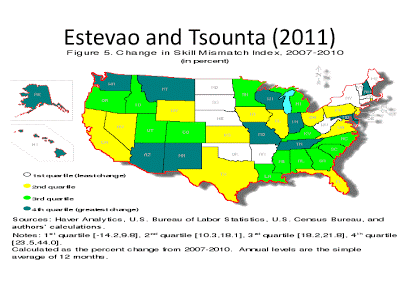
In an article for the Atlantic, Frederick Hess of the American Enterprise Institute links the problem of structural unemployment with the lack of quality job training/workforce development. He writes “economist Prakash Loungani of the International Monetary Fund has estimated that 25 percent of the unemployed are out of work today due to skill-job mismatches. Georgetown’s Harry Holzer has calculated that today’s unemployment rate of 9.1 percent would be nearer to 8 percent if a majority of these jobs were filled (…) Fact is,
Posted by at 7:04 PM
Labels: Inclusive Growth
Saturday, June 18, 2011
The great jobs mismatch
In an article on structural unemployment, Robert Samuelson writes that “one puzzle of this somber economy is the existence of unfilled jobs in the midst of mass unemployment. You might think (I did) that with almost 14 million Americans unemployed — and nearly half those for more than six months — companies could fill almost any opening quickly. Not so. Somehow, there’s a mismatch between idle workers and open jobs. Economist Prakash Loungani of the IMF estimates that 25% of unemployment is structural; that’s more than 3 million jobs.” Read the full article at the Washington Post.
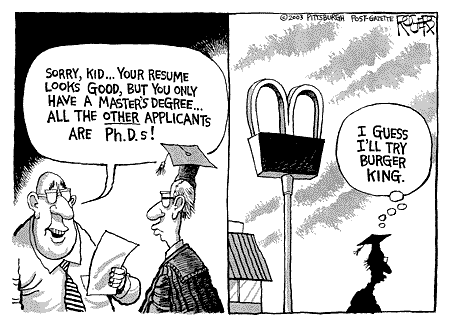
In an article on structural unemployment, Robert Samuelson writes that “one puzzle of this somber economy is the existence of unfilled jobs in the midst of mass unemployment. You might think (I did) that with almost 14 million Americans unemployed — and nearly half those for more than six months — companies could fill almost any opening quickly. Not so. Somehow, there’s a mismatch between idle workers and open jobs. Economist Prakash Loungani of the IMF estimates that 25% of unemployment is structural;
Posted by at 1:26 PM
Labels: Inclusive Growth
Subscribe to: Posts