Showing posts with label Inclusive Growth. Show all posts
Monday, January 16, 2012
“Treat us right, not white”: MLK Day 2012

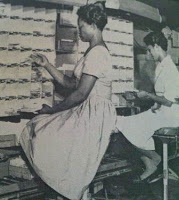

In the 1910s, when delivering mail was a hazardous job, the post office was one of the few places where African-Americans could find work. The bulk of long-distance mail was delivered by rail; the railway cars where mail clerks worked were made of wood and were prone to falling apart—while the train was in motion.
When steel cars began to replace the wooden ones, the job of delivering mail became safer. The Railway Mail Association, a labor union which excluded blacks, began to recruit white workers to displace blacks from the postal work. In 1913, a group of African Americans formed a union of their own to protect their jobs and give blacks a voice with the postal authorities.
Against all odds, this black union survived. By 1921, it had made enough progress that a bureaucrat in the post office assured the the president of the union that the union members would be “treated white”. The president replied that he would prefer that his members just “be treated right”.
Hence the title “Treat us right, not white”, a fascinating history of this union—the National Alliance of Postal and Federal Employees (NAPFE)—written by my friend Paul Nehru Tennassee, the noted historian, political scientist and labor leader. The book is available here.
The union will mark its 100th anniversary in 2013 at the foot of Lookout Mountain, Tennessee, where it was founded. The union’s historian, Paul Nehru Tennassee, has a colorful history of his own which I hope will be told some day.



In the 1910s, when delivering mail was a hazardous job, the post office was one of the few places where African-Americans could find work. The bulk of long-distance mail was delivered by rail; the railway cars where mail clerks worked were made of wood and were prone to falling apart—while the train was in motion.
When steel cars began to replace the wooden ones,
Posted by at 12:30 AM
Labels: Inclusive Growth
Monday, January 9, 2012
How Inequality Damages Economies
Economic expansion last longer in regions with more equal income distributions, my IMF colleagues Andy Berg and Jonathan Ostry say in Foreign Affairs. The effect is large. If Latin America, for example, could bridge half of its inequality gap with East Asia, its growth spells would last twice as long as they do now. This work is part of a growing research emphasis at the IMF on the consequences and causes of income inequality. In earlier work, my colleagues and I showed that fiscal austerity leads to greater declines in wages than in profits — see this earlier post and a summary of it in the press.
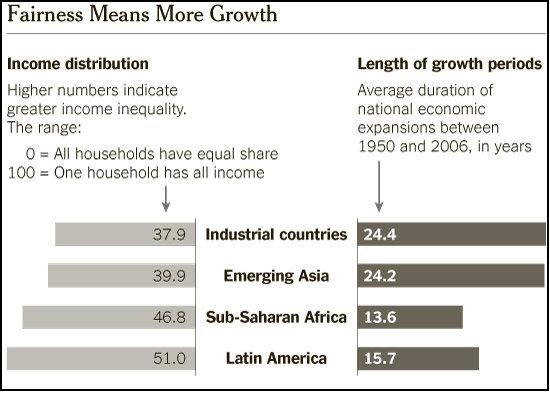
Economic expansion last longer in regions with more equal income distributions, my IMF colleagues Andy Berg and Jonathan Ostry say in Foreign Affairs. The effect is large. If Latin America, for example, could bridge half of its inequality gap with East Asia, its growth spells would last twice as long as they do now. This work is part of a growing research emphasis at the IMF on the consequences and causes of income inequality.
Posted by at 8:40 PM
Labels: Inclusive Growth
Thursday, December 15, 2011
JEC Report Highlights Critical Role of Unemployment Insurance
A new report from the U.S. Congress Joint Economic Committee (JEC) finds that if federal UI benefits are allowed to expire, over 2 million long‐term unemployed workers stand to lose their benefits in early 2012. That number could grow to 5 million before the end of 2012.
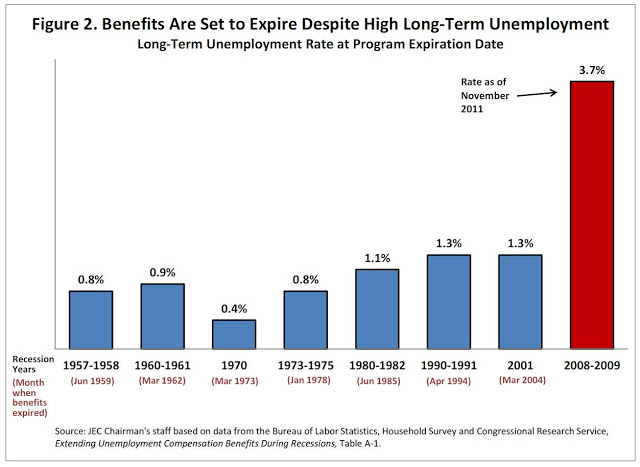
Entitled “The Case for Maintaining Unemployment Insurance: Supporting Workers and Strengthening the Economy,” the report finds that at 3.7 percent, the current long-term unemployment rate is nearly three times higher than it has ever been when Congress let federal benefits expire.
“Unemployment benefits serve as a critical lifeline to workers and their families in the face of a sudden and severe drop in income,” said Senator Bob Casey, Chairman of the JEC. “These benefits help struggling families pay for their necessities such as food, housing, clothing, and utilities—obligations that continue even when a family member loses a job.”
On average these benefits only meet half of basic household expenditures but they kept over 3 million Americans out of poverty in 2010. Research shows that extending federal UI benefits during periods of high unemployment works to pull the economy back from a downward spiral whereby reduced consumer demand leads to further reductions in economic activity, and that in turn leads to more job losses.
“Continuing the current emergency federal UI programs is vital to the economic recovery. A temporary reauthorization would not only give millions of struggling long-term unemployed Americans a lifeline, it would bolster the economic recovery by generating jobs and accelerating economic growth. Washington must put aside partisan bickering and give American families the help they need to stay on their feet,” said Casey.
Report highlights include:
- Over 40 percent of the unemployed have been without a job for at least six months, and over 30 percent have been unemployed for at least one year. Letting emergency federal benefits expire now would be unprecedented and could derail the recovery.
- Even without lengthening the maximum allowable duration of benefits, continuing federal benefits could generate up to 400,000 jobs. The boost to the economy from additional spending on UI benefits is estimated to be as large as $1.90 for each dollar of assistance—the greatest “bang-for-the-buck” among a range of fiscal policies designed to boost gross domestic product (GDP) and create jobs, according to the non-partisan Congressional Budget Office (CBO).
- Claims that extended UI benefits deter unemployed workers from looking for work are unfounded. On the contrary, beneficiaries of federal UI benefits have spent more time searching for work than those who were ineligible for UI benefits. Studies find the impact of additional benefits on the unemployment rate to be small.
- Any increase in the unemployment rate because of federal UI benefits is most likely because the beneficiaries remain attached to the labor force and continue to search for work, not because they refuse employment or do not search for a job.
A new report from the U.S. Congress Joint Economic Committee (JEC) finds that if federal UI benefits are allowed to expire, over 2 million long‐term unemployed workers stand to lose their benefits in early 2012. That number could grow to 5 million before the end of 2012.
Entitled “The Case for Maintaining Unemployment Insurance: Supporting Workers and Strengthening the Economy,” the report finds that at 3.7 percent,
Posted by at 10:28 PM
Labels: Inclusive Growth
Tuesday, November 29, 2011
How does Fiscal Austerity affect the 99% vs. the 1%?

During times of fiscal austerity, income inequality goes up. Inequality goes up more when the austerity comes about through spending cuts than through tax hikes. The income share of the richest 1% of the population increases after fiscal austerity. Those are the main findings of a new paper by Luca Agnello and Ricardo Sousa.
The paper adds to a growing, but still scant, literature on how fiscal austerity affects different segments of the population. My paper with Larry Ball of Johns Hopkins University and my IMF colleague Daniel Leigh [available here] shows that fiscal austerity lowers incomes—hitting wage-earners more than others—and raises unemployment, particularly long-term unemployment. These costs must be balanced against the potential longer-term benefits that consolidation can confer.
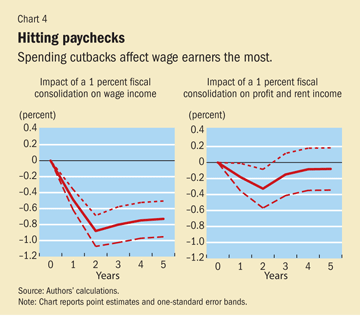
Agnello and Sousa note that their results are “close in spirit” to the evidence of Ball, Leigh and Loungani that “fiscal consolidation reduces the wage share in total income. The authors suggest that, while the fall in wage income is persistent, the fall in capital and property income is short-lived. This can be explained by the fact that fiscal austerity plans typically call for a fall in public sector wages or lead to an increase in unemployment (in particular, long-term unemployment)” (p. 10, Agnello and Sousa).

During times of fiscal austerity, income inequality goes up. Inequality goes up more when the austerity comes about through spending cuts than through tax hikes. The income share of the richest 1% of the population increases after fiscal austerity. Those are the main findings of a new paper by Luca Agnello and Ricardo Sousa.
The paper adds to a growing, but still scant, literature on how fiscal austerity affects different segments of the population.
Posted by at 11:19 AM
Labels: Inclusive Growth
Monday, October 31, 2011
World of Work Report 2011: Making markets work for jobs
ILO says world heading for a new and deeper jobs recession, warns of more social unrest, in its annual World of Work Report.
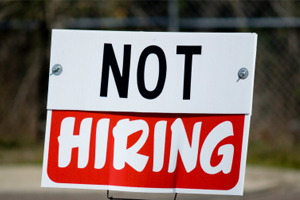
ILO says world heading for a new and deeper jobs recession, warns of more social unrest, in its annual World of Work Report.
Posted by at 6:10 PM
Labels: Inclusive Growth
Subscribe to: Posts