Showing posts with label Inclusive Growth. Show all posts
Friday, October 18, 2013
Blanchard on Unemployment, Flexibility & IMF Advice
My VoxEU post with Olivier Blanchard and Florence Jaumotte tries to move beyond ritual invocation of the mantra of “labor market flexibility.” We develop the concepts of “micro” and “macro flexibility”; explain why they are needed; what labor market institutions help or hinder micro and macro flexibility; and assess IMF advice against the backdrop of these concepts. The Staff Discussion Note on which our post is based is available here.
My VoxEU post with Olivier Blanchard and Florence Jaumotte tries to move beyond ritual invocation of the mantra of “labor market flexibility.” We develop the concepts of “micro” and “macro flexibility”; explain why they are needed; what labor market institutions help or hinder micro and macro flexibility; and assess IMF advice against the backdrop of these concepts. The Staff Discussion Note on which our post is based is available here.
Posted by at 3:22 PM
Labels: Inclusive Growth
Wednesday, September 18, 2013
Distributional Consequences of Fiscal Consolidation
The IMF released a second working paper on the distributional impacts of fiscal consolidation. Like the previous work, this one concludes that “fiscal consolidations are likely to raise inequality through various channels including their effects on unemployment. Spending-based consolidations tend to worsen inequality more significantly, relative to tax-based consolidations.” For more on the IMF’s recent work on fiscal policy, see this presentation at UNICEF.
The IMF released a second working paper on the distributional impacts of fiscal consolidation. Like the previous work, this one concludes that “fiscal consolidations are likely to raise inequality through various channels including their effects on unemployment. Spending-based consolidations tend to worsen inequality more significantly, relative to tax-based consolidations.” For more on the IMF’s recent work on fiscal policy, see this presentation at UNICEF.
Posted by at 1:30 PM
Labels: Inclusive Growth
Tuesday, September 10, 2013
Okun’s Not Broken: Jobs and Growth are Still Linked
I sound like a broken record (young people will not know how a broken record sounds, let alone what a ‘record’ is) but I gave a talk at the New School for Social Research today on how jobs and growth are linked in many countries across the globe. On a personal note: It was difficult not to ‘feel verklempt’ giving a talk at New School–Robert’s Heilbroner’s “The Wordly’s Philosophers” is probably why I became an economist.
I sound like a broken record (young people will not know how a broken record sounds, let alone what a ‘record’ is) but I gave a talk at the New School for Social Research today on how jobs and growth are linked in many countries across the globe. On a personal note: It was difficult not to ‘feel verklempt’ giving a talk at New School–Robert’s Heilbroner’s “The Wordly’s Philosophers” is probably why I became an economist. Read the full article…
Posted by at 8:00 PM
Labels: Inclusive Growth
“Austerity” and Inequality: Engaging UNICEF
In my presentation at UNICEF today I spoke about the impacts of fiscal consolidation (often called “austerity” in the blogosphere) on long-term unemployment, labor’s share of income, and inequality.
Here’s a link to the paper.
 |
| The announcement |
 |
| The view from the UNICEF conference room |
In my presentation at UNICEF today I spoke about the impacts of fiscal consolidation (often called “austerity” in the blogosphere) on long-term unemployment, labor’s share of income, and inequality.
Here’s a link to the paper.
The announcement
The view from the UNICEF conference room Read the full article…
Posted by at 7:33 PM
Labels: Inclusive Growth
Friday, September 6, 2013
U.S. “Structural” Unemployment: Updated Estimates
Each release of the U.S. payroll employment report leads to a debate on the extent to which unemployment is cyclical vs. structural. I’ve just updated the estimates of U.S. structural unemployment reported in my 2011 IMF Working Paper. (Please note that IMF working papers represent the views of the authors and not the official view of the IMF or of any institution with which my co-authors are affiliated.)
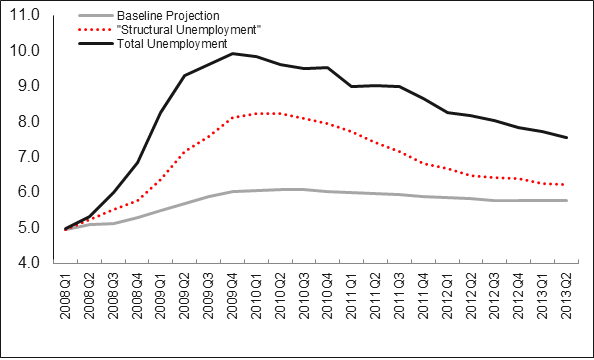
The bottom line? The estimate of structural unemployment has declined over the past year in line with the decline in the actual unemployment rate. In the figure below, the solid (black) line shows the U.S. unemployment rate declining from nearly 10 percent in 2009:Q4 to about 7 ½ percent today. The dotted (red) line is the estimate of structural unemployment; it too has declined over that time and the latest estimate of structural unemployment is 6.2 percent. There is a lot of concern about U.S. long-term unemployment. In this case too, there has been a decline in the estimate of the structural component of long-term unemployment, but it is more gradual than in the case of total unemployment.
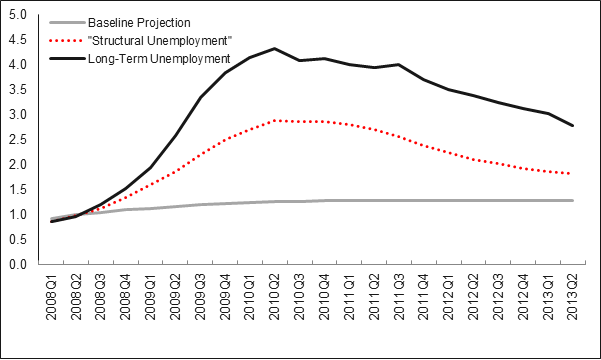
Intrigued? This post by Menzie Chinn (Econbrowser) has a nice ‘cheat sheet’ on how these estimates were constructed.
Each release of the U.S. payroll employment report leads to a debate on the extent to which unemployment is cyclical vs. structural. I’ve just updated the estimates of U.S. structural unemployment reported in my 2011 IMF Working Paper. (Please note that IMF working papers represent the views of the authors and not the official view of the IMF or of any institution with which my co-authors are affiliated.)
Estimate of Structural Unemployment, Read the full article…
Posted by at 10:34 AM
Labels: Inclusive Growth
Subscribe to: Posts