Showing posts with label Inclusive Growth. Show all posts
Tuesday, August 23, 2016
Growing Apart, Losing Trust? The Impact of Inequality on Social Capital
There is a widespread perception that trust and social capital have declined in United States as well as other advanced economies, while income inequality has tended to increase. While previous research has noted that measured trust declines as individuals become less similar to one another, this paper examines whether the downward trend in social capital is responding to the increasing gaps in income. The analysis uses data from the American National Election Survey (ANES) for the United States, and the European Social Survey (ESS) for Europe. Our analysis for the United States exploits variation across states and over time (1980-2010), while our analysis of the ESS utilizes variation across European countries and over time (2002-2012). The results provide robust evidence that overall inequality lowers an individual’s sense of trust in others in the United States as well as in other advanced economies. These effects mainly stem from residual inequality, which may be more closely associated with the notion of fairness, as well as inequality in the bottom of the distribution. Since trust has been linked to economic growth and development in the existing literature, these findings suggest an important, indirect way through which inequality affects macro-economic performance.
For details, see the new IMF Working Paper.
There is a widespread perception that trust and social capital have declined in United States as well as other advanced economies, while income inequality has tended to increase. While previous research has noted that measured trust declines as individuals become less similar to one another, this paper examines whether the downward trend in social capital is responding to the increasing gaps in income. The analysis uses data from the American National Election Survey (ANES) for the United States,
Posted by at 6:42 PM
Labels: Inclusive Growth
Tuesday, August 16, 2016
Is Uncertainty Hurting Productivity?
Since the global financial crisis, productivity growth has been weak and there have been bouts of heightened uncertainty. My new paper shows that, historically, increases in aggregate uncertainty have reduced productivity growth in industries. The impact is stronger in industries that depend heavily on external finance. This effect is also larger during recessions, when financing constraints are more likely to be binding. These findings suggest that counter-cyclical macro policies can have beneficial impacts on productivity growth during uncertain times (which corroborates conclusions reached by Philippe Aghion and co-authors in a recent set of papers) as well as policies aimed at addressing weak corporate balance sheets. My paper is co-authored with Sam Choi, Davide Furceri and Yi Huang and is available here.
Since the global financial crisis, productivity growth has been weak and there have been bouts of heightened uncertainty. My new paper shows that, historically, increases in aggregate uncertainty have reduced productivity growth in industries. The impact is stronger in industries that depend heavily on external finance. This effect is also larger during recessions, when financing constraints are more likely to be binding. These findings suggest that counter-cyclical macro policies can have beneficial impacts on productivity growth during uncertain times (which corroborates conclusions reached by Philippe Aghion and co-authors in a recent set of papers) as well as policies aimed at addressing weak corporate balance sheets.
Posted by at 6:18 PM
Labels: Inclusive Growth
Monday, August 15, 2016
Workshop on Global Labor Markets
IMF-OCP Policy Center-Brunel University
Workshop on Global Labor Markets
September 1-2, 2016, Paris

Thursday, September 1
9-9.15 Opening remarks:
Tao Zhang, Deputy Managing Director, IMF
Karim El Aynaoui, Managing Director, OCP Policy Center
Session 1: Does Growth Create Jobs? Global and Regional Evidence
Chair: Prakash Loungani (IMF)
Background paper on Okun’s Law
9.15-10.30 Laurence Ball (Johns Hopkins University)
Does One Law Fit All? Okun’s Law in Advanced & Developing Economies (Draft Paper and Presentation)
Tayeb Ghazi (OCP Policy Center)
Okun’s Law: (Un)fit for Low-Income Countries?
Nathalie Gonzalez-Prieto (IMF)
What Lies Beneath: Okun’s Law in U.S. States (Draft and Presentation)
10.30-10.45 Coffee break
10.45-12 Discussants: Willi Semmler (New School for Social Research)
Ekkehard Ernst (ILO)
Francois Facchini (University of Paris 1)
Mai Dao (IMF)
12-1.30 Lunch
1.30-2 Karim El Aynaoui and Aomar Ibourk (OCP Policy Center)
Policy Lessons from Okun’s Law for Developing Countries
Session 2: Jobs and Growth: The Role of Policies and Institutions
Chair: Jean-Bernard Chatelain (Paris School of Economics)
2-3 Haje Schutte and Karen Wilson (OECD)
The Sustainable Development Goals as Business Opportunities
Aurelio Parisotto (ILO)
Decent Work for All: Parsing Goal 8 of the SDGs
3-3.15 Coffee break
3.15-4 Romain Duval (IMF)
Can Reform Waves Turn the Tide? Some Case Studies Using the Synthetic Control Method
Discussant: Nauro Campos (Brunel University)
4-4.45 Sebastian Weber (ECB)
Reassessing the Role of Labor Market Institutions for the Business Cycle
Discussant: Mai Dao (IMF)
4.45-5.30 Giovanni Melina (IMF)
Sectoral Labor Mobility and Optimal Monetary Policy
Discussant: Manasa Patnam (CREST-ENSAE)
Friday, September 2
Session 3: Labor Flows: Mobility, Migration, Displacement
Chair: Nauro Campos (Brunel University)
9-9.45 Amine Ouazad (Ecole Polytechnique)
Job Displacement and Crime: Evidence from Danish Microdata
Discussant: Ahmed Tritah (Universite du Maine)
9.45-10.45 Alessandro Turrini (European Commission)
Labor Mobility and Labor Market Adjustment in the EU
Anda David (Agence Française de Développement)
Migration and Employment Interactions in a Crisis Context: The Case of Tunisia
10.45-11 Coffee break
11-11.30 Discussants: Davide Furceri (IMF)
Nawal Zaaj (Higher Council of Scientific Research, Morocco)
11.30-12.15 Martin Kahanec (Central European University)
Free Movement of Workers within the EU
12.15-1.30 Lunch
Session 4: Policy Priorities and Prospects for the EU
Chair: Nauro Campos (Brunel University)
1.30-2 Rodolphe Blavy (IMF, Europe Office)
An Overview of Developments and Policy Debates
2-2.30 Francesco Saraceno (OFCE-Sciences Po)
An Assessment of EU Fiscal Policy
2.30-3.15 Panel: Alessandro Turrini (European Commission)
Willi Semmler (New School for Social Research)
3.15-3.30 Coffee break
Session 5: The Design of Labor Market Institutions
Chair: Ahmed Tritah (Universite du Maine)
Active Labor Market Policies
3.30-4.30 Bruno Crepon (ENSAE-CREST)
Active Labor Market Policies: A Review
Veronica Escudero (ILO)
Cross-Country Evidence of Active Labor Market Policies
Minimum Wages, Unemployment Insurance and Employment Protection Legislation
4.30-5.15 Sabina Dewan (JustJobs Network)
Ekkehard Ernst (ILO)
Romain Duval (IMF)
Summing-up
5.15-5.30 Laurence Ball (Johns Hopkins University)
IMF-OCP Policy Center-Brunel University
Workshop on Global Labor Markets
September 1-2, 2016, Paris
Thursday, September 1
9-9.15 Opening remarks:
Tao Zhang, Deputy Managing Director, IMF
Karim El Aynaoui, Managing Director, OCP Policy Center
Session 1: Does Growth Create Jobs? Global and Regional Evidence
Chair: Prakash Loungani (IMF)
Background paper on Okun’s Law
Posted by at 10:42 AM
Labels: Inclusive Growth
Friday, August 12, 2016
How Reliable is China’s Output Data?
“There is some evidence pointing to possible overstatement of growth recently, but the overstatement is likely moderate and the official national accounts data—while there is much room for improvement—likely provide a broadly reliable picture,” according to an IMF report.
China’s nominal GDP is probably larger than the official estimate. This could reflect flaws in measuring service consumption, including the inability to fully capture the switch from state-owned industrial firms to market-based (and often smaller) service firms. A study by the Rhodium Group, which duplicates the authorities’ statistical methodology, but addresses some key weaknesses, suggests nominal GDP is underestimated by, for example, 13–16 percent in 2008, and some other studies, while using different approaches, show similar results.
But growth may be smoothed since the smallest and most volatile firms may not be adequately captured in the statistical methodology. Indeed, skepticism that growth is overstated has grown recently, arising largely from the more pronounced weakening in some hard indicators compared to official growth data, including consumption of energy, industrial value added, and commodity imports. A few studies indicate that growth is not overstated over a long time horizon, but that the volatility is understated. Some further argue that the official nominal GDP data are reliable, but the weaknesses in deflators cause real growth to be smoothed. For example, the single deflation approach, which deflates input and output using the same deflator, tends to overstate growth when commodity prices decline sharply. But a counterargument is that the dynamism in the service sector is robust and not well reflected in the hard indicators mentioned above. For example, private consumption is buoyant, with retail sales growing by around 10 percent y/y in real terms.
“Underlying” growth may be weaker than officially reported, but only somewhat.
- Correlation. A sudden decline in the correlation between overall growth data and individual hard indicators could signal that the official data might overstate growth. However, looking at 12-month rolling correlations for real GDP growth versus electricity production, cement, crude steel and freight, does not suggest a recent significant decline (though the series are noisy).
- High frequency-based estimates. Out-of-sample estimates of growth from high-frequency PMIs and consumption/investment indicators are about ¼‒ ½ percent lower than official growth data in 2015.
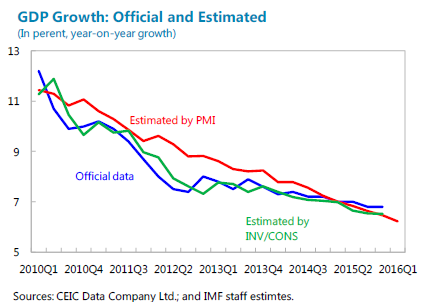
These results, however, are only indicative of possible slower underlying growth. While providing some cross checks, they are not based on comprehensive datasets and cannot substitute for national account statistics. These approaches focus on underlying growth by analyzing variables traditionally shaping economic fundamentals, while actual growth also includes transitory factors not captured (e.g., the current strength of financial services).”
“There is some evidence pointing to possible overstatement of growth recently, but the overstatement is likely moderate and the official national accounts data—while there is much room for improvement—likely provide a broadly reliable picture,” according to an IMF report.
China’s nominal GDP is probably larger than the official estimate. This could reflect flaws in measuring service consumption, including the inability to fully capture the switch from state-owned industrial firms to market-based (and often smaller) service firms.
Posted by at 9:41 AM
Labels: Inclusive Growth
Wednesday, August 10, 2016
Demographic Dividends, Gender Equality, and Economic Growth: The Case of Cabo Verde
A new IMF working paper analyzes Cabo Verde’s demographic transition from the perspective of gender equality. It concludes: “As the pace of the demographic transition slows, promoting gender equality and increasing women’s labor force participation will be progressively more important in enhancing otherwise slow-growth dynamics, reducing poverty, and improving the lives of all, women and men.”
A new IMF working paper analyzes Cabo Verde’s demographic transition from the perspective of gender equality. It concludes: “As the pace of the demographic transition slows, promoting gender equality and increasing women’s labor force participation will be progressively more important in enhancing otherwise slow-growth dynamics, reducing poverty, and improving the lives of all, women and men.”
Posted by at 3:59 PM
Labels: Inclusive Growth
Subscribe to: Posts