Showing posts with label Inclusive Growth. Show all posts
Thursday, May 10, 2018
Gender Equality: Which Policies Have the Biggest Bang for the Buck?
A new IMF paper finds that “higher public spending on education, better sanitation facilities, low adolescent fertility, and narrower marriage age gaps are significantly related to narrower gender gaps in education. […] better infrastructure, a stronger institutional environment, more equal legal rights, and low adolescent fertility rates are strongly associated with higher female labor force participation. When labor market protection is low, an increase in protection is associated with a narrowing of labor force participation gaps between men and women. But when labor market protection levels are high, an increase in protection is associated with a widening in labor force participation gaps.”
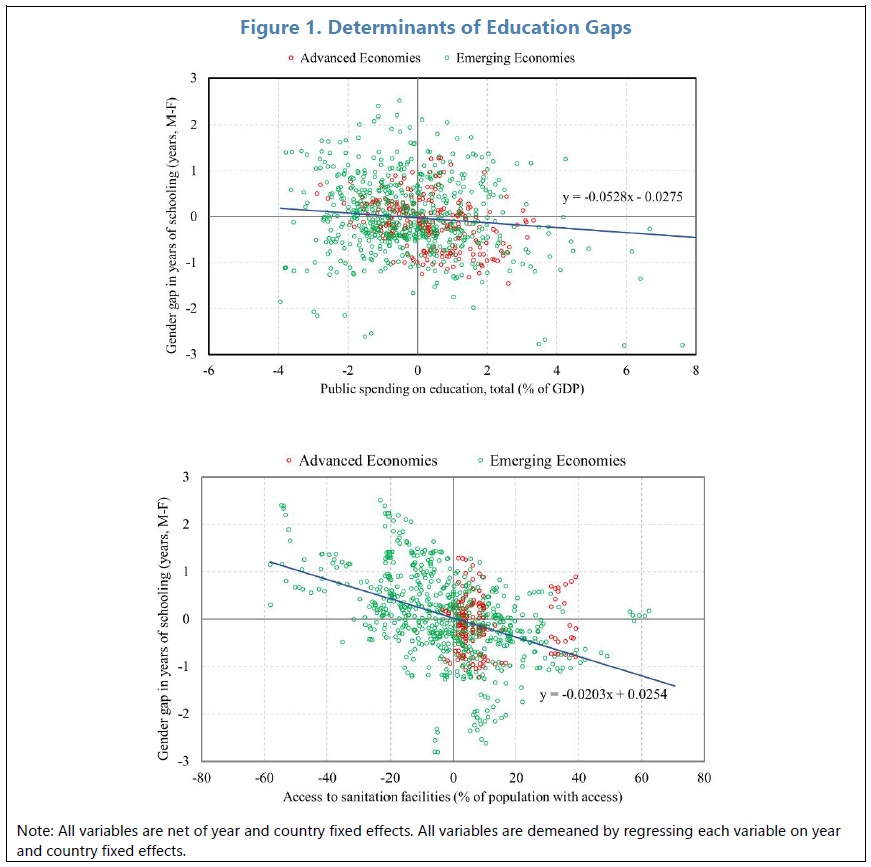
A new IMF paper finds that “higher public spending on education, better sanitation facilities, low adolescent fertility, and narrower marriage age gaps are significantly related to narrower gender gaps in education. […] better infrastructure, a stronger institutional environment, more equal legal rights, and low adolescent fertility rates are strongly associated with higher female labor force participation. When labor market protection is low, an increase in protection is associated with a narrowing of labor force participation gaps between men and women.
Posted by at 5:08 PM
Labels: Inclusive Growth
Remittances and labor market outcomes in LICs, MICs and Fragile States
From a new IMF working paper by Ralph Chami, Ekkehard Ernst, Connel Fullenkamp, and Anne Oeking”
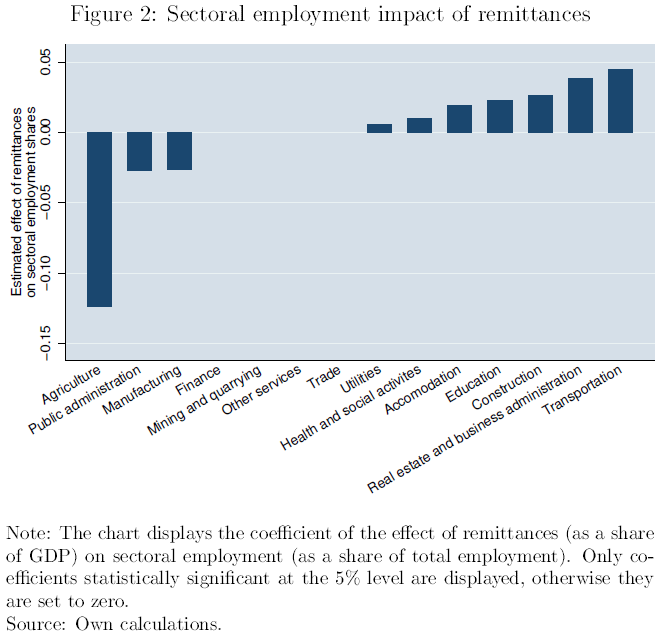
“We present cross-country evidence on the impact of remittances on labor market outcomes. Remittances appear to have a strong impact on both labor supply and labor demand in recipient countries. These effects are highly significant and greater in size than those of foreign direct investment or offcial development aid. On the supply side, remittances reduce labor force participation and increase informality of the labor market. In addition, male and female labor supply show significantly different sensitivities to remittances. On the demand side, remittances reduce overall unemployment but benefit mostly lower-wage, lower-productivity nontradables industries at the expense of high-productivity, high-wage tradables sectors. As a consequence, even though inequality declines as a result of larger remittances, average wage and productivity growth declines, the latter more strongly than the former leading to an increase in the labor income share. In fragile states, in contrast, remittances impose a positive externality, possibly because the tradables sector tends to be underdeveloped. Our findings indicate that reforms to foster inclusive growth need to take into account the role of remittances in order to be successful.”
From a new IMF working paper by Ralph Chami, Ekkehard Ernst, Connel Fullenkamp, and Anne Oeking”
“We present cross-country evidence on the impact of remittances on labor market outcomes. Remittances appear to have a strong impact on both labor supply and labor demand in recipient countries. These effects are highly significant and greater in size than those of foreign direct investment or offcial development aid. On the supply side, remittances reduce labor force participation and increase informality of the labor market.
Posted by at 11:30 AM
Labels: Inclusive Growth
What Drives Labor and Product market Reforms in Advanced Countries?
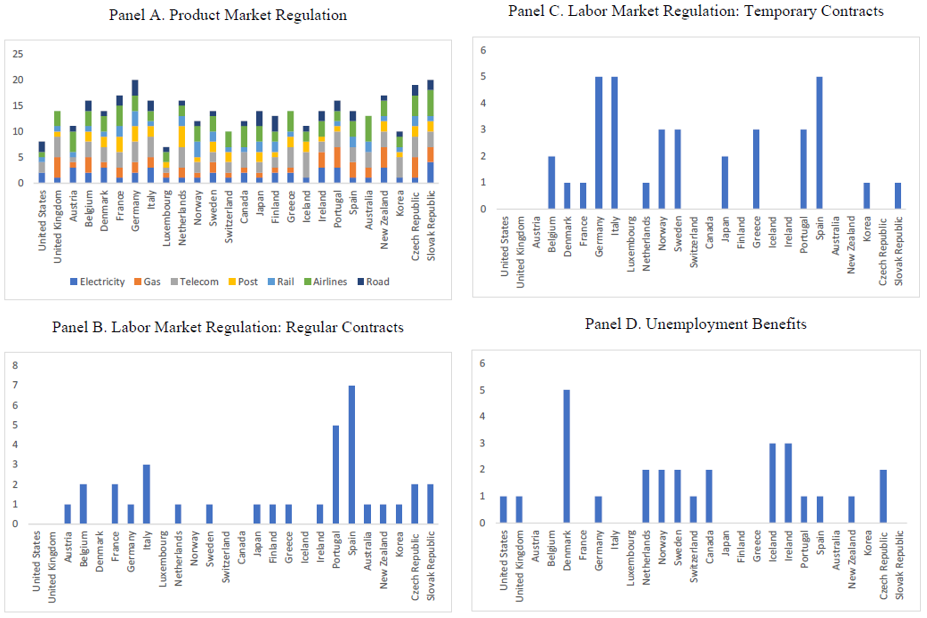
A new IMF working paper by Romain A Duval Davide Furceri, and Jakob Miethe find “widespread support for the crisis-induces-reform hypothesis. Reforms are also more likely to happen when other countries undertake them or there is formal pressure to implement them. Other robust correlates are more specific to certain areas—for example, political factors are most relevant for job protection reforms.”
“High unemployment, recession and/or an open economic crisis tend to be associated with a greater likelihood of reform. The effect is economically significant. For example, an increase of 10 percentage points in unemployment (as seen in several European economies in the aftermath of the Great Recession) is associated with an increase in the probability to undertake a major EPL reform for regular contract of about 5 percentage points — that is, about twice the average probability in the sample.”
“[…] outside pressure increases the likelihood of reform in certain areas. Reforms are more likely when other countries also undertake them and when there is formal pressure: many product market reforms in EU countries have occurred during their accession process, and competition-relevant EU directives have also been an important factor behind deregulation.”
A new IMF working paper by Romain A Duval Davide Furceri, and Jakob Miethe find “widespread support for the crisis-induces-reform hypothesis. Reforms are also more likely to happen when other countries undertake them or there is formal pressure to implement them. Other robust correlates are more specific to certain areas—for example, political factors are most relevant for job protection reforms.”
“High unemployment, recession and/or an open economic crisis tend to be associated with a greater likelihood of reform.
Posted by at 11:22 AM
Labels: Inclusive Growth
Wednesday, May 9, 2018
Low Inflation in Asia
From the new IMF Regional Economic Outlook for Asia Pacific:
“The main findings are as follows:
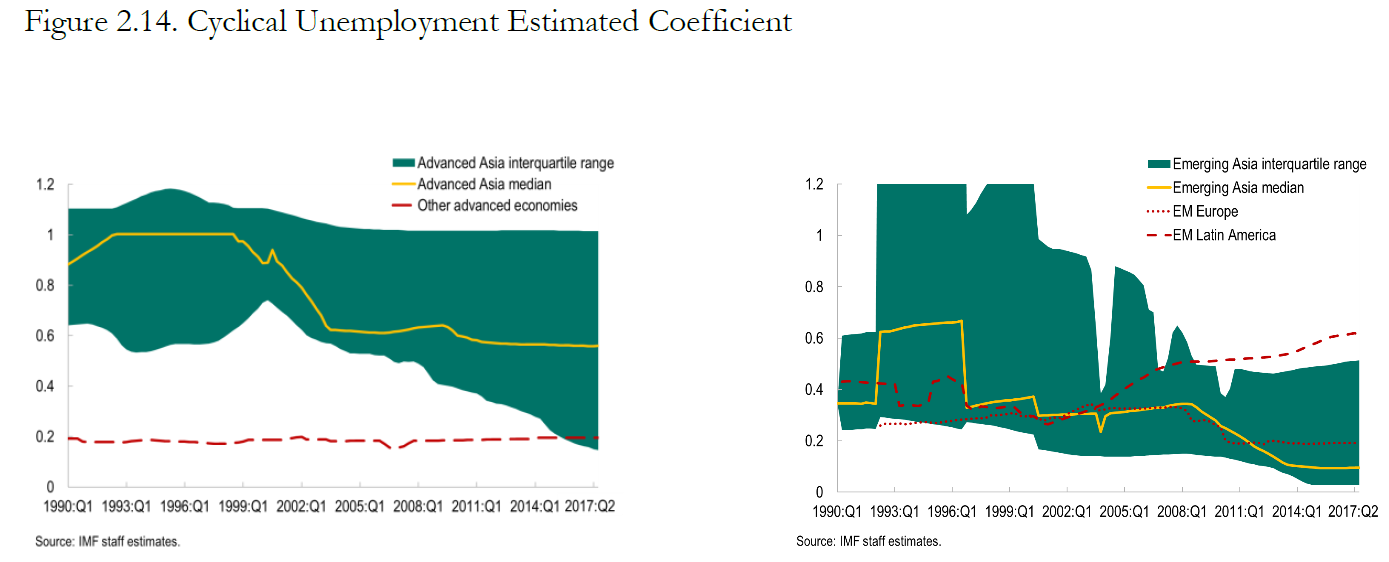
- Recent low inflation has been driven mainly by temporary forces, including imported inflation. Phillips curve estimation indicates that weaker import prices, including low commodity prices, contributed to half of the undershooting of inflation targets in advanced Asia and most of the undershooting in emerging Asia in recent years. In addition, China seems to have played an important role in driving both global and regional inflation. More generally, an analysis looking at temporary and trend components suggests that temporary shocks have accounted for the bulk of the recent reduction in inflation.
- The inflation process has become more backward-looking. While inflation expectations are generally relatively well anchored, especially in advanced Asia and in economies with inflation-targeting frameworks, the importance of expectations in driving inflation has declined in recent years with past inflation playing a larger role.
- The sensitivity of inflation to the unemployment gap has declined. There seems to be a flattening of the Phillips curve compared to the 1990s in advanced Asia and a similar but more continuous flattening in emerging Asia. Outside of Asia, the slope of the Phillips curve seems to have been more stable.”
“The main policy implications of the findings are:
- Central banks should be vigilant in responding to early signs of inflationary pressure, including from global factors. A sudden increase in inflation may then persist, and disinflating may be costly if sensitivity of inflation to the unemployment gap has declined.
- It will be important to strengthen monetary policy frameworks and improve central bank communications in order both to increase the role of expectations in driving inflation and to maintain expectations anchored to targets.
- To mitigate the role of imported inflation, exchange rates should be allowed to adjust more flexibly.
- In principle, the monetary policy response to commodity price shocks should be to accommodate first- round effects but not the second-round effects.”
From the new IMF Regional Economic Outlook for Asia Pacific:
“The main findings are as follows:
- Recent low inflation has been driven mainly by temporary forces, including imported inflation. Phillips curve estimation indicates that weaker import prices, including low commodity prices, contributed to half of the undershooting of inflation targets in advanced Asia and most of the undershooting in emerging Asia in recent years. In addition, China seems to have played an important role in driving both global and regional inflation.
Posted by at 3:38 PM
Labels: Inclusive Growth
Saturday, May 5, 2018
Is inflation dead?
From a presentation by Surjit S Bhalla:
“Some facts to consider about CPI inflation:
- Inflation in the US averaged 1.9 % between 1996 and 2009; and 70 basis points lower over the next eight years.
- A little appreciated inflation fact is that the mean inflation rate in 21 Advanced Economies (AE) excluding the US, averaged some 25 bp less than the US.
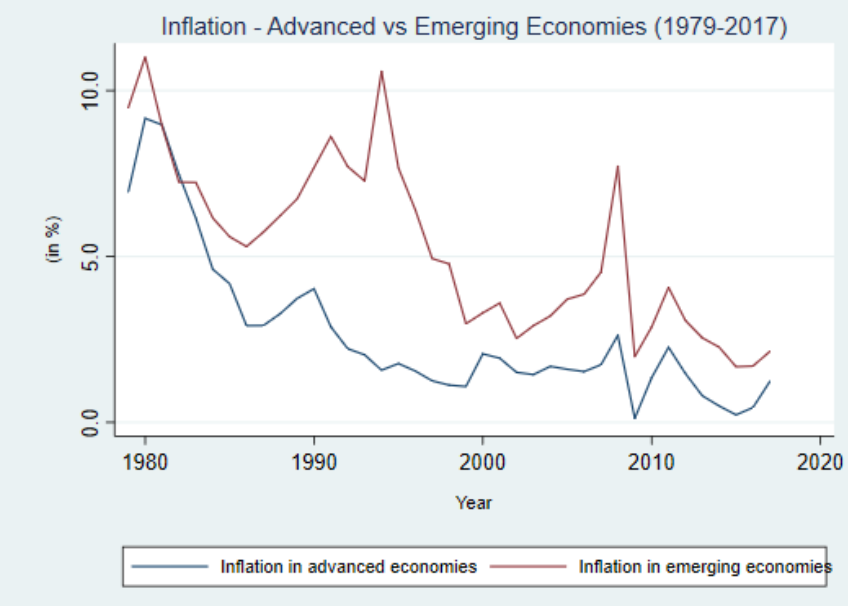
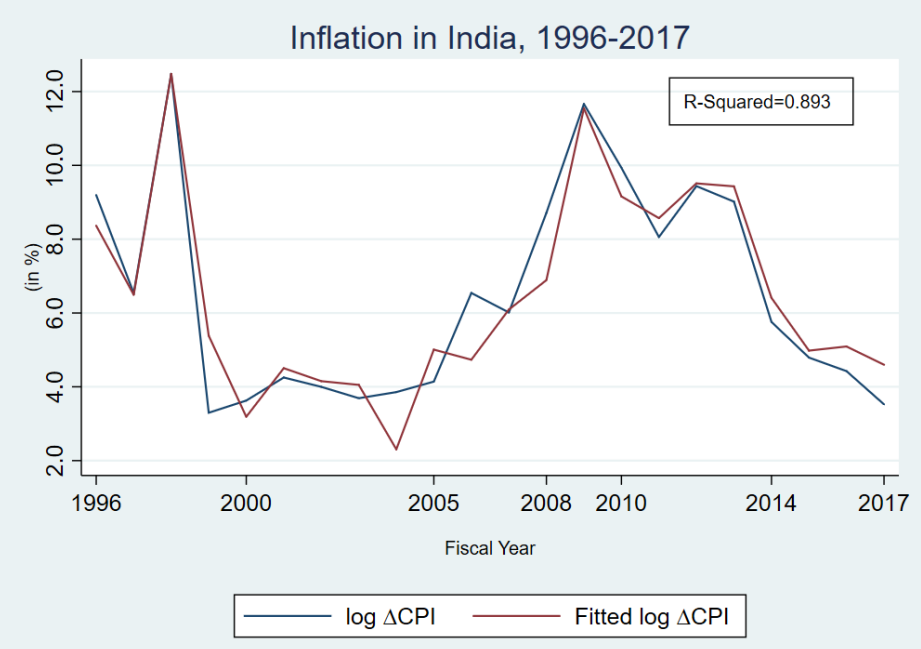
- Charts 1 and 2 document median inflation in the Advanced, and the Rest, economies from 1979 to 2017, and 1996 to 2017.
- Note that inflation decline set in prior to 2007 , and in reality started somewhere in the mid-1990s.”
“Explanations for the inflation slowdown:
- Fiscal deficit trends provide zero clues about this slowdown in inflation.
- World GDP growth [IMF weights] was the highest 1996-2007.
- World growth has moved inversely to world inflation.
- Output gap, or considerations thereof, do not explain, inflation slowdown.
- Demography (changes in dependency ratio) does explain some of the decline in inflation.
- However, the most consistent explanation for the decline in inflation is the large increase in college graduates in the Rest of the world compared to such supply in the West (Advanced Economies)”
“What explains Indian inflation? – Procurement prices and rural wage growth:
- Procurement prices and rural wage growth matters for Indian inflation, not much else.
- Further, the impact of procurement prices is diminishing over time, especially over the last three years.
- Each 1% increase in (lagged) procurement prices leads to a 12 bp increase in inflation.
- Each 1 % increase in rural wages leads to a 28 bp increase in inflation.
- The model is able to explain 89 % of the variation in log inflation, 1996-2017.”
In my recent paper with Sangyup Choi, Davide Furceri, Saurabh Mishra, and Marcos Poplawski-Ribeiro, we study the dynamic impact of global oil price shocks on domestic inflation. We find that a 10 percent increase in global oil inflation increases domestic inflation by about 0.4 percentage point on impact, with the effect vanishing after two years and being similar between advanced and developing economies. My paper is available here. The working paper version is available here.
From a presentation by Surjit S Bhalla:
“Some facts to consider about CPI inflation:
- Inflation in the US averaged 1.9 % between 1996 and 2009; and 70 basis points lower over the next eight years.
- A little appreciated inflation fact is that the mean inflation rate in 21 Advanced Economies (AE) excluding the US, averaged some 25 bp less than the US.
- Charts 1 and 2 document median inflation in the Advanced,
Posted by at 2:19 PM
Labels: Inclusive Growth
Subscribe to: Posts