Showing posts with label Global Housing Watch. Show all posts
Monday, January 13, 2020
Experts Confer on the State of the U.S. Rental Housing Market
Global Housing Watch Newsletter: January 2020
*Below is a conference summary prepared by Pedro Gete (IE Business School).
- The real estate market is poised for a favorable year even with an expected slowdown in the economy in 2020.
- Experts also pointed out the importance of population flows to understand recent housing dynamics, the need to rethink housing policy, and the strong effects that technology—such as Airbnb—is having on housing markets.
- Conference is part of the Federal Reserve Bank of St. Louis’ work in tracking developments in the U.S. housing market.
The Federal Reserve Bank of St. Louis hosted its first annual conference on December 5-6, 2019 on the U.S. rental housing markets. The conference was organized by Carlos Garriga and Don Schlagenhauf of the Federal Reserve Bank of St. Louis, and Pedro Gete from IE Business School. This conference brought together top experts to discuss current trends in the rental housing market alongside in-depth research to help understand the dynamics driving these markets and potential implications of policy decisions.
The view from the private sector and government agencies
The conference included Paul Liegey from the Bureau of Labor Statistics and participants from the private sector: Jeffrey Adler (Yardi Systems); Cris DeRitis (Moody’s); Mike Fratantoni (Mortgage Bankers Association); and Svenja Gudell (Zillow Group); Taylor Marr (Redfin); and Frank Nothaft (CoreLogic). What follows are the key takeaways from these participants:
- The overall outlook for the U.S. economy remains favorable. Most panelists projected slower economic growth in 2020, with real GDP growth between 2 percent and 2.5 percent. Only one forecast had real GDP growth slightly under 1 percent. Comments suggested the recent interest rate cuts by the Fed would cushion a slowdown from turning to a recession.
- Panelists generally agreed that the real estate market was poised for a favorable year even with a slowdown in the economy, as demographics should produce growth in household formation which would generate steady demand for home purchases. Panelists also agreed that the supply of homes to be added in 2020 is unlikely to meet new demand, effectively pushing up prices and reducing affordability for first-time buyers.
- While the demographics are favorable to increasing home sales in 2020, the continued lack of supply and higher prices are likely to keep many potential first-time buyers in the rental market, keeping the demand for rental units stable to increasing. Panelists noted, however, drivers of demand for multifamily units varied across the county: in large (high-cost) coastal cities, demand has been driven by international migration; in mid-size cities in the West, Texas, and South, demand has been driven by domestic migration.
- Panelists offered various hypotheses for the lack of supply for new housing units (both owner-occupied and rental). Panelists noted that anecdotally labor shortages are often cited for containing building. However, economic data suggest the labor reason may be over-emphasized: while total employment growth has been slow, average wage growth for construction workers has slowed, which suggests lower demand for these positions. Among others, alternative hypotheses offered by panelists included: longer time to completion on new construction; a lack of available lots; desire to age in place by older generations; and a large future supply of homes over next 20 years due to the passing of baby boomers.
The view from policymakers and academics
The conference also included participants from the central banks and academia. What follows are the key takeaways from this group.
- Housing Supply and Affordability, presented by Raven Molloy (Federal Reserve Board). Coauthors: Charles G. Nathanson (Northwestern University) and Andrew Paciorek (Federal Reserve Board). The authors develop a model to understand how housing supply constraints affect housing affordability. The model predicts that supply constraints will increase the price of housing services (or rents) by only about half as much as the house purchase price. This is because purchase prices reflect current rents as well as future increases in rents. Using metro-area data, the authors find sizeable effects of supply constraints on house prices, but little effect on rent, house/lot size, location, or housing expenditures. The authors conclude that housing supply constraints distort housing consumption and affordability much less than their estimated effects on house prices would suggest.
- Landlord rights, Evictions, and Rent Affordability, presented by Thao Le (Georgia State University). Coauthors: N. Edward Coulson (University of California) Irvine and Lily Shen (Clemson University). The authors develop a search model to understand the effect of eviction cost on rent affordability. The model predicts that a lower eviction cost will lead to lower rent, higher supply, a higher vacancy rate, a lower homeless rate, and a potentially higher eviction rate. Using data, the authors confirm the model predictions. In areas where landlords have stronger rights, rental houses are more affordable, and the vacancy rate is higher. The results highlight a delicate balance between strict regulations, eviction and rent affordability.
- Affordable Housings and City Welfare, presented by Pierre Mabille (New York University). Coauthors: Jack Favilukis (University of British Columbia) and Stijn Van Nieuwerburgh (Columbia University). The authors evaluate the effect of affordable housing policies (zoning changes, rent control, housing vouchers, and tax credits) on the well-being of citizens. Using a model calibrated to the New York, MSA, they find that housing affordability policies carry substantial insurance value but cause misallocation in labor and housing markets. For example, increasing the housing stock in the urban core by relaxing zoning regulations is welfare improving. Contrary to conventional wisdom, increasing the generosity of the affordable housing or housing voucher systems is also welfare improving. Increasing the housing safety net for the poorest households creates welfare gains for society. How the affordability policies are financed has first-order effects on welfare gains.
- The Price-Rent Ratio during the Boom and Bust, presented by Paul Willen (Federal Reserve Bank of Boston). Coauthors: Jaclene Begley (Fannie Mae) and Lara Loewenstein (Federal Reserve Bank of Cleveland). They decompose the change in the price of occupant-owned property into three components: (1) changes in rent; (2) changes in the relative price of investor-and occupant-owned property; and (3) changes in the price-rent ratio. They show that changes in the price-rent ratio accounts for most of the variation and argue that this has significant implications for theories of the 2000s housing boom and bust.
- The Effect of Home-Sharing on House Prices and Rents: Evidence from Airbnb, presented by Davide Proserpio (University of Southern California). Coauthors: Kyle Barron (NBER) and Edward Kung (UCLA). The authors find that 1 percent increase in Airbnb listings is causally associated with a 0.018 percent increase in rental rates and 0.026 percent increase in house prices. Considering the rapid growth in Airbnb, this accounts for about one-fifth of the average annual increase in national rents, and one-seventh of the average annual increase in housing prices. While this is an important factor, demographic changes across cities zip codes can explain three-fourths of the differences in rent and housing price growth.
- Why is the rent so darn high? Presented by Greg Howard (University of Illinois). Coauthor: Jack Liebersohn (Ohio State University). Rents are high because of migration. The authors show that three-quarters of the CPI-rent increase in the United States from 2000 to 2018 is due to increased demand to live in ex-ante housing-supply-inelastic cities (that is, cities where is it difficult to build new housing). The authors also show that despite low short-run migration rates, people have high long-run mobility. Moreover, the pattern of migration across cities matches the patterns in labor-market and amenity changes.

From left to right: Carlos Garriga (Federal Reserve Bank of St. Louis), Frank Nothaft (CoreLogic), Taylor Marr (Redfin), Svenja Gudell (Zillow Group), and Mike Fratantoni (Mortgage Bankers Association).

From left to right: Randal Verbrugge (Federal Reserve Bank of Cleveland), Paul Liegey (Bureau of Labor Statistics), Jeffrey Adler (Yardi Systems) and Cris DeRitis (Moody’s).
Global Housing Watch Newsletter: January 2020
*Below is a conference summary prepared by Pedro Gete (IE Business School).
- The real estate market is poised for a favorable year even with an expected slowdown in the economy in 2020.
- Experts also pointed out the importance of population flows to understand recent housing dynamics, the need to rethink housing policy,
Posted by at 5:00 AM
Labels: Global Housing Watch
Friday, January 10, 2020
Housing View – January 10, 2020
On cross-country:
- Asset Bubbles and Global Imbalances – Federal Reserve Bank of Richmond
On the US:
- Dominating Firms Can Depress House Prices as Well as Wages – Wall Street Journal
- Experts predict what the 2020 housing market will bring – Washington Post
- Trump Administration Plans Roll Back of Low-Income Housing Rules – Wall Street Journal
- Our cities don’t have enough affordable housing. Changing this policy will help – CNN
- New Trump Administration Regulations Say That Affordable Housing Is Fair Housing – Reason
- AEI Housing Market Indicators release on September 2019 data – American Enterprise Institute
- Pricey California Targeted in New Effort for Housing Density – Bloomberg
- Home Purchase Sentiment Index Caps Off Strong 2019 Near Its Survey High – Fannie Mae
- How Wealthy Towns Keep People With Housing Vouchers Out – ProPublica
- Opinion: Unintended consequences: How ‘green’ regulations exacerbate the housing crisis – Market Watch
- As Trump Ditches a Fair Housing Rule, New York City Doubles Down – Citylab
- California Governor Pushes $1.4 Billion Plan To Tackle Homelessness – NPR
- Why The Most Favorable Markets for Tech Expansion Aren’t Where You Might Think – Zillow
On other countries:
- [Brazil] Brazil’s house prices keep falling – Global Property Guide
- [Canada] Canada’s house price boom takes off – Global Property Guide
- [United Kingdom] London house prices link to earnings is ‘almost entirely dislocated’ – Financial Times
- [United Kingdom] UK house price affordability worsens over past decade – Financial Times
On cross-country:
- Asset Bubbles and Global Imbalances – Federal Reserve Bank of Richmond
On the US:
- Dominating Firms Can Depress House Prices as Well as Wages – Wall Street Journal
- Experts predict what the 2020 housing market will bring – Washington Post
- Trump Administration Plans Roll Back of Low-Income Housing Rules – Wall Street Journal
- Our cities don’t have enough affordable housing.
Posted by at 5:00 AM
Labels: Global Housing Watch
Thursday, January 2, 2020
Housing View – January 2, 2020 [2020 AEA Annual Meeting Special Edition]
Below is a preliminary list of papers that will presented at this year’s AEA Annual Meeting on January 3-5 in San Diego, California.
On housing and cycles
- Housing Cycles and Exchange Rates – Paper
- Is the Behavior of Sellers with Expected Gains and Losses Relevant to Cycles in House Prices? – Paper
- China’s Housing Bubble, Infrastructure Investment, and Economic Growth – Paper and Presentation
- Black-Cat Markets and the Value of Superstition: Evidence from Housing Prices in China – AEA
- Regional housing market risk – AEA
- ‘Memory’ in the Middle: Housing Price – Macroeconomic Interactions in the United States – Paper
- The Impact of Parental Wealth on College Enrollment & Degree Attainment: Evidence from the Housing Boom & Bust – AEA
- Villains or Scapegoats? The Role of Subprime Borrowers in Driving the United States Housing Boom – Paper
- Property Tax Limits and Female Labor Supply: Evidence from the Housing Boom and Bust – AEA
- Local House Price Comovements – Paper
- How Auctions Amplify House-Price Fluctuations – Paper
- Unemployment and the United States Housing Market during the Great Recession – AEA
On housing and credit
- Mortgage Credit and Housing Markets – Paper
- Mortgage Debt, Consumption, and Illiquid Housing Markets in the Great Recession – Paper
- The Geography of Mortgage Lending in Times of FinTech – Paper
- Credit Surface of Mortgage Loans: Lenders’ Belief of Housing Markets – AEA
- Concentration and Lending in Mortgage Markets – AEA
- Policy Uncertainty and Bank Mortgage Credit – Paper and Presentation
On housing policy
- The Macroprudential Toolkit: Effectiveness and Interactions – Paper
- Aggregate and Distributional Impacts of Housing Policy: China’s Experiment – Paper
- Unintended Consequences of LTV Limits on Credit and Housing Choices – Paper
- Sticky Expectations in the Housing Market: Evidence from the Housing Purchase Restriction Policy – AEA
- Harping on about HARP: Consequences of Ineligibility for the Home Affordable Refinance Program – Paper
- The Anatomy of the Transmission of Macroprudential Policies – Paper
- Comparing the PRA Program to Other Housing Options for People with Disabilities – AEA
- Targeting In-Kind Transfers through Market Design: A Revealed Preference Analysis of Public Housing Allocation – AEA
- Bank Capital Requirements and Asset Prices: Evidence from the Swiss Real Estate Market – Paper
On housing affordability
- (Why) Are Housing Costs Rising? – Paper
- Affordable Housing and City Welfare – Paper
- Do More Housing Units Reduce Nearby Rents? – AEA
- Procyclical Price-Rent Ratios: Theory and Implications – Paper
- Religion, Ideology, and Housing Affordability: Israeli Settlement of the West Bank – Paper
- Highly Disaggregated Land Unavailability – Paper
On housing and evictions
- Does Eviction Have Spillovers on Children? – AEA
- Housing Insecurity, Homelessness and Populism: Evidence from the UK – Paper
- Measuring Housing Stability with Consumer Reference Data – AEA
On housing, investors, and speculation
- Investors and Housing Affordability – Paper
- Fundamental and Speculative Demands for Housing – AEA
- S. Housing as Global Safe Haven Asset: Evidence from China Shocks – Paper
- Capital Flows, Asset Prices, and the Real Economy: A “China Shock” in the US Real Estate Market – AEA
- Capital Flows, Real Estate, and City Business Cycles: Micro Evidence from the German Boom – AEA
On housing and the sharing economy
- Does bike sharing increase house prices? Evidence from micro-level data in Shanghai – Paper and Presentation
- The Last Mile Matters: Impact of Dockless Bike Sharing on Subway Housing Price Premium – Paper
- Airbnb and Private Investment in Chicago Neighborhoods – Paper
On housing, the environment, and natural disasters
- Perception Versus Reality: The Noise Complaint Effect on Home Values – Paper
- How Much Does Nearby Blight Affect Real Estate Prices? The Case of Hurricane Sandy – Paper
- Dust Storms, Migration and Housing Markets – AEA
On housing and migration
- A Tale of Two Cities: The Impact of Cross-Border Migration on Hong Kong’s Housing Market – Paper and Presentation
- A World Divided: Refugee Centers, House Prices, and Household Preferences – Paper and Presentation
- The Real Estate Consequences of Immigration Shocks: Evidence from the United States’ Mexican Repatriation – AEA
- Residential Segregation and Ethnicity – AEA
- Immigration and Housing Rents: The 2015 Refugee Crisis in Germany – AEA
On housing and everything else
- The Role of Agents in Tax Evasion: Evidence from the Housing Market in China – Paper
- Inside Job: Evidence from the Chinese Housing Market – Paper
- On the Differential Impact of the Tax Cuts and Jobs Act on the Housing Market: Blue versus Red – Paper and Presentation
- Shifting House Price Gradients: Evidence Using Both Rental and Asset Prices – Paper
- Local Constant-Quality Housing Market Liquidity Indices – Paper
- Do Elderly Individuals Delay Claiming Social Security and Cash-out Home Equity When House Prices Appreciate? – Paper
- Street Name Fluency and Housing Prices – Paper and Presentation
- Picture and Playground: Valuing Coastal Amenities – Paper
- Endowments and Minority Homeownership – Paper
- Heterogeneous Households and Market Segmentation in a Hedonic Framework – Paper and Presentation
- Housing Search Frictions: Evidence from Detailed Search Data and a Field Experiment – AEA
- Housing Wealth, Bequests, and the Elderly – Paper
- Public Transport, Noise Complaints, and Housing: Evidence from Sentiment Analysis in Singapore – Paper and Presentation
- The Most Wonderful Time of the Year? Thin Markets, House Price Seasonality, and the December Discount – Paper
- Do School Shootings Erode Property Values? – Paper
- Collateral Value and Entrepreneurship: Evidence from a Property Tax Reform – Paper
- Tracing the Source of Liquidity for Distressed Housing Markets – Paper
- Neighborhood housing rent index construction and spatial discontinuity: a machine learning approach – Paper
- A Tale of Two Cities: The Impact of Cross-Border Migration on Hong Kong’s Housing Market – Paper and Presentation
*AEA indicates that neither the paper or presentation is available at the moment.
Below is a preliminary list of papers that will presented at this year’s AEA Annual Meeting on January 3-5 in San Diego, California.
On housing and cycles
- Housing Cycles and Exchange Rates – Paper
- Is the Behavior of Sellers with Expected Gains and Losses Relevant to Cycles in House Prices? – Paper
- China’s Housing Bubble, Infrastructure Investment, and Economic Growth – Paper and Presentation
- Black-Cat Markets and the Value of Superstition: Evidence from Housing Prices in China –
Posted by at 2:00 AM
Labels: Global Housing Watch
Friday, December 13, 2019
Housing View – December 13, 2019
On cross-country:
- Q3 2019: The global house price boom continues strong, especially in Europe, but sharp slowdown in North America, the Middle East and some parts of Asia-Pacific – Global Property Guide
- Prime Global Cities Index Q3 2019 – Knight Frank
On the US:
- Bold Predictions for 2020: Shrinking Homes and a More Stable Market – Zillow
- These Housing Markets Could Heat Up (Podcast) – Bloomberg
- Fix California’s Housing Crisis, Activists Say. But Which One? – Citylab
- A Modest Proposal: How Even Minimal Densification Could Yield Millions of New Homes – Zillow
- Mapping America’s Metropolitan Growth: Islands of Density in a Sea of No Growth – Zillow
- Home Purchase Sentiment Rebounds in November, Re-Approaches Survey High – FannieMae
- Home Equity in Retirement – Philadelphia Fed
- Owner-Occupancy Fraud and Mortgage Performance – Philadelphia Fed
- Opinion: To solve the problem of unaffordable entry-level housing, abolish single-family zoning – MarketWatch
- Vouchers can help the poor find homes. But landlords often won’t accept them. – VOX
- Fannie and Freddie Need Fixing — Urgently: A Response to Joe Nocera – Cato Liberty
- Release: New Carpenter Index developed by AEI Housing Center – American Enterprise Institute
- “Decommodifying” Housing and Other Magical Thinking – E21
- Tenants are winners in Manhattan’s oversupplied luxury home market – Financial Times
On other countries:
- [China] China’s Housing Market Goes the WeWork Way—and Thousands Get Evicted – Wall Street Journal
- [Israel] Does Location Matter? Evidence on Differential Mortgage Pricing in Israel – Bank of Israel
- [Lithuania] Lithuania’s modest house prices increase – Global Property Guide
- [Netherlands] Netherlands’ house price growth slowly decreasing – Global Property Guide
- [Norway] Norway’s financial stability as risk from household debt, property prices -regulator – Reuters
*Please note that Housing View will be on hiatus for the next three weeks.
On cross-country:
- Q3 2019: The global house price boom continues strong, especially in Europe, but sharp slowdown in North America, the Middle East and some parts of Asia-Pacific – Global Property Guide
- Prime Global Cities Index Q3 2019 – Knight Frank
On the US:
Posted by at 5:00 AM
Labels: Global Housing Watch
Tuesday, December 10, 2019
Housing Market in Cyprus
From the IMF’s latest report on Cyprus:
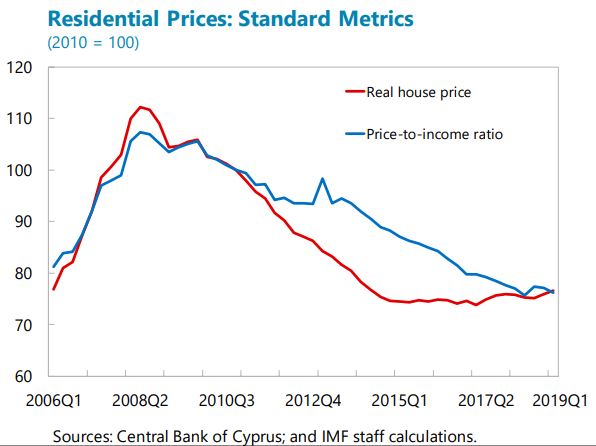
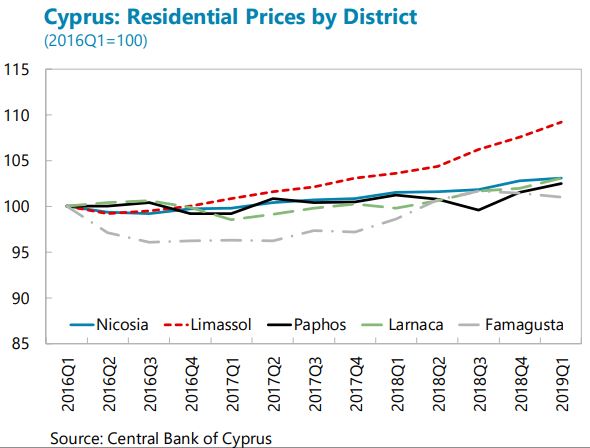
“Property prices are rising gradually but unevenly across markets (…). Rising demand for housing and business offices is being met with increasing supply from new construction, as evidenced by the rising issuance of building permits, and release of repossessed collateral properties by banks. Real estate holdings by banks, CACs and investment funds have also increased. Overall residential prices grew by 2.7 percent (yoy) in 2019:Q1 while sales transactions rose by nearly 6 percent during 2018.14 The property market remains highly segmented, however, with higher price increases observed primarily in a growing luxury segment in some coastal areas (e.g., Limassol), fueled by the CIP-linked demand from non-residents, with limited spillovers to other segments so far. Rents have been rising rapidly—17 percent in 2018— mainly driven by the growing demand from foreign students and lagging supply of rental property investments, prompting the authorities to increase rental and housing subsidies and a range of incentives for developers to increase supplies of affordable housing and rental properties.
Macro-financial risks from the property market appear limited now but warrant close monitoring. While the sales of repossessed collateral properties by banks and CACs could potentially depress prices, downward pressures from such sales have not been evident in any market segments. However, it is important to continue monitoring sectoral and regional real estate market developments, considering the segmented nature of the market. Macroprudential measures tailored to the market segment should be undertaken if warranted, e.g. if the luxury sales become associated with rapid credit growth or high loan-to-value ratios. On the supervisory front, continued monitoring is needed on the large holdings of repossessed real estate by banks and CACs, to discourage and limit the risk of excessive holding of foreclosed properties. Also, the increased real estate holding by investment funds warrants close monitoring to mitigate risks related to liquidity mismatches. Supervisory tools, in particular Pillar 2 requirements and explicit bank-specific objectives, should continue to be used to discourage excessive holding of foreclosed properties by banks.”
From the IMF’s latest report on Cyprus:
“Property prices are rising gradually but unevenly across markets (…). Rising demand for housing and business offices is being met with increasing supply from new construction, as evidenced by the rising issuance of building permits, and release of repossessed collateral properties by banks. Real estate holdings by banks, CACs and investment funds have also increased. Overall residential prices grew by 2.7 percent (yoy) in 2019:Q1 while sales transactions rose by nearly 6 percent during 2018.14 The property market remains highly segmented,
Posted by at 11:01 AM
Labels: Global Housing Watch
Subscribe to: Posts