Showing posts with label Global Housing Watch. Show all posts
Monday, April 20, 2020
A Look at Demographia’s Latest Housing Affordability Survey
Global Housing Watch Newsletter: April 2020
*In this interview, Wendell Cox talks about Demographia’s latest housing affordability . Wendell Cox is an American urban policy analyst and academic. He is the principal of Demographia (Wendell Cox Consultancy). The survey is co-authored with Hugh Pavletich of Performance Urban Planning.
Hites Ahir: You recently released the 16th Annual Demographia International Housing Affordability Survey: 2020. Tell us about the housing affordability measure used in the survey.
Wendell Cox: Demographia uses the “median multiple,” which is the median house price divided by the median household income. This measure meets two important requirements for assessing middle-income housing affordability; it evaluates the relationship between housing costs and household incomes, and it measures the middle of the market.
Hites Ahir: How does your measure compare to other existing measures?
Wendell Cox: Demographia presents current housing affordability between markets as well as in an historical context. This may be the most important difference with other measures, which often consider only recent experience, limited to only a few years or a decade or two.
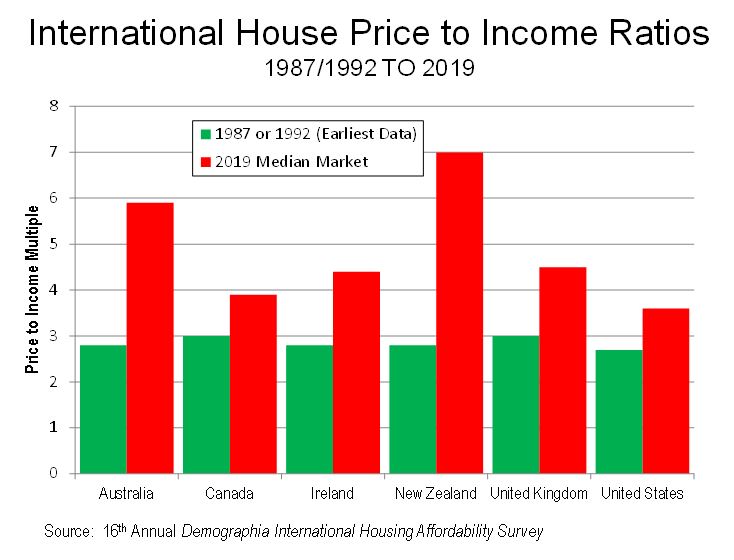
In many metropolitan markets, housing affordability has deteriorated significantly in the last three decades, from a time that in many nations the median multiple was 3.0 or below.
Figure 1.
Hites Ahir: Which countries and cities does it cover?
Wendell Cox:The Survey includes Australia, Canada, China (Hong Kong), Ireland, New Zealand, Singapore, the United Kingdom and the United States. The principal focus is on the more than 90 major housing markets areas (metropolitan areas) with more than 1,000,000 residents. More than 200 additional smaller markets are also included.
Hites Ahir: What is the overall message from the latest survey?
Wendell Cox: The message of this edition as well as the entire series is that governments should closely monitor housing affordability, to position themselves to restore it where it has been lost and maintain it where it remains.
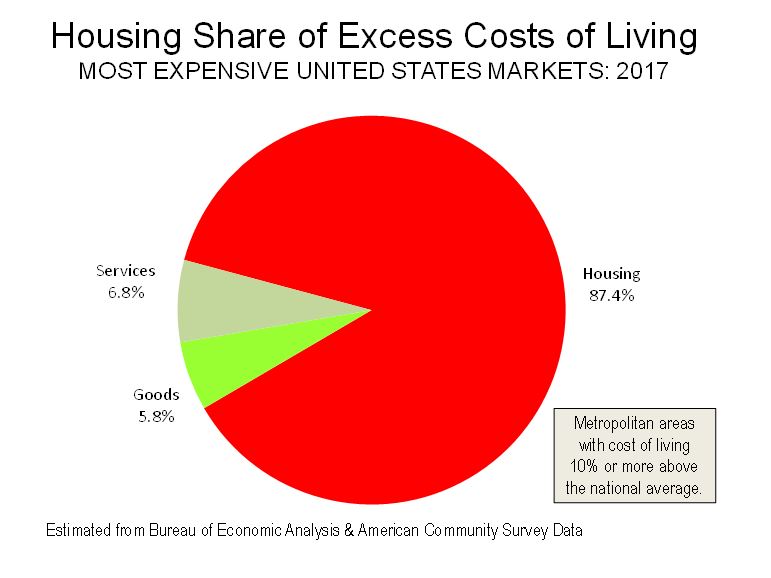
The costs of housing largely define differences in the cost of living and thus, the standard of living. In the United States, we estimate that 87 percent of the excess cost of living in higher cost metropolitan areas is comprised of housing costs.
This is an international problem, as is indicted in recent Organisation for Economic Cooperation and Development (OECD) research, Under Pressure: The Squeezed Middle-Class, suggests an existential threat to the middle-class in OECD countries. According to the OECD, the costs of living have risen much more rapidly than household incomes over the past three decades. Housing, according to the OECD, has been “the largest spending category” and “has been the main driver of rising middle-class expenditure in recent decades.” According to the OECD, owned housing costs have contributed more to the problem than those of rentals, though rental cost increases have been significant.
Figure 2.
Considerable economic research has associated diminished housing affordability with more restrictive land use regulation. In the Demographia Survey, virtually all of the major housing markets that are “severely unaffordable” have urban containment (such as urban growth boundaries and other policies that severely limit or prohibit new development on the urban fringe).
Research in Australia, New Zealand, the United Kingdom and the United States has found comparable land values spiking 10 times and more across urban growth boundaries. Within the San Francisco metropolitan area, economists Edward Glaeser of Harvard and Joseph Gyourko of the University of Pennsylvania found land values for median value houses were “roughly 10 times” the “minimum profitable production cost.” This is in a market stretching across five counties, with ample suitable land, nearly all of it off-limits to development.
There is need for reform, and we cite Paul Cheshire, Max Nathan and Henry Overman of the London School of Economics who suggest that urban planning should focus on “people rather than places.” Part of the solution, according to former World Bank principal planner Alain Bertaud, is to apply “basic economic principles to the practice of urban planning.”
Hites Ahir: How does the findings of this editions compare to the past editions?
Wendell Cox: We have reported on the commitments made by New Zealand’s Labour government to make major land use policy revisions to restore housing affordability and establish effective infrastructure finance mechanisms.
We have also focused on subsidized low-income housing and the extent to which its cost and availability is driven by market housing costs. Because housing subsidies are typically based on ability to pay, deteriorating housing affordability compromises the ability of government to provide for low income housing.
Hites Ahir: In the current issue of the survey, you talk about Singapore. Could you talk to us about “Singapore’s unequalled housing challenge”?
Wendell Cox: Singapore is a city-state confined to an island that has virtually no hinterland in which inexpensive housing development can occur. Yet this topographically contained market has housing affordability considerably better than many markets that have administratively imposed urban containment.
Singapore designed a market that kept house price increases under control, despite the shortage of land. It started with a commitment, more than a half-century ago, to “(…) encourage a property-owning democracy in Singapore and to enable Singapore citizens in the lower middle-income group to own their own homes.” The mandate was assigned to the Housing Development Board (HDB) which has delivered on the objective.
Singapore’s model for the world is not so much the characteristics of its market, as it is having adopted a fundamental objective of housing affordability and focusing on its achievement.
Hites Ahir: How is the ongoing crisis related to Covid-19 likely to affect next year’s survey?
Wendell Cox: Obviously, the economic decline from the lockdowns will make things worse, and probably more for the middle-income households we focus on. Lower-income households are likely to be impacted even more. Housing affordability seems more likely to worsen than to stay the same or improve.
Global Housing Watch Newsletter: April 2020
*In this interview, Wendell Cox talks about Demographia’s latest housing affordability . Wendell Cox is an American urban policy analyst and academic. He is the principal of Demographia (Wendell Cox Consultancy). The survey is co-authored with Hugh Pavletich of Performance Urban Planning.
Hites Ahir: You recently released the 16th Annual Demographia International Housing Affordability Survey: 2020.
Posted by at 5:00 AM
Labels: Global Housing Watch
Friday, April 17, 2020
Housing View – April 17, 2020
On the US:
- Coronavirus is squeezing more people out of the housing market – Axios
- Fed’s Housing-Market Concerns Increase Pressure to Help Mortgage Firms – Wall Street Journal
- Another U.S.-Wide Housing Slump Is Coming – Bloomberg
- Making a Home That’s Affordable, for Good – Citylab
- Despite Stay-at-Home Order, Seattle’s Real-Estate Market Continues to Show Up – Wall Street Journal
- Rental Market Likely Headed for a Slowdown – Harvard Joint Center for Housing Studies
- America’s Housing Finance System in the Pandemic, Part 3: Q&A on the Ugly Fight over Servicer Advances – Harvard Joint Center for Housing Studies
- Housing policy should stop creating competition between young and old – The Hill
On other countries:
- [Germany] The German housing market cycle: Answers to FAQs – Bundesbank
- [United Arab Emirates] Property prices in UAE continues to drop – Global Property Guide
- [United Kingdom] What is the outlook for the UK housing market? – Financial Times
On the US:
- Coronavirus is squeezing more people out of the housing market – Axios
- Fed’s Housing-Market Concerns Increase Pressure to Help Mortgage Firms – Wall Street Journal
- Another U.S.-Wide Housing Slump Is Coming – Bloomberg
- Making a Home That’s Affordable, for Good – Citylab
- Despite Stay-at-Home Order, Seattle’s Real-Estate Market Continues to Show Up – Wall Street Journal
- Rental Market Likely Headed for a Slowdown – Harvard Joint Center for Housing Studies
- America’s Housing Finance System in the Pandemic,
Posted by at 5:00 AM
Labels: Global Housing Watch
Wednesday, April 15, 2020
The German housing market cycle: Answers to FAQs
From a new paper by the Bundesbank:
“Research Question
Frequently asked questions in the analysis of housing markets are: What are the effects of interest rates, income or housing supply on house prices? What is the impact of house price increases on the supply of housing? How much is housing inflation due to land price increases and what is the contribution of construction prices? How long do house price fluctuations last? This paper seeks to shed light on the joint price and supply responses on the German housing market to exogenous changes in macroeconomic determinants.
Contribution
Computing typical reactions of price and supply on the housing market across different episodes of the house price cycle requires a long time series for house prices. The paper presents a novel aggregate price index for housing in Germany, which goes back to 1993. The long house price series, which can be split into a land and a construction price component, is incorporated in an econometric model that takes into account the interaction between the price and supply of housing.
Results
Estimation results suggest that house prices in Germany mainly depend on current and expected income and on the level of interest rates. A decomposition suggests that land prices react more strongly to interest rate changes and to current income developments, whereas for construction prices expected income and the level of construction activity appear to play a larger role. While in the years before the Great Recession, construction prices contributed most to house price growth, land price growth was the main driver behind the recent strong house price increases. The estimates point to a moderate housing supply elasticity in international comparison. The house price dampening effect of additional housing supply is found to be small. This is the result of the combination of a positive price effect of additional construction via construction prices and a price dampening effect of additional building land. Finally, house prices and residential investment take several years to adjust to shocks.”
From a new paper by the Bundesbank:
“Research Question
Frequently asked questions in the analysis of housing markets are: What are the effects of interest rates, income or housing supply on house prices? What is the impact of house price increases on the supply of housing? How much is housing inflation due to land price increases and what is the contribution of construction prices? How long do house price fluctuations last?
Posted by at 8:36 AM
Labels: Global Housing Watch
Friday, April 10, 2020
Housing View – April 10, 2020
On cross-country:
- Housing Markets in a Pandemic: Evidence from Historical Outbreaks – SSRN
On the US:
- Real Estate Taxes and Home Value: Winners and Losers of TCJA – Federal Reserve Bank of Philadelphia
- Airbnb’s COVID-19 crisis could be a boon for affordable housing – Fast Company
- Why U.S. Housing Bubble 2.0 Is About To Burst – Forbes
- Housing Returns with Mortgage and Price Shocks – American Real Estate Society
- These Housing Markets Will Be Hit Worst by Coronavirus – Nasdaq
- These are the U.S. housing markets that are most vulnerable to a coronavirus downturn – Market Watch
- S. Housing Markets Vulnerable to Coronavirus Impact Clustered in Northeast and Florida – ATTOM
- ‘Affordable’ housing can cost $1 million per unit in California. Coronavirus could make it worse – Los Angeles Times
- The Delayed Crisis: The Entire Real Estate Industry Adapts To The Global Pandemic – Forbes
On other countries:
- [Egypt] Egypt’s house price falls decelerating – Global Property Guide
- [Macau] Macau’s house prices are now falling – Global Property Guide
- [Ukraine] Ukraine’s housing market still struggling – Global Property Guide
- [United Kingdom] UK house sales will collapse in 2020 as market goes into deep freeze, says study – The Guardian
- [United Kingdom] Does Homeownership Reduce Crime? A Radical Housing Reform in Britain – Centre for Economic Performance
On cross-country:
- Housing Markets in a Pandemic: Evidence from Historical Outbreaks – SSRN
On the US:
- Real Estate Taxes and Home Value: Winners and Losers of TCJA – Federal Reserve Bank of Philadelphia
- Airbnb’s COVID-19 crisis could be a boon for affordable housing – Fast Company
- Why U.S. Housing Bubble 2.0 Is About To Burst – Forbes
- Housing Returns with Mortgage and Price Shocks – American Real Estate Society
- These Housing Markets Will Be Hit Worst by Coronavirus – Nasdaq
- These are the U.S.
Posted by at 5:00 AM
Labels: Global Housing Watch
Monday, April 6, 2020
Room to Grow: Housing for a New Economy
Global Housing Watch Newsletter: March 2020
* Below is a conference summary on the US housing market prepared by Enrique Martínez García (Federal Reserve Bank of Dallas). The event was co-sponsored by the Real Estate Center at Texas A&M University and the Federal Reserve Bank of Dallas. The views expressed in this summary are those of the author and do not necessarily reflect the views of the Federal Reserve Bank of Dallas or the Federal Reserve System.
A broad range of economists, industry analysts, and experts met for this pre-coronavirus-upheaval conference held in Dallas during much calmer times on February 21, 2020 to discuss the latest trends affecting the U.S. and Texas housing markets. The speakers talked extensively about demographic factors (the millennials generation) and the many ways in which technology is replacing face-to-face transactions and creating new ways to build, buy and sell, and finance a home (fintech).
Macro trends and housing
Keith Phillips (Federal Reserve Bank of Dallas) and James P. Gaines (Real Estate Center at Texas A&M University) showcased a number of macro challenges and their consequences for affordable housing. Mr. Phillips argued that economy is navigating in an increasingly more uncertain world whereby low long-term interest rates could well prove to be a coin with two faces: on the one hand, low rates support housing markets by making ‘cheaper’ while, on the other hand, the low levels of long-term rates relative to the short-term rates (yield curve inversion) are a powerful signal of the growing risk of recession which in turn is a drag on the housing sector.
Mr. Phillips also highlighted the key role that international oil markets play in the macro outlook and, in particular, on housing in Texas and even in the U.S. as a whole. He cautioned that a downward risk for the U.S., a major oil-producing economy, arises from the possibility that oil prices fell below current prices which at the time stood around $56 per barrel barely above the average break-even price for much of the oil industry in Texas and the rest of the U.S. (which according to the Federal Reserve Bank of Dallas’ Energy Survey ranges between $48 and $54 per barrel).
Frank Nothaft (CoreLogic) further added to this that uncertainty over the severity and length of the coronavirus (COVID-19) outbreak in Wuhan (China) was beginning to disrupt the global economy and cause growing concern. Trying to gauge the potential impact on housing, Mr. Nothaft showed evidence on different areas across the U.S. hit by natural disasters as a case study. He warned that the impact on housing markets that could be expected from similar disruptions could be quickly felt and severe. He also noted that such disruptions tend to be followed afterwards by a spike in common delinquencies and faster house price and rent growth. Little did Mr. Phillips and Mr. Nothaft know how prescient their remarks would turn out to be in just a matter of weeks.
The importance of knowing your customers (millennials)
Mr. Gaines singled out two demographic trends in particular that, in his view, will likely upend housing markets for the next decade (at least): (a) housing supply continues to fall behind the demand because housing sales have yet to recover from the pre-2008 recession yet population projections anticipate more growth, and (b) the generational shift from generation X to the millennials is already impacting the why, when, and how to buy and sell a house. Mr. Gaines commented that the boom of 27-29 year-olds (see top plot in Figure 1) is also expected to boost housing demand in the next decade. Many other participants also noted in their remarks the challenges and opportunities for housing posed by the coming of age of millennials in the U.S. which became one of the central themes of the conference.
Echoing Mr. Gaines, Odeta Kushi (First American Financial Corp.) shared that First American’s own projections based on U.S. Census Bureau data suggest an increase in cumulative net new owner-occupied households among millennials in the U.S. (21-39 year-olds in 2019) of well over 15 million by 2040 relative to 2019 levels. Millenials are more educated than previous generations, but the millennials’ median income has only modestly outpaced that of the baby boomers and education itself is taking longer and adds the rising burden of student loans. According to Ms. Kushi, those are some of reasons why the rate of homeownership by age cohort is lower for millennials than it was for generation X or the baby boomers. She also indicated that household formation is crucial for housing—the first-time homebuyer market share is above 50% (at least since 2013)—and that average tenure length has gone up to 12 years (4 more years than in 2005), increasingly dependent on and a consequence of the choices made by millennials.
Jeanette I. Rice (CBRE) argued that, even when single-family is affordable, other aspects of the lifestyle of millennials are also affecting the trends and timing of household formation. Chief among them: (a) delayed “trigger points” for homebuying nowadays (getting married later at 28 for women and 30 for men, starting families later, and having fewer or no kids); and (b) renting is becoming more appealing to young professionals at the start of their careers in part because of the flexibility and ease of mobility from renter tenure. For Ms. Rice those lifestyle choices are contributing to delaying homeownership and continue to tilt the market towards renting multifamily housing. As a result, she concluded, multifamily remains strong and continues to attract a lot of attention and much domestic capital investment and even foreign investment (although foreign investment is mostly concentrated on the coasts and in Austin and Houston within Texas).
Whether these trends persist, Ms. Rice argued, will depend in part on whether homeownership among millennials picks up pace or not (see bottom plot in Figure 1) and on the ability of the housing sector to provide affordable solutions to address their needs. In relation to this, Ms. Kushi concurred with Ms. Rice on the strength of multifamily but suggested that robust multifamily supply is only part of the solution. She showed (by looking at the number of housing starts) that indeed multifamily recovered by 2013-14 and has been above its historical trends since then unlike single-family housing. However, while this may have contributed to make it relatively cheaper to rent than to buy among the least affordable U.S. metros, those same areas still tend to report among the lowest homeownership rates and largest outward migrations of millennials moving out (Figure 2).
Figure 1. The millennials’ growing role in U.S. housing
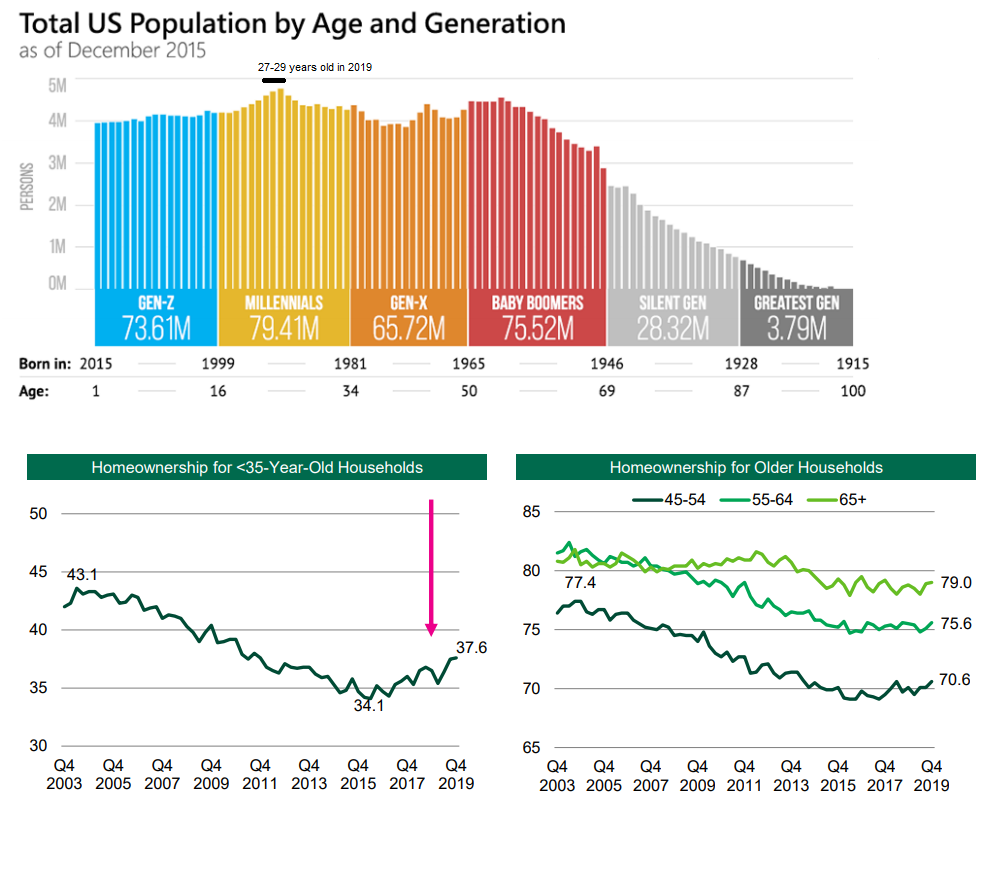
Source: Top panel: U.S. Census Bureau, Knoema. Bottom panel: CBRE Research, homeownership rates not seasonally-adjusted. Author’s rendering based on James Clapp (Certainty Home Loans) and Jeanette I. Rice (CBRE)’s figures.
Figure 2. Internal migration (by millennials)
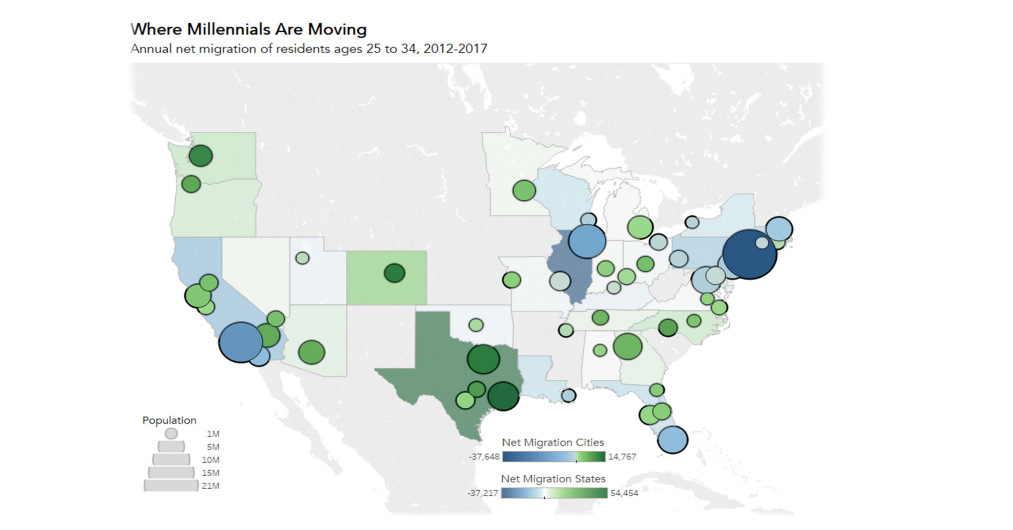
Source: U.S. Census Bureau, First American Financial Corp. Author’s rendering based on Odeta Kushi (First American Financial Corp.)’s figure.
The challenges of housing affordability
To the extent that U.S. and Texas housing have regained their footing over the last decade, Mr. Gaines stated, it certainly has not improved much for the low-price and entry-level segments of the market. Mr. Gaines showed that residential construction in these segments has not recovered relative to its pre-recession peak. The Texas data he reviewed (in itself a microcosm of U.S. housing) shows also that, under $200,000, neither sales nor the supply of vacant developed lots for homes has recovered much. Most significant going forward is that neither have the number of housing starts per capita or building permits in Texas.
Moreover, Ms. Kushi showed that the inventory of new and existing homes for sale is pretty tight in the U.S., at a historic quarter century low. Mr. Gaines indicated that the current months of inventory in Texas is also quite low but particularly so for the low-price segment–in the neighborhood of 2.3 months for homes between $100,000 and $200,000. Similarly, Mr. Nothaft noted that nationally months’ supply for sale by price tier for existing homes is particularly tight for entry-level homes and that new construction is also heavily tilted towards premium (rather than entry-level) home sales across the U.S. Not surprisingly then, one of the main challenges for housing going forward, concluded Mr. Gaines, is how to meet the housing needs in particular of low-income households and new entrants.
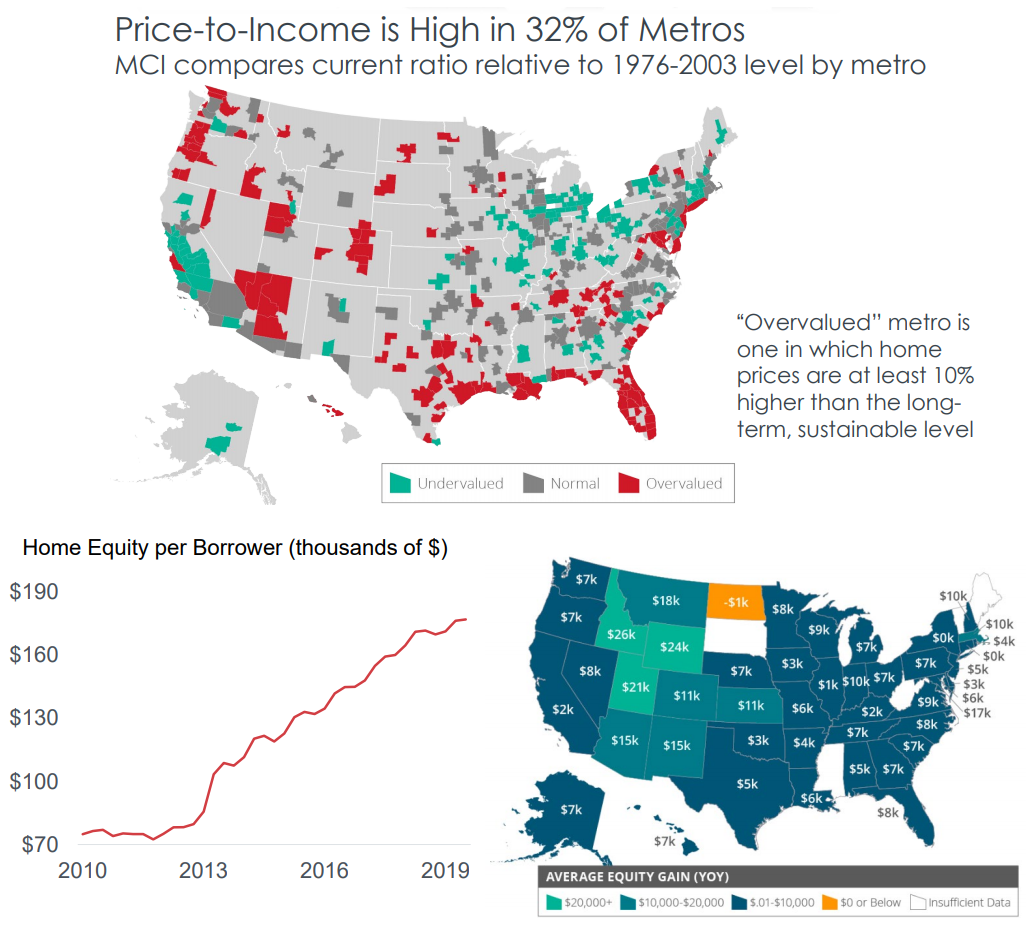
Mr. Gaines also presented evidence that Texas’ median home price growth has almost doubled the state’s median income since 2000. Along the same lines, Mr. Nothaft showed research that CoreLogic had done across all major metropolitan areas in the U.S. gauging the affordability of each metro market. The CoreLogic measure is based on the house price to income ratio relative to its metro-specific sustainable, long-run level. CoreLogic’s findings suggest that house prices have become out of step with incomes for the average household making 32% of all metropolitan statistical areas overvalued as of February 2020 (see top panel of Figure 3). Mr. Nothaft indicated that while no national price bubble can be identified, overvaluation risks and price declines in select areas area a concern.
Moreover, Mr. Nothaft said, the same strong rebound in house prices since 2013 that has worsened affordability has in turn generated large equity gains for homeowners. This housing equity gains have supported household spending—with a record $327 billion spent on home improvement and repairs alone in 2019 (see bottom panel of Figure 3).
Figure 3. Housing affordability in the U.S. and home equity gains
Source: Top panel: CoreLogic Market Condition Indicators (February 4, 2020). Bottom panel: CoreLogic Home Equity Report & Public Records, Joint Center for Housing Studies Leading Indicator of Remodeling Activity. Author’s rendering based on Frank Nothaft (CoreLogic)’s figures.
“Big data”, fintech place in housing finance
Kristopher S. Gerardi (Federal Reserve Bank of Atlanta) forcefully argued for more “big data” at the micro level in finance in order to gauge important risk factors associated with loan portfolios of developers and consumer mortgages. A better understanding of all liens on property including “piggybacks” and home-equity loans (and lines of credit) and about the characteristics of mortgages is critical to assess risks and for financial stability considerations. For instance, Mr. Gerardi argued that lack of data on “piggyback” mortgages, which became common in the 2000s, led to an underestimation of borrower mortgage leverage at origination which was hiding the increasing risks for housing finance prior to the 2008 recession. Lack of data also led to underestimates of certain “risky” mortgage products that facilitated speculation such as interest-only mortgages which we now know accounted for 30-50% of originations during the housing boom period.
Benjamin Navarro (Fannie Mae) noted the importance of government-sponsored enterprise (GSE) reform for the functioning of the markets providing support for housing finance and to ensure credit access for consumers. James Clapp (Certainty Home Loans) seconded the general view that trends in demographics continue to shape the future of housing. However, Mr. Clapp placed the emphasis on some key trends in the financing space and ultimately on the role of technology. Mr. Clapp showed that:
First, refinancing was still going on even as interest rates started to firm up between 2016 and 2019 (but dropping to only around 25% of the market) while purchase volume had been increasing at about 10% yearly during the same period. Second, data on the volume originated shows that about 60% is through retail banking, 10-25% is wholesale (but growing), and the rest accounts for the remaining 20-25% (which tends to be higher during refinancing periods). Independent mortgage bankers (IMBs) play a larger role on the retail side, particularly serving low- and middle-income customers. Third, the estimates show that one of the major loan expense items for lenders nowadays is the tech expense (over $1000 per loan according to the most recent estimates he discussed).
From all of this, Mr. Clapp noted that mid-size banks and large IMBs have seen their per loan costs increase sharply as they play catch up with the large banks who mostly operate with more sophisticated custom-built solutions and are able to spend more on technology. These technology expense numbers, Mr. Clapp argued, reflect the increasing role that technology is playing as a market disruptor. In his view, technology is both a response to and a reason for the continued compression of margins in loan origination. He also noted that the mortgage lending industry is being re-shaped by new technologies and the lenders’ own survival is increasingly dependent on the ability to spend in order to adapt their business models and adopt those technologies—among them, in particular, fintech.
Mr. Clapp also indicated that while disruption used to come from business-to-business (B2B) alternatives, now is in fact more and more about business-to-consumer (B2C) alternatives. B2B disruptors include the likes of Ellie Mae (founded in 1997), Finicity (1999), Black Knight (2008), FormFree (2008), Total Expert (2012), Blend (2012), Lead aggregators, Simplifile, Docutech, etc. And, more recently, the new crop of B2C consumer-direct fintech include much-talked-about startup banks like Varo (1 million customers), Monzo (3 million), Chime (5 million), MoneyLion (5.7 million), Revolut (8 million), Figure, etc.
Rethinking the supply-side of (affordable) housing
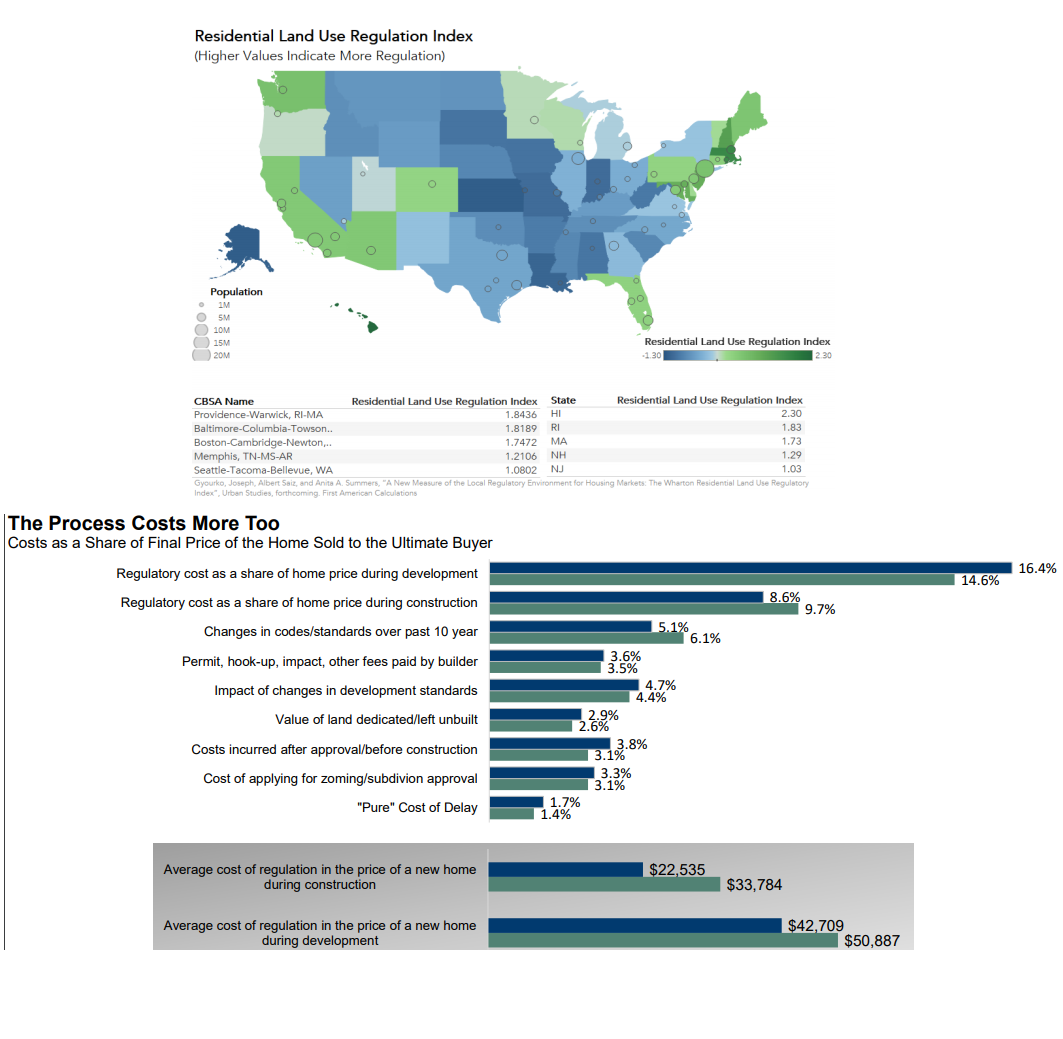
Mr. Nothaft showed that costs of building materials have been increasing more than inflation (lumber and steel, drywall and insulation, plumbing and electrical, and masonry and roofing all outpaced inflation between December 2016 and December 2019). Mr. Gaines showed similar trends for Texas with land values (and also improvement costs) being notably higher on more recent construction. Ms. Kushi argued that labor shortages are partly to blame for the increase in construction costs—the ratio of construction job openings to hires, for instance, has gone up fourfold since 2012. However, she also argued that tighter regulation particularly on residential land use (as can be seen in Figure 4) remains one of the major factors driving overall construction and urban land development costs up. And, in her view, a supply-restricted market ultimately drives up prices and makes housing less affordable.
The concern about regulation is an issue that was echoed and extensively discussed by Paige Shipp (Metrostudy) as well. Ms. Shipp argued that a great deal of this added regulatory burden arises from changes in societal attitudes (notably, NIMBY or Not In My Backyard views) that are becoming more widespread and impacting housing markets at the local level. Related to this, Ms. Rice noted the increasing mismatch between what is affordable and what is desired (which may reflect the desire for higher standards that in part motivates NIMBY regulations) is yet another reason discouraging homeownership among millennials.
Ms. Shipp argued that current market trends in construction are increasingly determined by technology. In Ms. Shipp’s view, the changes are partly organic arising from the need to adapt to a changing environment (NIMBY regulations, etc.) or dictated by the necessity to keep homes affordable (higher density through multifamily and lower square footage).
Ms. Shipp also highlighted how financing for real estate technology developments is booming (with venture-backed capital leading the way forward) driven by the ever-growing need to build quality homes at affordable prices. Changes are, arguably, long overdue since the way houses are being built is basically the same way it was 60 years ago with huge inefficiencies and material waste. Among the most relevant trends arising from technological innovation, Ms. Shipp cited off-site construction (for example, the experiences of BMC, Entekra, Ecocor and Blu Homes) or the growing use of 3D printing. Mr. Navarro similarly alluded in his remarks to the impact on affordability of modular homes and other alternative construction methods.
And, finally, Ms. Shipp argued that change can also come from technologically-enabled disruption—an issue that was cited by Federal Reserve Bank of Dallas President Robert Kaplan in his opening remarks to the conference and that President Kaplan extensively discusses in his work. Some of the disruption can come simply from outside forces, Ms. Shipp noted, citing the example of Berkshire Hathaway’s acquisition of Clayton Homes. Others may come by altering the business model in very fundamental ways. For instance, Ms. Shipp spoke of companies that are getting a lot of traction whose business model is based on removing the agent from the process: Zillow, Opendoor, RedfinNow, Offerpad, Orchard, knock, etc. She also cited on-going efforts to integrate housing in broader sales platforms (Amazon’s recent partnership with Realogy) and even circumvent the builders (start-ups selling pre-fabricated houses through Amazon, etc.).
Concluding remarks
As Pia Orrenius (Federal Reserve Bank of Dallas) said in her closing remarks, much has changed in housing over the past decade and many of the trends discussed at this conference will surely continue to be scrutinized going forward and will be revisited at the next conference in two years. But, certainly, we are living through interesting and challenging times for the U.S. housing sector with still much… room to grow.
Figure 4. The impact of tighter regulation on U.S. housing
Source: Bottom panel: NAHB, First American Financial Corp, Gyourko et al. (forthcoming). Author’s rendering based on Odeta Kushi (First American Financial Corp.)’s figures.
Session 1—Overview of Texas Economy and Housing Markets

From left to right: Keith Phillips (Federal Reserve Bank of Dallas), Harold D. Hunt (Real Estate Center at Texas A&M University), and James P. Gaines (Real Estate Center at Texas A&M University).
Session 2—The Future of Housing Finance

From left to right: W. Scott Frame (Federal Reserve Bank of Dallas), James Clapp (Certainty Home Loans), Benjamin Navarro (Fannie Mae), and Kristopher S. Gerardi (Federal Reserve Bank of Atlanta).
Keynote
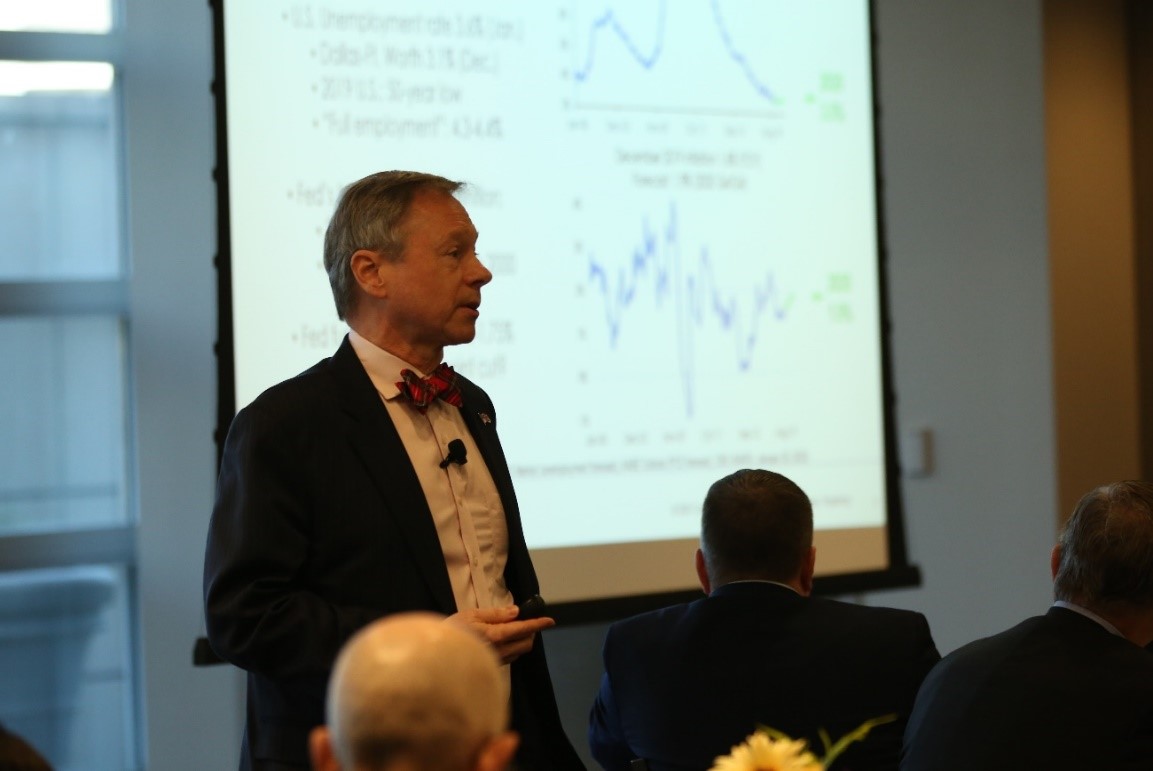
Frank Nothaft (CoreLogic).
Session 3—Housing Trends and Outlook
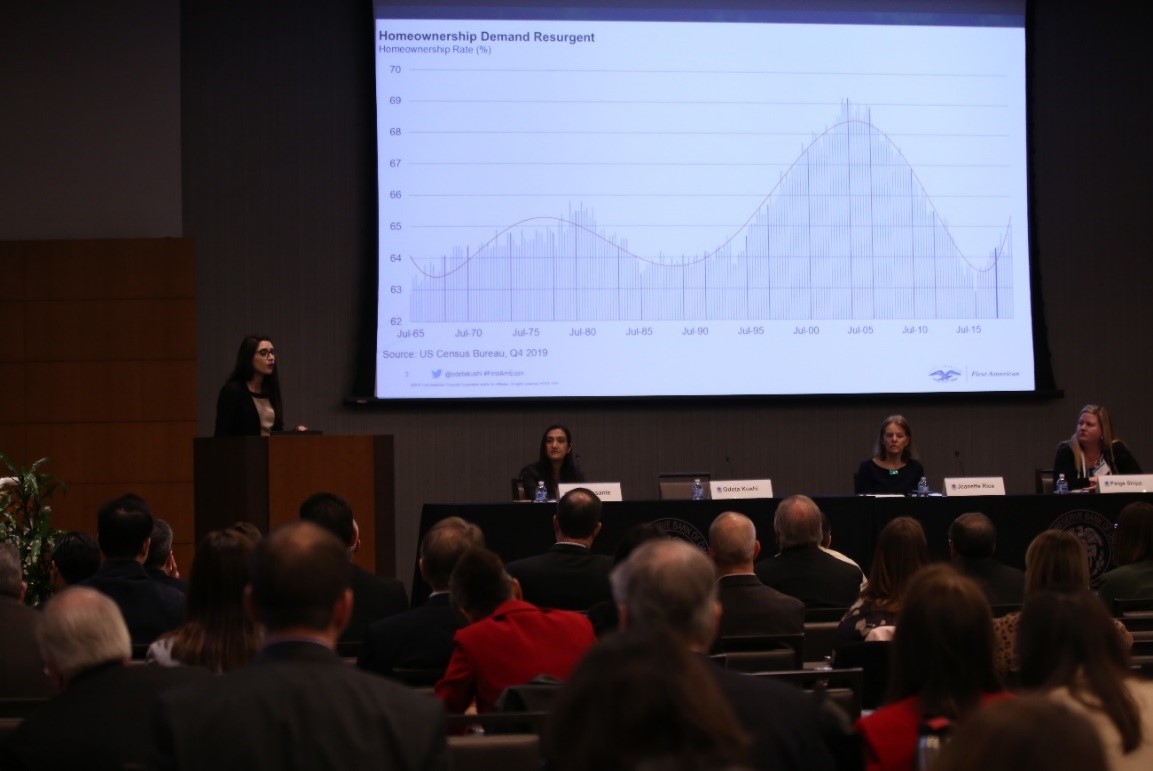
From left to right: Odeta Kushi (First American Financial Corp.), Laila Assanie (Federal Reserve Bank of Dallas), Jeanette I. Rice (CBRE), and Paige Shipp (Metrostudy).
About the Author
Enrique Martínez García is a senior research economist and policy advisor at the Federal Reserve Bank of Dallas. He works on the Federal Reserve Bank of Dallas International House Price Database and on the joint Federal Reserve Bank of Dallas—Lancaster University Management School International Housing Observatory and has done extensive research on topics related to housing. Of particular interest because of their relevance to this conference would be his research on the impact of oil prices on housing (Grossman et al. (2019) and his research on testing and date-stamping breaks due to mildly explosive behavior that can be indicative of unsustainable house prices across metro areas in Texas and the U.S. (Grossman et al. (2016) and Grossman et al. (2019)). Martínez García thanks Valerie Grossman (Federal Reserve Bank of Dallas) and Luis Bernardo Torres (Real Estate Center at Texas A&M University) for their helpful suggestions and feedback.
Global Housing Watch Newsletter: March 2020
* Below is a conference summary on the US housing market prepared by Enrique Martínez García (Federal Reserve Bank of Dallas). The event was co-sponsored by the Real Estate Center at Texas A&M University and the Federal Reserve Bank of Dallas. The views expressed in this summary are those of the author and do not necessarily reflect the views of the Federal Reserve Bank of Dallas or the Federal Reserve System.
Posted by at 5:00 AM
Labels: Global Housing Watch
Subscribe to: Posts