Showing posts with label Global Housing Watch.   Show all posts

Housing Market in Ireland

From the IMF’s latest report on Ireland:

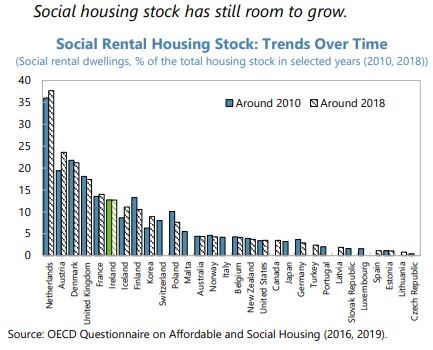
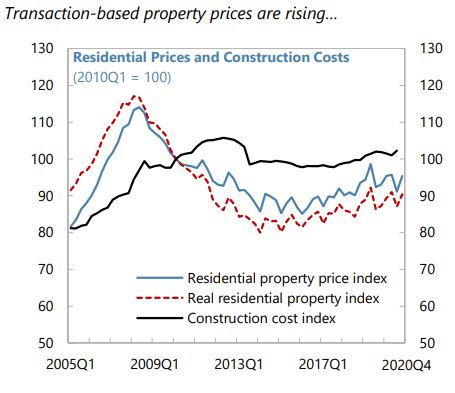
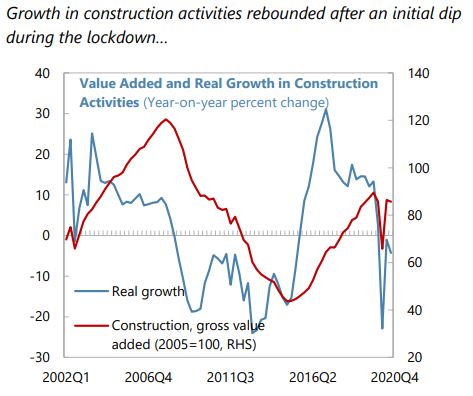
“Well-targeted macroprudential measures contained the build-up of vulnerabilities in the housing market and helped stabilize prices, but supply shortages and affordability concerns are on the rise. The initial dampening impact of COVID on the housing market was followed by a robust recovery in H2:2020, with the overall fall in residential construction only at 2 percent in 2020, which was largely due to the stringent first lockdown. To ease the dampening impact of the third lockdown on housing construction, the Health Regulations allowed for the designation of certain social housing projects as essential projects13, however, the housing supply-demand gap will likely widen further in the pandemic aftermath. After a small decline in H1:2020, house prices started to grow as demand exceeded supply. If an increasing part of household pandemic savings is directed to the housing market it could put further upward pressure on house prices.

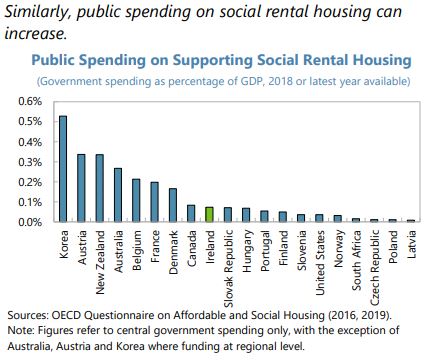
Reducing shortages in affordable housing requires a multi-pronged approach. The government’s effort in this regard is welcome but more needs to be done by (i) releasing more land for development, (ii) streamlining approval processes for permits and re-zoning, (iii) assessing incentives to build rental properties, and (iv) increasing supply, including of social housing. The establishing of the Land Development Agency is a step in the right direction. On the other hand, policies should resist stimulating demand further given the existing supply-demand imbalances, and avoid resorting to short-term solutions such as relaxing prudential regulations to enable households to borrow more and the program to subsidize home purchase needs to be carefully designed and remain limited in size in order to minimize risks to the financial sector.

(…)

The authorities reiterated their commitment to address the housing and climate change challenges. They noted the progress towards improving housing supply and affordability through a comprehensive policy package, including the Help-to-buy Program, National Cost Rental Policy, and Land Development Agency (LDA) Bill, that provides a permanent basis to increase the supply of social and affordable homes and promote optimal use of State land. The recently legislated Affordable Housing Bill includes a 10 percent affordable housing requirement on new developments in addition to the existing requirement for 10 percent social housing. The authorities highlighted the recently legislated carbon tax increase, with a trajectory to 2030, and the ring-fenced use of the projected revenues of €9.5 billion for investment in energy efficiency, just transition, and low-emission agriculture. Additionally, the National Home Retrofit Scheme provides incentives for homeowners to improve their energy rating with 35 to 50 percent grant elements.”

From the IMF’s latest report on Ireland:

“Well-targeted macroprudential measures contained the build-up of vulnerabilities in the housing market and helped stabilize prices, but supply shortages and affordability concerns are on the rise. The initial dampening impact of COVID on the housing market was followed by a robust recovery in H2:2020, with the overall fall in residential construction only at 2 percent in 2020, which was largely due to the stringent first lockdown.

Read the full article…

Posted by at 3:54 PM

Labels: Global Housing Watch

Housing Market in Cyprus

From the IMF’s latest report on Cyprus:

“Nevertheless, challenges are building. Nearly half of legacy NPLs were terminated five years earlier, potentially requiring sizable write-downs (Annex VI). Foreclosures have been suspended until end-July for smaller, collateralized loans and proposals under discussion in Parliament are expected to weaken the framework (¶22, third bullet). More than 80 percent of bank loans are to highly leveraged households and SMEs, concentrated in sectors like accommodation, food and retail, implying a high risk of an escalation of default rates and lower recovery value of assets after the expiry of loan repayment and foreclosure moratorium (Box 1). Banks are also exposed to property market risks through real estate holdings and collateral valuation. Although regulatory forbearance and fiscal support have prevented an immediate surge in loan impairments, a new wave of defaults as loan repayment obligations resume amidst tapering fiscal support could quickly consume the capital buffers of banks. Based on a stylized scenario with a 10 percent increase10 in NPLs that would push the latter to some 19.5 percent of total loans from the current 17.7 percent, staff estimates that restoring capital and provisions to pre-pandemic levels would entail capital needs of 1.5 percent of GDP.

(…)

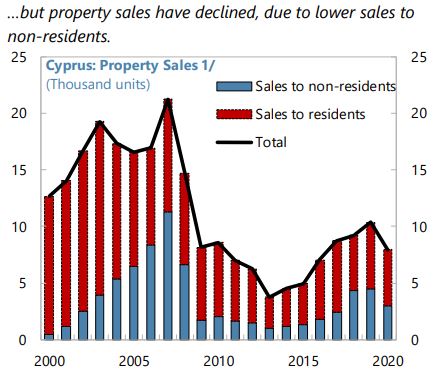
Macro-financial risks from possible declines in property prices should be closely monitored, especially given the continued active use of debt-to-asset swaps in NPL resolution by banks and CACs. Risks appear limited for now given stable residential price developments (Text Figure 5 and Figure 8) and limited size of commercial real estate transactions. To ensure proper collateral valuation, results of actual sales transactions of repossessed collateral properties should be used by banks and CACs to review adequacy of valuation methodologies of these assets. Supervisory guidance to prevent excessive holding of repossessed collateral assets by banks should be maintained.”

From the IMF’s latest report on Cyprus:

“Nevertheless, challenges are building. Nearly half of legacy NPLs were terminated five years earlier, potentially requiring sizable write-downs (Annex VI). Foreclosures have been suspended until end-July for smaller, collateralized loans and proposals under discussion in Parliament are expected to weaken the framework (¶22, third bullet). More than 80 percent of bank loans are to highly leveraged households and SMEs, concentrated in sectors like accommodation,

Read the full article…

Posted by at 3:27 PM

Labels: Global Housing Watch

Housing Market in Denmark

From the IMF’s latest report on Denmark:

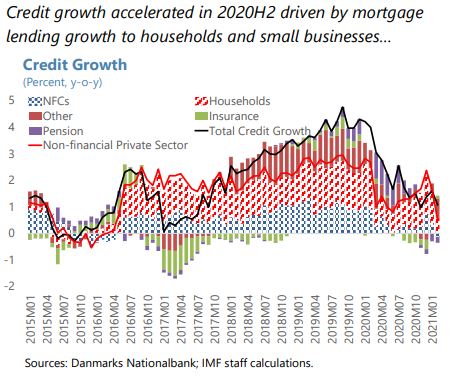
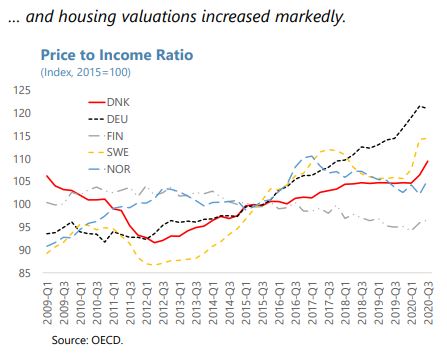
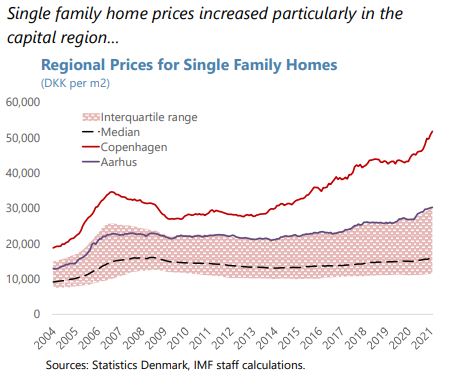
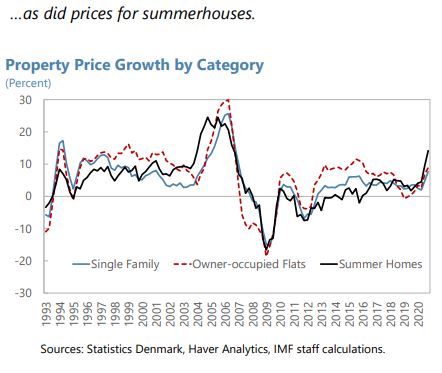
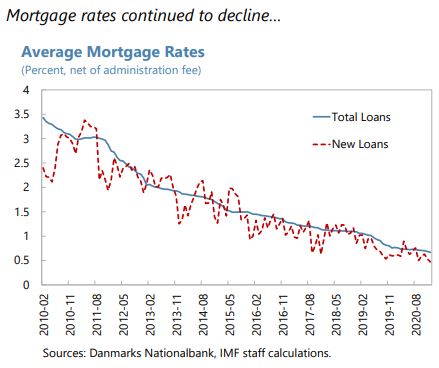
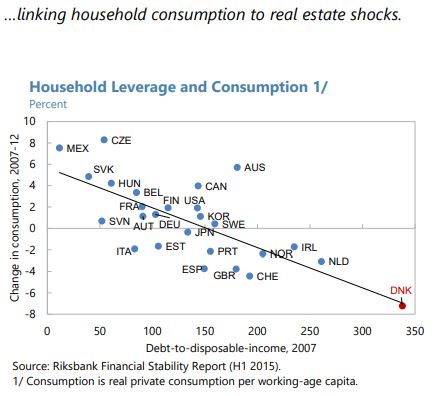
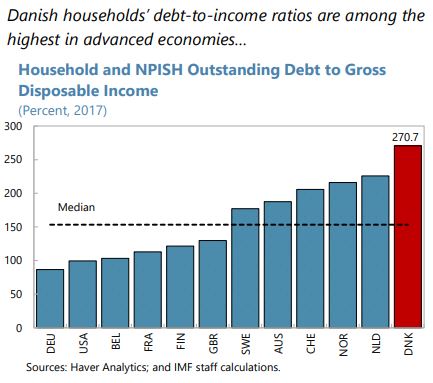
“Credit to households and house price growth accelerated during the pandemic. Before the pandemic, household leverage was high. Credit growth stalled at the onset of the pandemic but strongly recovered in 2020H2, driven primarily by mortgage lending. Residential property prices rose sharply in 2020H2, particularly for summer-houses, likely partially influenced by a temporary increase in tax deductions for summerhouse owners (…).

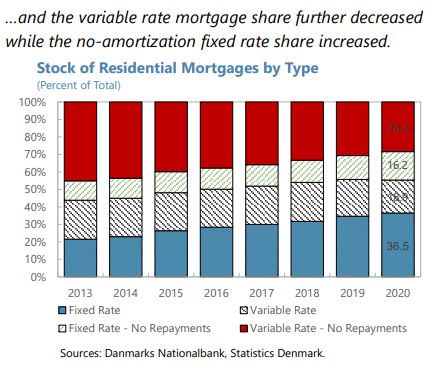
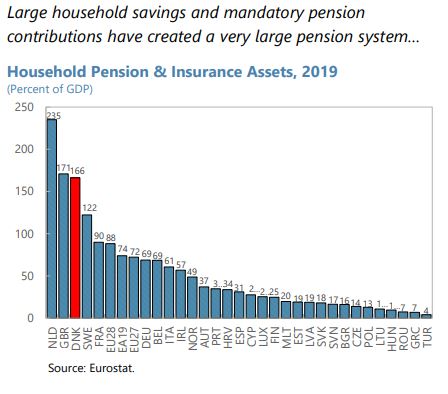
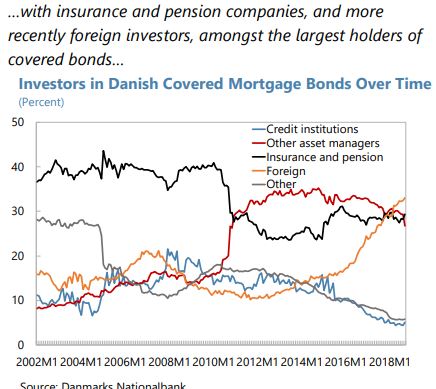
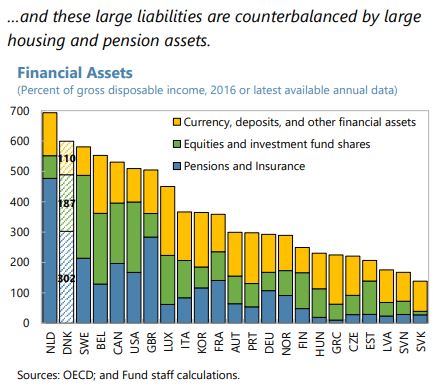
Macrofinancial vulnerabilities due to high and increasing household leverage amid high house valuations warrant close monitoring. High debt, combined with illiquid assets (concentrated in real estate via housing and pension assets) exposes households to price and interest rate shocks that can impact their balance sheet asymmetrically and spillover to aggregate demand. Continued strong house price growth increases the likelihood of a revaluation that could harm highly-leveraged households, particularly those who purchased in overvalued urban areas and low-income households. These vulnerabilities are compounded by the still large proportion of variable-rate and interest-only mortgages in the system (…). Moreover, MCIs and pension and insurance companies are highly interconnected and dependent on the health of the housing sector.

Recent developments warrant tightening prudential tools while deploying coordinated tax and housing supply policies.

–Macroprudential policy. The authorities should shift focus toward income-based measures, including tightening debt-to-income (DTI), LTI, and debt-service-to-income caps would help address high leverage and encourage faster amortization, as loan-to-value (LTV) constraints are less binding in the current environment with high house price growth. The authorities should tighten DTI restrictions for all loans, irrespective of their LTV ratios. DTI caps could be differentiated based on borrowers’ riskiness. Highly-leveraged households should be subject to mandatory amortization, regardless of maturity- and rate-type (SIP 2018). Tighter limits on income-based measures for interest-only and floating-rate mortgages or higher minimum down-payment requirements should also be considered. The proposed risk-based prudential framework could be combined with the macroprudential setup to facilitate calibration of these measures, especially for lower risk groups, e.g., first-time home buyers.

–Tax policy. The tax treatment of owner-occupied housing remains favorable relative to other savings and compared to most OECD countries. Taking advantage of the current low rate environment, MID should be reduced in a manner consistent with the overall tax framework.48 Staff recommend prioritizing reforms to better link property taxes to current market valuations. Balancing tax incentives for pension contributions could release resources for larger down-payments.

–Housing supply. Rent controls in Denmark are high relative to peer countries and should be reduced to stimulate the rental market, while protecting the interests of the most vulnerable. Review of urban area restrictions on the size of new apartments should continue to improve demand-supply mismatches. Streamlined zoning and planning procedures across municipalities could increase supply, thereby alleviating price pressures.”

From the IMF’s latest report on Denmark:

“Credit to households and house price growth accelerated during the pandemic. Before the pandemic, household leverage was high. Credit growth stalled at the onset of the pandemic but strongly recovered in 2020H2, driven primarily by mortgage lending. Residential property prices rose sharply in 2020H2, particularly for summer-houses, likely partially influenced by a temporary increase in tax deductions for summerhouse owners (…).

Macrofinancial vulnerabilities due to high and increasing household leverage amid high house valuations warrant close monitoring.

Read the full article…

Posted by at 4:05 PM

Labels: Global Housing Watch

U.S. Housing Markets and the COVID-19 Crisis: EconoFact

“From EconoFact: The perception of falling prices of single-family homes and record levels of unemployment raise the specter of rising levels of mortgage defaults. Mortgage defaults in the wake of the economic and financial collapse in the Fall of 2008 contributed to the tepid economic recovery from that crisis, as well as personal hardship for those who lost their houses; by 2010, approximately 11.5 percent of single-family residential mortgages were delinquent and more than 2 percent were in foreclosure. There are concerns that similar developments now could derail economic recovery. But drawing parallels between 2020 and 2008 is problematic because conditions differ substantially across the two periods in the run-up to the crisis and in its first few months.” See full brief by Jeff Zabel.


“From EconoFact: The perception of falling prices of single-family homes and record levels of unemployment raise the specter of rising levels of mortgage defaults. Mortgage defaults in the wake of the economic and financial collapse in the Fall of 2008 contributed to the tepid economic recovery from that crisis, as well as personal hardship for those who lost their houses; by 2010, approximately 11.5 percent of single-family residential mortgages were delinquent and more than 2 percent were in foreclosure.

Read the full article…

Posted by at 9:55 AM

Labels: Global Housing Watch

A Look at Demographia’s Latest Housing Affordability Survey

Global Housing Watch Newsletter: April 2020


*In this interview, Wendell Cox talks about Demographia’s latest housing affordability . Wendell Cox is an American urban policy analyst and academic. He is the principal of Demographia (Wendell Cox Consultancy). The survey is co-authored with Hugh Pavletich of Performance Urban Planning.


Hites Ahir: You recently released the 16th Annual Demographia International Housing Affordability Survey: 2020. Tell us about the housing affordability measure used in the survey.

Wendell Cox: Demographia uses the “median multiple,” which is the median house price divided by the median household income. This measure meets two important requirements for assessing middle-income housing affordability; it evaluates the relationship between housing costs and household incomes, and it measures the middle of the market.


Hites Ahir: How does your measure compare to other existing measures?

Wendell Cox: Demographia presents current housing affordability between markets as well as in an historical context. This may be the most important difference with other measures, which often consider only recent experience, limited to only a few years or a decade or two.

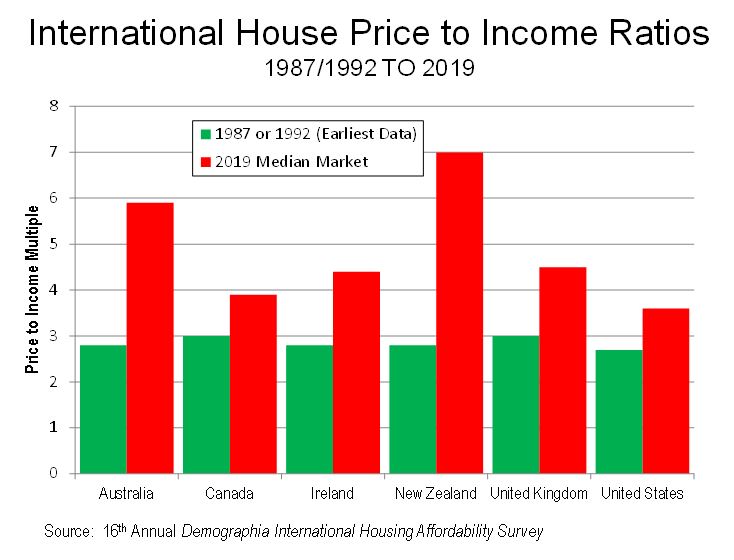
In many metropolitan markets, housing affordability has deteriorated significantly in the last three decades, from a time that in many nations the median multiple was 3.0 or below.


Figure 1.
Hites Ahir: Which countries and cities does it cover?

Wendell Cox:The Survey includes Australia, Canada, China (Hong Kong), Ireland, New Zealand, Singapore, the United Kingdom and the United States. The principal focus is on the more than 90 major housing markets areas (metropolitan areas) with more than 1,000,000 residents. More than 200 additional smaller markets are also included.


Hites Ahir: What is the overall message from the latest survey?

Wendell Cox: The message of this edition as well as the entire series is that governments should closely monitor housing affordability, to position themselves to restore it where it has been lost and maintain it where it remains.

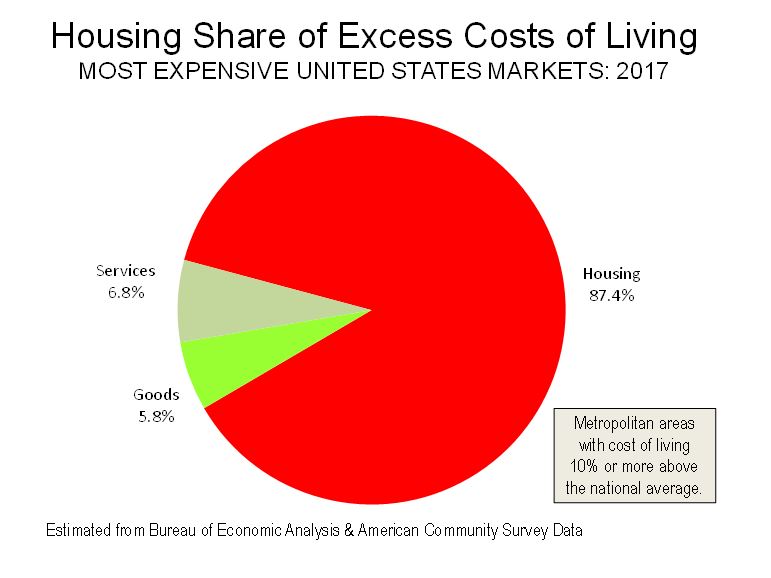
The costs of housing largely define differences in the cost of living and thus, the standard of living. In the United States, we estimate that 87 percent of the excess cost of living in higher cost metropolitan areas is comprised of housing costs.

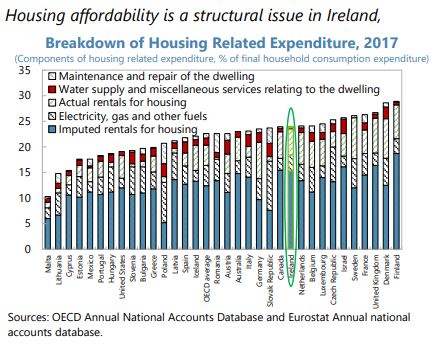
This is an international problem, as is indicted in recent Organisation for Economic Cooperation and Development (OECD) research, Under Pressure: The Squeezed Middle-Class, suggests an existential threat to the middle-class in OECD countries. According to the OECD, the costs of living have risen much more rapidly than household incomes over the past three decades.  Housing, according to the OECD, has been “the largest spending category” and “has been the main driver of rising middle-class expenditure in recent decades.” According to the OECD, owned housing costs have contributed more to the problem than those of rentals, though rental cost increases have been significant.


Figure 2.
Considerable economic research has associated diminished housing affordability with more restrictive land use regulation. In the Demographia Survey, virtually all of the major housing markets that are “severely unaffordable” have urban containment (such as urban growth boundaries and other policies that severely limit or prohibit new development on the urban fringe).

Research in Australia, New Zealand, the United Kingdom and the United States has found comparable land values spiking 10 times and more across urban growth boundaries. Within the San Francisco metropolitan area, economists Edward Glaeser of Harvard and Joseph Gyourko of the University of Pennsylvania found land values for median value houses were “roughly 10 times” the “minimum profitable production cost.” This is in a market stretching across five counties, with ample suitable land, nearly all of it off-limits to development.

There is need for reform, and we cite Paul Cheshire, Max Nathan and Henry Overman of the London School of Economics who suggest that urban planning should focus on “people rather than places.” Part of the solution, according to former World Bank principal planner Alain Bertaud, is to apply “basic economic principles to the practice of urban planning.”


Hites Ahir: How does the findings of this editions compare to the past editions?

Wendell Cox: We have reported on the commitments made by New Zealand’s Labour government to make major land use policy revisions to restore housing affordability and establish effective infrastructure finance mechanisms.

We have also focused on subsidized low-income housing and the extent to which its cost and availability is driven by market housing costs. Because housing subsidies are typically based on ability to pay, deteriorating housing affordability compromises the ability of government to provide for low income housing.


Hites Ahir: In the current issue of the survey, you talk about Singapore. Could you talk to us about “Singapore’s unequalled housing challenge”?

Wendell Cox: Singapore is a city-state confined to an island that has virtually no hinterland in which inexpensive housing development can occur. Yet this topographically contained market has housing affordability considerably better than many markets that have administratively imposed urban containment.

Singapore designed a market that kept house price increases under control, despite the shortage of land. It started with a commitment, more than a half-century ago, to “(…) encourage a property-owning democracy in Singapore and to enable Singapore citizens in the lower middle-income group to own their own homes.” The mandate was assigned to the Housing Development Board (HDB) which has delivered on the objective.

Singapore’s model for the world is not so much the characteristics of its market, as it is having adopted a fundamental objective of housing affordability and focusing on its achievement.


Hites Ahir: How is the ongoing crisis related to Covid-19 likely to affect next year’s survey?

Wendell Cox: Obviously, the economic decline from the lockdowns will make things worse, and probably more for the middle-income households we focus on. Lower-income households are likely to be impacted even more. Housing affordability seems more likely to worsen than to stay the same or improve.
Global Housing Watch Newsletter: April 2020


*In this interview, Wendell Cox talks about Demographia’s latest housing affordability . Wendell Cox is an American urban policy analyst and academic. He is the principal of Demographia (Wendell Cox Consultancy). The survey is co-authored with Hugh Pavletich of Performance Urban Planning.


Hites Ahir: You recently released the 16th Annual Demographia International Housing Affordability Survey: 2020.

Read the full article…

Posted by at 5:00 AM

Labels: Global Housing Watch

Newer Posts Home Older Posts

Subscribe to: Posts