Showing posts with label Global Housing Watch. Show all posts
Friday, January 18, 2013
House Prices in Hong Kong
Two different pricing models are examined, which provide some mild, but on balance inconclusive, evidence that prices are higher than suggested by current fundamentals.
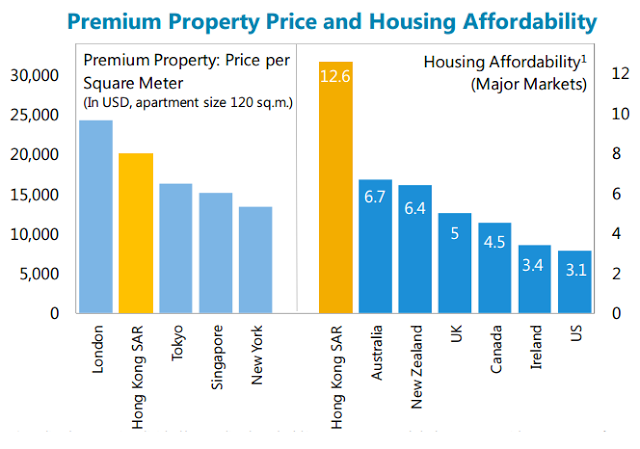
Housing in Hong Kong SAR is expensive. Compared to other regions, house prices in Hong Kong SAR are less affordable as measured by the ratio of median household income to median house price. In absolute terms, U.S. dollars per square meter, prices are also relatively expensive and premium real estate prices are on par or higher than in other high-cost housing.
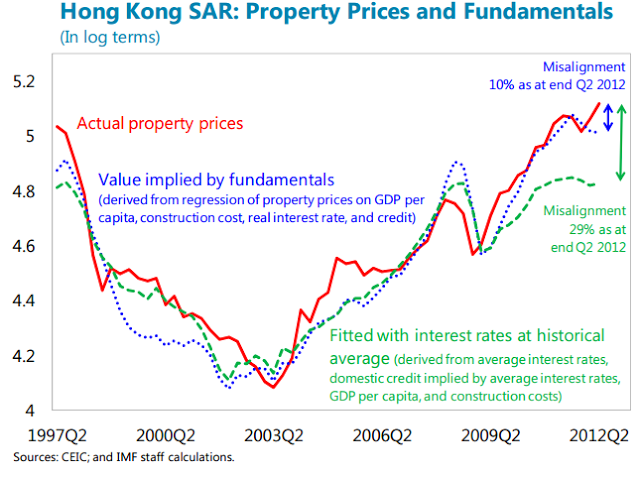
A regression-based approach indicates prices are about 10 percent above the level suggested by current macroeconomic fundamentals.However, the fundamentals themselves are in some sense abnormal, as loose global monetary conditions have pushed down considerably Hong Kong SAR’s real interest rate. The real interest rate, moreover, is a key driver of housing prices in the model. To illustrate the impact of the eventual normalization of global monetary conditions, the regression estimates were used to calculate the price that would prevail if the real interest rate was at its 2003–07 average, with a concomitant change to credit. This exercise suggests that housing prices are some 30 percent higher than they would be if Hong Kong SAR’s real interest rate returned to the 2003–07 average. An asset pricing model, however, finds that prices are broadly consistent with fundamentals. The model compares the market price with a benchmark based on an equilibrium relationship between prices, rents, and cost of ownership. The basis for assessing misalignment from fundamentals is that the cost of owning a house (imputed rent) should be the same as the cost of renting a similar house for the same time period. By this measure, smaller-sized flats are found to be some 7 percent above the benchmark while the luxury end of the market is found to be slightly below the corresponding benchmark.
From the latest IMF’s report on Hong Kong’s economy:
Two different pricing models are examined, which provide some mild, but on balance inconclusive, evidence that prices are higher than suggested by current fundamentals.
Housing in Hong Kong SAR is expensive. Compared to other regions, house prices in Hong Kong SAR are less affordable as measured by the ratio of median household income to median house price. In absolute terms, U.S. dollars per square meter,
Posted by at 12:41 PM
Labels: Global Housing Watch
Saturday, December 29, 2012
House Prices in France
According to a new report, “Macroeconomic risks related to a correction in real estate prices appear to be relatively contained. The increase in housing prices (over 100 percent in real terms since the mid 1990s) has been supported by stronger fundaments (higher population growth, relatively low supply of housing, and low household indebtedness) than in other countries with rising real estate prices, but also by tax incentives that have fueled demand without addressing underlying supply constraints. There is a perception of price overvaluation, especially in Paris (by 10-20 percent at end-2011 according to staff estimates). However, there is no housing glut or household debt overhang that could trigger a sudden price adjustment. Moreover, stress tests suggest that banks are well placed to absorb the impact of a possible sizable price adjustment owing to tight underwriting criteria (emphasizing sustainability of the borrower’s income, not collateral value) and the absence of nonrecourse loans. The impact of a possible price correction on private demand would also be contained reflecting weak evidence of wealth effects on consumption.”
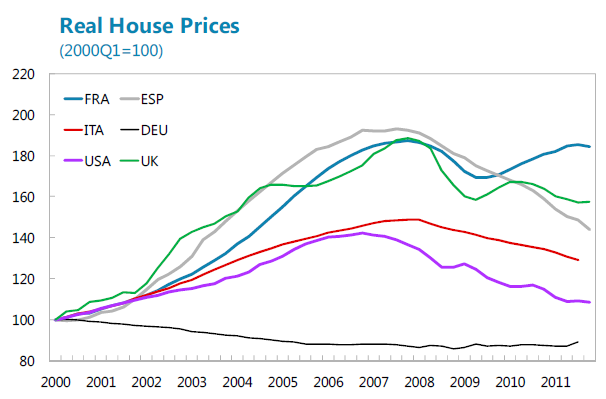
According to a new report, “Macroeconomic risks related to a correction in real estate prices appear to be relatively contained. The increase in housing prices (over 100 percent in real terms since the mid 1990s) has been supported by stronger fundaments (higher population growth, relatively low supply of housing, and low household indebtedness) than in other countries with rising real estate prices, but also by tax incentives that have fueled demand without addressing underlying supply constraints.
Posted by at 10:25 PM
Labels: Global Housing Watch
Friday, December 28, 2012
Macroprudential Policies and Housing Prices
Several countries in Central, Eastern and Southeastern Europe used a rich set of prudential instruments in response to last decade’s credit and housing boom and bust cycles. A new paper collects detailed information on these policy measures in a comprehensive database covering 16 countries at a quarterly frequency. The authors use this database to investigate whether the policy measures had an impact on housing price inflation. Their evidence suggests that some—but not all—measures did have an impact. These measures were changes in the minimum CAR and non-standard liquidity measures (marginal reserve requirements on foreign funding, marginal reserve requirements linked to credit growth).
Several countries in Central, Eastern and Southeastern Europe used a rich set of prudential instruments in response to last decade’s credit and housing boom and bust cycles. A new paper collects detailed information on these policy measures in a comprehensive database covering 16 countries at a quarterly frequency. The authors use this database to investigate whether the policy measures had an impact on housing price inflation. Their evidence suggests that some—but not all—measures did have an impact.
Posted by at 12:43 AM
Labels: Global Housing Watch
Friday, September 21, 2012
House Prices in Korea
“Housing prices have peaked in Seoul but are rising in the rest of Korea,” according to a new report from the IMF. The report says that “following a protracted period of rising prices, housing prices in Seoul have remained weak due to a still large, albeit declining, inventory of unsold homes and limited expectation of price appreciation. The steady rise in housing prices outside Seoul (which have moderated recently) has been supported by contracting supply, a rapid increase in rents, and a rise in demand supported by strong non-bank lending. In response to the weakness in the Seoul housing market, the authorities have relaxed regulations in May 2012, including by raising loan-to-value (LTV) and debt-to-income (DTI) ratios applied to some high-house price districts.”
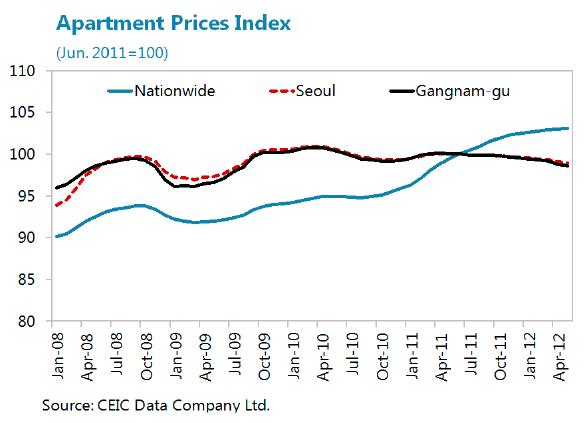
“Housing prices have peaked in Seoul but are rising in the rest of Korea,” according to a new report from the IMF. The report says that “following a protracted period of rising prices, housing prices in Seoul have remained weak due to a still large, albeit declining, inventory of unsold homes and limited expectation of price appreciation. The steady rise in housing prices outside Seoul (which have moderated recently) has been supported by contracting supply, a rapid increase in rents, and a rise in demand supported by strong non-bank lending.
Posted by at 1:46 PM
Labels: Global Housing Watch
Monday, September 17, 2012
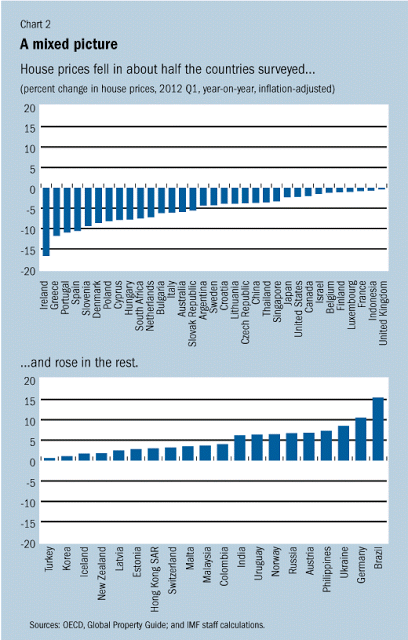
Global House Prices Still Showing Down Trend
- Prices still falling in roughly half of 54 countries tracked around world
- Brazil, Germany among countries seeing house prices rise
- Within United States, housing picture varies considerably
Price trends vary widely between countries, with Ireland, Greece, Portugal, and Spain seeing the biggest falls in the past year and Brazil and Germany, substantial increases.
While overall the trend is mixed, there is no sign of an uptick in the global index of house prices, a weighted average of prices in 54 countries, according to our research. The index remained level during the second quarter of 2012—the latest quarter for which consistent data is available for a large group of countries—and the GDP-weighted index continued to decline. Continue reading here.
- Prices still falling in roughly half of 54 countries tracked around world
- Brazil, Germany among countries seeing house prices rise
- Within United States, housing picture varies considerably
House prices in the United States have started to pick up a little recently, but globally prices are still on a down trend, according to research by the International Monetary Fund (IMF).
Price trends vary widely between countries, Read the full article…
Posted by at 8:43 PM
Labels: Global Housing Watch
Subscribe to: Posts