Showing posts with label Global Housing Watch. Show all posts
Friday, May 6, 2016
Housing Sector Developments in Australia and New Zealand: Diverging Tales
House prices in Australia and New Zealand have more than doubled in real terms since 1990, rising substantially faster than the Organisation for Economic Co-operation and Development (OECD) average (Figure 1.1.1). This increase has often been attributed to the liberalization of their banking systems during the 1980–90s and the transition to lower interest rates in the last decade (see Hunt 2015; Ellis 2005). The rise in house prices has been accompanied by a sharp increase in household debt, with debt-to-income ratios roughly tripling since the 1990s in both countries and mortgage debt accounting for a substantial share of the total. Household debt-to-income ratio is a key variable from a financial stability and macroeconomic risk perspective as it reflects the risks borne by households and the possible amplification of house price declines to the macro economy (Debelle 2004; April 2014 Regional Economic Outlook: Asia and Pacific, Chapter 2).

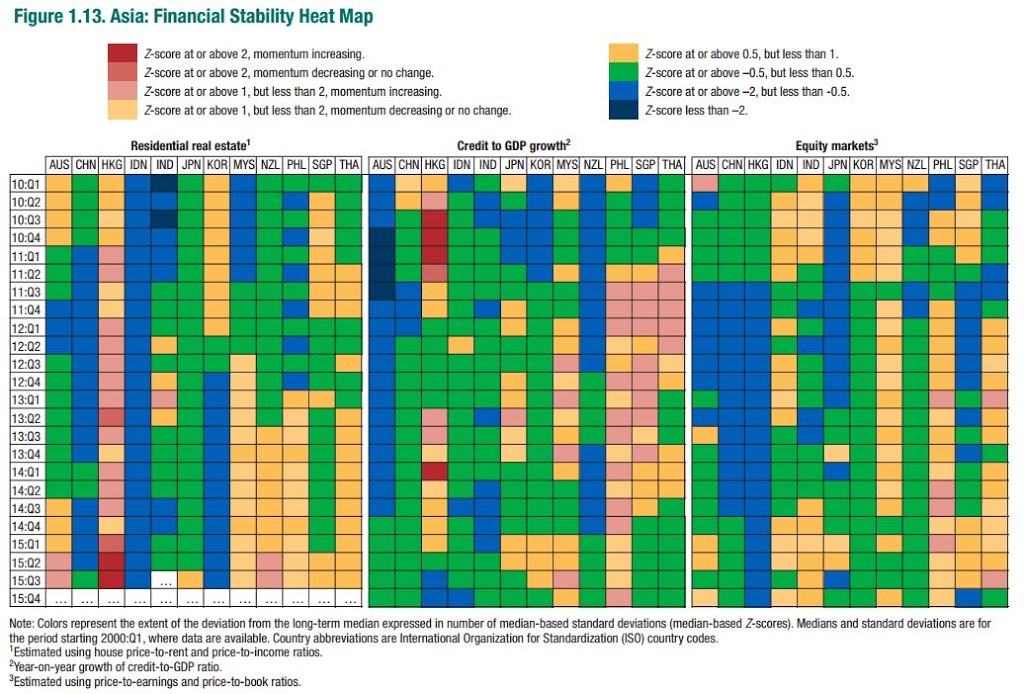
The housing market in both Australia and New Zealand appears to reflect moderate overvaluation. Valuation ratios such as price to income are now above historical norms. While some of that is expected given low interest rates (allowing higher debt to be serviceable), other fundamental factors such as income per capita, interest rates, and working-age population suggest moderate overvaluation (see IMF 2015a, 2016c). The financial stability heat map also suggests that prices are currently higher than recent trends (Figure 1.13).
Concerns about house price inflation have been prominent for well over a decade and have triggered regulatory and prudential responses. Recently, the authorities in both countries have stepped up measures. In October 2013, the Reserve Bank of New Zealand (RBNZ) placed a temporary “speed limit” on high loan-to-value ratio (LVR) residential mortgage lending, whereby banks must restrict new mortgages at LVRs more than 80 percent to no more than 10 percent of their total residential mortgage lending. Although house price inflation in Auckland initially moderated in response to the measures (and tighter monetary policy), it has subsequently accelerated. In May 2015, the RBNZ announced additional measures (effective November 2015): (1) residential property investors (though not owner-occupiers) in Auckland are required to have a deposit of at least 30 percent; (2) the existing 10 percent speed limit for loans at high LVRs is retained in Auckland, while it is increased elsewhere to 15 percent to reflect the more subdued housing market conditions there; (3) a new class for loans to residential property investors was established and expected to attract a higher risk weighting than owner-occupier mortgages; (4) the 2015/16 budget introduced a new property sales tax for nonprimary residences that are bought and sold within two years; and (5) the government announced a tightening of reporting and taxation rules for foreign buyers.
The Australian Prudential Regulatory Authority (APRA) has stepped up its supervisory intensity through a gradual and targeted approach. It advised banks in December 2014 that it would focus on higher-risk mortgage lending (interest-only and high loan-to-income or loan-to-value ratios), issuing guidelines to limit growth of investor lending to 10 percent a year, and strengthening loan affordability. In response to the recommendations of the Financial Sector Inquiry, APRA announced that large banks would need to hold more capital against residential mortgage exposures by raising the average risk weight (to 25 percent) for large banks. Recent data suggest that house price inflation is gradually responding to the regulatory measures, but it is too early to assess whether such inflation is at more sustainable rates.
Can the banking sector withstand a housing downturn? Four large Australian-owned banks account for the bulk of banking sector assets in both Australia and New Zealand. Against this background, the authorities in both countries have collaborated on stress testing, including a combined scenario with a severe downturn in the housing market (40 percent cumulative decline) (APRA 2014). While this extreme scenario would have a substantial adverse impact on profitability and capital ratios, with losses on residential mortgages accounting for about one-third of total credit losses, minimum capital requirements are not breached. However, banks with substantially reduced capital ratios would be constrained in their ability to raise funding, impacting credit growth and aggregate demand.
From the IMF’s Regional Economic Outlook: Asia and Pacific:
House prices in Australia and New Zealand have more than doubled in real terms since 1990, rising substantially faster than the Organisation for Economic Co-operation and Development (OECD) average (Figure 1.1.1). This increase has often been attributed to the liberalization of their banking systems during the 1980–90s and the transition to lower interest rates in the last decade (see Hunt 2015; Ellis 2005).
Posted by at 9:00 AM
Labels: Global Housing Watch
Thursday, May 5, 2016
Housing Market in Malaysia

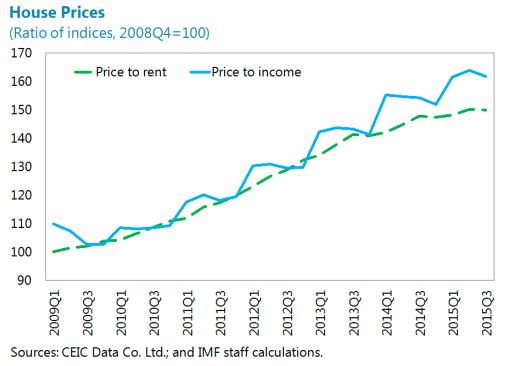
“Household debt has increased by 15 percentage points of GDP since end-2009 but growth has begun to moderate as of late (…). Close to 50 percent of the debt is owed on residential property and about 60 percent are variable rate loans. Macroprudential measures have helped to curb household borrowing (…). The impact of measures continues to be felt and the reduced loan applications and approvals reflect in part an enhanced framework for risk-based pricing of loans. Read the full article…
Posted by at 9:00 AM
Labels: Global Housing Watch
Wednesday, May 4, 2016
House Prices in Hungary
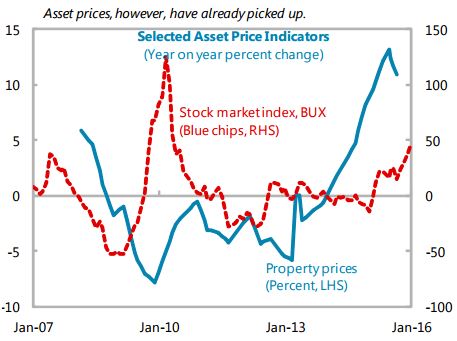
“(…) since the crisis, estimates based on the MVF2 [the multivariate filter with financial frictions] have been higher than those by other methods, suggesting that house prices and credit have been particularly low relative to potential levels,” according to IMF’s report on Hungary.
Posted by at 6:02 PM
Labels: Global Housing Watch
Monday, April 25, 2016
Understanding the Commercial Real Estate Investment Ecosystem
Turns in the economy take economists, even the best of them, by surprise. In late-August 1990, Alan Greenspan, then chairman of the Federal Reserve, said that “those who argue that we are already in a recession are reasonably certain to be wrong”—of course, the recession had already begun. His successor, Ben Bernanke, predicted in 2007 that the “subprime problem [in the housing sector] is contained.” Yet, without forecasts, as this excellent new report from the World Economic Forum notes, we would be driving a car “while looking only in the rear view mirror rather than through the windscreen.”
There are few economic forecasts more important than those of the real estate sector. As Ed Leamer has said, “housing is the cycle.” Collapses in this sector have been associated with severe crises, including the global financial crises of recent years. While this crisis increased the spotlight on the residential sector, much less is known about the commercial real estate sector.
This report is thus welcome for the information it provides on the commercial real estate ecosystem—the main players and their motives. But the report is far more ambitious. Its goal is to provide an early warning system for commercial real estate crashes. Moreover, the intent is to build a system that can be scaled up to the global level—it is currently applied to 10 U.S. cities— and also applied to other asset classes, including the residential real estate sector.
So, does the effort succeed? Yes, in my view. The authors show that the risk of crashes in the commercial real estate prices in U.S. cities can be linked to developments in a few macroeconomic indicators—inflation rates, bond yields, consumer confidence, employment—and to growth in the sector’s net operating income. There is thus no complex or secret ingredient needed to assess the risks of crashes: one only has to look out the windscreen.
This is a useful exercise even if, as the authors readily admit, they do not try to understand the deep causes of what leads sharp run-ups in commercial real estate prices in the first place. As they note, often “one does not need to know the causes of a condition to be able to diagnose the effects of the condition.” Academics may have the luxury of debating what causes ‘bubbles’ in real estate markets—or indeed if they even exist—but policymakers have to deal with the consequences of cleaning up the mess when there is a crash, regardless of why it happened. Whether there was a bubble in house prices in Ireland in the 2000s will be the topic of numerous doctoral dissertations; what the policymaker takes from episode is that the cost of cleaning up after the crash was 40 percent of the country’s annual income.
The IMF is happy to have been part of the advisory and steering committee that has guided this report and the other important work carried out by the World Economic Forum’s Asset Dynamics group. We share the desire to pay close attention to the real estate sector, to devise policies to ward off crashes, and to put in place policies that will minimize the costs of crashes that will nevertheless occur. As our Deputy Managing Director Min Zhu declared in 2014, “the era of benign neglect of house price booms is over.” I look forward to the extension of the early warning system developed here to other cities and to sectors, including residential real estate.
Global Housing Watch Newsletter: April 2016
Turns in the economy take economists, even the best of them, by surprise. In late-August 1990, Alan Greenspan, then chairman of the Federal Reserve, said that “those who argue that we are already in a recession are reasonably certain to be wrong”—of course, the recession had already begun. His successor, Ben Bernanke, predicted in 2007 that the “subprime problem [in the housing sector] is contained.” Yet, without forecasts,
Posted by at 12:30 PM
Labels: Global Housing Watch
Wednesday, March 30, 2016
Marja C Hoek-Smit on Housing Markets in Developing and Emerging Countries
In the interview below, Marja C Hoek-Smit—Director of the International Housing Finance Program at the Wharton School and Director of HOFINET—the Housing Finance Information Portal—talks about her work, about housing markets in emerging and developing economies, and about some of the challenges, and success stories. In doing so, she provides a global picture of the housing market in emerging and developing economies—a region where much remains to be known.
Hites Ahir: Please tell us about your work.
Marja C Hoek-Smit: The broad focus of my work is first on improving the efficiency and reach of urban housing markets in developing and emerging market countries, both real-side markets and housing finance markets. Second, an increasingly important part of what I do is to find the best way to subsidize those who cannot afford to pay for available housing or need a subsidy to access housing finance. In many emerging market countries 60 to 75 percent of the urban population cannot access formal housing markets for a variety of reasons.
Housing is important from an economic, social and political perspective, and, in countries with substantial mortgage markets, the housing sector is critical from a financial stability perspective. Yet, housing has for the past decades not received the attention it deserves, and housing conditions in some developing countries have deteriorated despite economic growth. International agencies have mostly focused on upgrading slum areas. Poor housing is too often just seen as a poverty or low-income problem relative to “unavoidable” house-price trends, a perception that leads to very blunt policies for the improvement of housing conditions, in particular in the type of subsidies applied to housing. For example, in many countries subsidizing interest rates on mortgage loans provided through state housing finance institutions, remains the preferred way to address the “affordability” problem, even though such subsidies are known to be unnecessarily costly, limit the expansion of the private housing finance system and are inequitable. Reasons for high and increasing house-prices are often not analyzed in any detail, nor are reasons for housing finance markets to remain small and mortgage interest rates high relative to the risk-free rate. Yet answers to these questions are critical in the design of the right policy instruments aimed at making these systems more efficient.
Housing markets are complex and depend on well-functioning finance- and land-markets, and on facilitative legal and regulatory systems and administrative procedures in these supply markets. The analysis of housing markets therefore requires many different types of skills. In many countries housing policy is still seen as the domain of planners and architects, and it is difficult to incorporate economic and financial sector aspects of housing in policy analysis.
My consulting work is focused on assisting governments in bringing the different strands of housing market analysis together- on the demand and supply side- and in developing comprehensive housing policies for different segments of the housing market. For the broad middle income market that means addressing the constraints facing private developers in supplying housing for this population segment, and working with the financial sector to assist the expansion of mortgage markets. Relatively small demand-side subsidies may be needed to improve access for households at the margin. For the market segment where low-incomes and poverty make it impossible for market actors to deliver housing, support needs to be much more comprehensive and may focus primarily on the supply of rental housing or alternative home-ownership strategies.
The second pillar of my work is education. My academic and executive teaching is similarly focused on the housing sector in this broader context. Jointly with my colleagues from the Wharton School, I established an executive education program with a focus on housing markets, and housing finance sector analysis, and the related public policies, for senior public and private sector professionals from developing and emerging market countries. The International Housing Finance Program (IHFP) of the Wharton Zell/Lurie Real Estate Center has consistently offered courses both at Wharton and in emerging market countries over the past 30 years and has developed a joint housing finance program for Sub-Saharan African countries with Cape Town University.
More recently a third component has been added to this mix, the development of global data systems for the housing finance sector. Because of the dearth of comparable data on housing markets and housing finance systems globally, the IHFP established a standardized and longitudinal data collection effort – the Housing Finance Information Network. We research and work with many countries’ housing finance institutions to collect such data for more than 140 countries and make it available on a public web-portal — HOFINET. http://hofinet.org
Hites Ahir: What are the key problems and challenges that the housing sector faces in emerging market economies?
Marja C Hoek-Smit: On the demand side, low incomes relative to house prices, the informality of incomes (often as high as 60 percent of the labor force), high inequality (increased over the past years particularly in Sub-Saharan Africa and SE Asia), high indebtedness, and related low propensity to save, are major constraints on the demand side, exacerbated by a lack of access to finance.
On the supply-side, constraints in real-supply-systems are frequently a more difficult problem to solve and lead to high prices relative to construction costs. Rapid urbanization at increasingly lower levels of per capita income strain governments’ capacity to provide services and infrastructure, including transportation systems, for formal housing expansion, increasing land scarcity. Unrealistically high standards and zoning/planning restrictions, as well as inefficiencies of the permitting process drive up housing costs and make it impossible for developers to cater to lower middle, and middle income groups.
Difficulties in safely expanding housing finance systems, are often a more binding constraint on the supply-side and include: i) poor systems to understand and deal with credit risk, ii) high transaction costs associated with lower-income and non-salaried customers, iii) stress on funding sources, iv) lack of mechanisms to deal with asset-liability mismatches when capital market funding is limited, and, iv) in some emerging market economies, the dominance of government housing finance systems benefitting from implicit subsidies and the related reluctance of private lenders to enter the market, ultimately limiting the overall scale of mortgage availability. In addition, Basel III regulations and solvency and liquidity requirements make it more difficult for the banking sector to expand longer term mortgage lending and the banking sector is the core provider of mortgage loans in most emerging market countries.
Hites Ahir: Which regions face the biggest challenges and why?
Marja C Hoek-Smit: Low-income countries that are urbanizing rapidly, starting from a low urban base, face the most complex urban housing problems, i.e., countries in Sub-Sahara Africa, and South and SE Asia. On the other end of the spectrum are the highly urbanized middle income countries of Latin America with dominant state supported and subsidized housing finance systems, such as Mexico and Brazil, which have created policy-induced volatility in the housing- and construction markets and stress in the housing finance systems. While these policies were successful in addressing high income inequality, they created locational inequalities and housing risks for households and government. Mexico has started a process of comprehensive policy reform both on the real-supply side and in the housing finance system.
Hites Ahir: What are some of the successful approaches to expand affordable housing?
Marja C Hoek-Smit: From the above discussion it follows that there is not one right approach or set of policies that address the housing affordability problems across emerging market countries and that policies must differ according to the specific demand and supply constraints in each market. In general, countries that have invested in a comprehensive housing market analysis, differentiated by type of urban area, and have put in place a medium/long-term agenda for reforms of land-policies, and land registration systems, planning regulations, housing finance sector and subsidy policies, have done better compared to countries with similar demographics and income levels that have not addressed these issues. Several countries are in the process of implementing such comprehensive approach to housing reforms, e.g., Mexico, South Africa, Egypt, India, and, although in an early phase, Indonesia. I focus here on two countries that have gone through such reforms in the past.
Thailand is a country that reformed its housing finance system and its urban development policies in the 1980s and 1990s, and was able to gradually expand the formal supply of middle and lower-middle income housing with minimum subsides. Community-based upgrading and resettlement policies were effective in further decreasing its sizable urban slum population by the early 2000s. Political instability and budget cuts for housing during the recent decade, however, are serving to jeopardize these achievements.
Chile is a country that has implemented a successful housing sector reform program that has been fine-tuned over many years. Like Thailand, it reformed its government housing finance system in the 1980s. It introduced demand-side subsidies linked to market-rate loans for the middle income segment. Its private housing finance system expanded and so did the private housing market. Gradually, Chile was able to decrease the proportion of the population that cannot access market provided housing, but with increasing subsidy levels. It adjusted its approach to support housing for the lowest-income group many times, and, currently, supports the supply of housing for the poor with very high supply-side subsidies channeled through NGOs. The recent economic down-turn has put pressure on the subsidy budget, however. This cloud may have a silver lining. It may entice Chile’s housing ministry to analyze whether its liberal housing subsidy system may in fact have price effects that it should address.
Outstanding issues in both countries are the lack of development of a private rental sector.
From the Global Housing Watch Newsletter: March 2016
In the interview below, Marja C Hoek-Smit—Director of the International Housing Finance Program at the Wharton School and Director of HOFINET—the Housing Finance Information Portal—talks about her work, about housing markets in emerging and developing economies, and about some of the challenges, and success stories. In doing so, she provides a global picture of the housing market in emerging and developing economies—a region where much remains to be known.
Posted by at 9:00 AM
Labels: Global Housing Watch
Subscribe to: Posts