Showing posts with label Global Housing Watch. Show all posts
Friday, December 15, 2017
Housing View – December 15, 2017
On cross-country:
- Conference on Urban Development and Economics in Developing World – Asian Development Bank
- Data needs and Statistics compilation for macroprudential analysis – Bank for International Settlements
- The Future of Global Real Estate – Savills
On the US:
- The Inflow of New Bay Area Residents Has Grown More Financially Selective, While the Outflow Has Spread to Higher Income Levels – BuildZoom
- Reactions to the tax plan – Bloomberg, Curbed, NPR, NYU Furman Center, Politico, Reason, Washington Post
- Snapshots of the US Housing Market: Ten Years Later – Conversable Economist
- Mortgage-Default Research and the Recent Foreclosure Crisis – Federal Reserve Bank of Boston
- Cities turn to ‘missing middle’ housing to keep older millennials from leaving – Washington Post
- How Affordable Urban Housing Stays Affordable – Bloomberg
- House hunting: State-by-state differences in house price appreciation – Federal Reserve Bank of St. Louis
- How Will a Turbulent 2017 Affect Housing in 2018? – Trulia
- Housing Wealth Fluctuations Affect Seniors’ Health Care Choices – NBER
- New Report: Surge in the Supply of Higher-Cost Rental Housing is Slowing Amidst Persistent Affordability Challenges for Working-Class Households – Harvard Joint Center for Housing Studies
- House prices in Chicago suburbs fall as crime rate rises – Financial Times
On other countries:
- [Australia] Housing Accessibility for First Home Buyers – Reserve Bank of Australia
- [Australia] Chinese capital controls send tremor through Australian property – Reuters
- [Australia] Australian housing markets hurt by Chinese capital outflow restrictions – Global Property Guide
- [Australia] ‘Share of foreign ownership in Australian housing market not significant enough to raise concerns’ – Global Property Guide
- [Australia] Construction boom poses risk to housing markets in Australia – Global Property Guide
- [Canada] Three Things Keeping Me Awake at Night – Bank of Canada
- [Canada] Shadow Lending Growing as Canadians Chase Housing Dream – Bloomberg
- [Canada] Jennifer Keesmaat: It’s time to rethink Canada’s housing system – Maclean’s
- [Canada] Is Canada One Step Closer to Declaring Housing a Human Right? – Citylab
- [China] Beijing housing demolitions spark rare street protests – Financial Times
- [Germany] Unemployment Benefit Recipients: Causes, Reactions and Consequences of Housing Relocations – SpringerLink
- [Germany] The Americans are coming to Germany – Global Property Guide
- [Greece] Why real estate prices in Greece are set to rise? – Global Property Guide
- [Ireland] Housing Supply Coordination Task Force for Dublin – Department of Housing, Planning and Local Government
- [Netherlands] Brexit Refugees Heading to Amsterdam Raise Local Housing Concern – Bloomberg
- [New Zealand] New Zealand looks to ban foreigners from buying houses – Financial Times
- [Singapore] Singapore land supply for private housing in H1 2018 almost steady – Reuters
- [Sweden] Amortization Requirements Benefit Well-Off and Hurt Liquidity-Constrained Housing Buyers – Lars E.O. Svensson
- [United Kingdom] Britain’s buy-to-let boom is coming to an end – Economist
- [United Arab Emirates] Abu Dhabi, Property Market Outlook, Winter 2017 – Cluttons

Photo by Aliis Sinisalu
On cross-country:
- Conference on Urban Development and Economics in Developing World – Asian Development Bank
- Data needs and Statistics compilation for macroprudential analysis – Bank for International Settlements
- The Future of Global Real Estate – Savills
On the US:
Posted by at 9:06 AM
Labels: Global Housing Watch
Friday, December 8, 2017
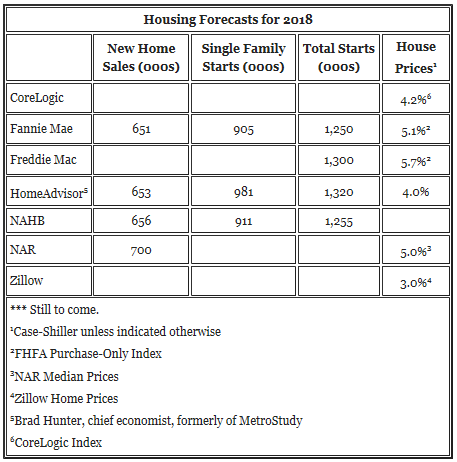
2018 Housing Forecasts
2018 Housing Forecasts collected by Bill McBride:
Posted by at 8:09 PM
Labels: Forecasting Forum, Global Housing Watch
Housing View – December 8, 2017
On cross-country:
- Global developments in residential property prices – second quarter of 2017 – Bank for International Settlements
- Global House Price Index – Q3 2017 – Knight Frank
- European Commission Annual Growth Survey confirms ‘State of Housing’ report – Housing Europe
- Why Affordable Housing is Key To Deliver SDGs – SDG Watch Europe
- Reform of the French Social Housing Sector – Housing Europe
On the US:
- The Awakening of Millennial Homeownership Demand – Fannie Mae
- A journey through office space from Babylonian scribes to Milton Waddams to Apple’s ‘mothership’ – Rutgers Real Estate Center
- Mortgage-Default Research and the Recent Foreclosure Crisis – Federal Reserve Bank of Boston
- Place Database – Lincoln Institute of Land Policy
- Is Homeownership Bad for Wealth Accumulation? – Federal Reserve Bank of St. Louis
- Urban Revival in America, 2000 to 2010 – NBER
- House Price Beliefs And Mortgage Leverage Choice – NBER
- 2016 Q3 Commercial Real Estate Market Survey – National Association of Realtors
- Gig Economy Workers and Homeownership – Fannie Mae
- Reactions to the tax plan – Bloomberg, Builder Magazine, Citylab, Slate
- 2018 Housing Forecasts – Calculated Risk
On other countries:
- [Australia] Aussie states to encourage ‘built-to-rent’ housing projects – Global Property Guide
- [Canada] The Housing Supply Myth – Kwantlen Polytechnic University
- [Canada] Mortgage and consumer credit trends – CMHC
- [China] Hidden peril awaits China’s banks as property binge fuels mortgage fraud frenzy – Reuters
- Housing Challenges in Chinese Cities Under Urbanization – Urbanization and Urban Governance in China
- [Denmark] A regional model of the Danish housing market – Danmarks Nationalbank
- [France] French housing market heating up led by Paris – Reuters
- [India] Affordable housing is a no-brainer for India’s bulls – Financial Times
- [Ireland] The roots of Ireland’s property crisis – Economist
- [Sweden] Swedish construction firms see no major fall in housing demand ahead- c.bank survey – Reuters
- [United Arab Emirates] Dubai, Property Market Outlook, Winter 2017 – Cluttons
- [United Kingdom] London’s property market is rescued by its former colony, Hong Kong – Economist
- [United Kingdom] UK stamp duty cut for first-time buyers raises concerns – Global Property Guide
Photo by Aliis Sinisalu
On cross-country:
- Global developments in residential property prices – second quarter of 2017 – Bank for International Settlements
- Global House Price Index – Q3 2017 – Knight Frank
- European Commission Annual Growth Survey confirms ‘State of Housing’ report – Housing Europe
- Why Affordable Housing is Key To Deliver SDGs – SDG Watch Europe
- Reform of the French Social Housing Sector – Housing Europe
On the US:
- The Awakening of Millennial Homeownership Demand – Fannie Mae
- A journey through office space from Babylonian scribes to Milton Waddams to Apple’s ‘mothership’ – Rutgers Real Estate Center
- Mortgage-Default Research and the Recent Foreclosure Crisis – Federal Reserve Bank of Boston
- Place Database – Lincoln Institute of Land Policy
- Is Homeownership Bad for Wealth Accumulation?
Posted by at 5:00 AM
Labels: Global Housing Watch
Thursday, December 7, 2017
Macroprudential Policy in China’s Real Estate Market
From the IMF’s latest report on China:
“The counter-cyclical capital buffer (CCyB) is an important macroprudential instrument. The FSS-C could review this regularly, and make proposals for its activation. Activation/adjustment should also be considered jointly with measures to further rein in shadow banking, and possible increases in capital requirements for other reasons (Box 6).
The PBC’s macroprudential assessment (MPA) has been a useful monitoring tool but its purpose and structure would now benefit from review. The MPA monitors seven categories of financial stability indicators (recently broadened to cover off-balance sheet credit expansion) on a bank-by-bank basis, some of which are key macroprudential indicators. Assessments under MPA, such as compliance with interest rate or credit policy, involve some PBC discretion, as do the administrative penalties applied informally to banks failing the MPA. Currently the MPA is used to determine access to PBC facilities and remuneration of reserves, rather than being tailored to address systemic risk. MPA results should not determine access to PBC facilities. Moreover, the purpose of the MPA should be reviewed and clarified, its structure simplified, and the methodology published. To ensure close interagency coordination, any macroprudential action recommended on the basis of the MPA should be discussed by the proposed FSS-C, for action by individual regulators.
Tighter liquidity requirements are warranted on macroprudential grounds. At the entity level, negotiable certificates of deposit have recently been included in the limit on interbank liabilities. However, the Liquidity Coverage Ratio (LCR) should also be extended to smaller banks, and at the product level, rules on asset allocation and redemption should be tightened, and valuation rules should be revised.
Data gaps, including insufficient interagency information sharing, should be addressed. Collection of loan-book related data by the CBRC appears to be strong, but supervisory access to data has not kept pace as risks have migrated to investment books and off-balance sheet products. Priorities are (i) better granular data on banks’ investments and interbank exposures; (ii) empowering the FSS-C to require institutions, including nonfinancial institutions that provide financial services, to report data related to financial stability; and (iii) adopting common accounting standards across financial institutions to facilitate monitoring risks. Ongoing plans to develop a joint regulatory financial data platform should be prioritized. The quality and scope of the credit registry system should be strengthened by capturing individual indebtedness to nonbanks (such as P2P). Fuller coverage and centralization of property market indicators across all regions is desirable.
Property market risks have risen, while the tools for managing them are predominantly local. Homebuyers are more leveraged than during the last episode of rising market risk, and the rising share of high-LTV mortgages is a concern. Refinements to the calibration of housing market measures—such as the use of stressed interest rate assumptions in debt-service-to-income limits—would be useful.
Property market policies that are decentralized and implemented at the municipal level should be standardized. While measures are enacted in consultation with local branches of the PBC, CBRC, and other relevant authorities, local governments’ GDP growth targets and social stability and fiscal objectives may prevent timely tightening or lead to premature relaxation of some measures. There are sound reasons for local government involvement in these decisions. But local-level committees, involving local governments and local PBC and CBRC offices, should be formalized and meetings held regularly, using risk analysis provided by the PBC, to help ensure comparable treatment across cities and reduce the scope for belated tightening or premature relaxation.”
From the IMF’s latest report on China:
“The counter-cyclical capital buffer (CCyB) is an important macroprudential instrument. The FSS-C could review this regularly, and make proposals for its activation. Activation/adjustment should also be considered jointly with measures to further rein in shadow banking, and possible increases in capital requirements for other reasons (Box 6).
The PBC’s macroprudential assessment (MPA) has been a useful monitoring tool but its purpose and structure would now benefit from review.
Posted by at 1:30 PM
Labels: Global Housing Watch
Wednesday, December 6, 2017
Housing in the Maldives
The IMF’s new report on the Maldives says that: “Careful monitoring is warranted, supported by prudential measures on housing. Private sector credit has grown rapidly, led by the housing and construction sector. Banks’ credit to the private sector has continued to grow, driven by lower NPLs and an accommodative monetary policy stance since 2015. Banks require 150 percent of collateral on loans extended and a 20–25 percent down payment as insurance against default risk, which households can meet by drawing on their pension assets. In the context of a sharp increase in housing-related loans and exposure of the Maldives Pension Administration Office (MPAO), careful monitoring is recommended.”
The IMF’s new report on the Maldives says that: “Careful monitoring is warranted, supported by prudential measures on housing. Private sector credit has grown rapidly, led by the housing and construction sector. Banks’ credit to the private sector has continued to grow, driven by lower NPLs and an accommodative monetary policy stance since 2015. Banks require 150 percent of collateral on loans extended and a 20–25 percent down payment as insurance against default risk,
Posted by at 5:00 AM
Labels: Global Housing Watch
Subscribe to: Posts