Showing posts with label Global Housing Watch. Show all posts
Tuesday, October 9, 2018
Georgia: Residential Property Price Index
From the IMF’s latest report on Georgia:
“The compilation of an RPPI will facilitate the assessment of developments and risks in property markets. It will therefore be useful for monetary policy as it will improve the understanding of the linkages between property asset prices and financial assets. The National Bank of Georgia compiles a rudimentary index that tracks residential and commercial property prices in two districts of Tbilisi—one is known for expensive properties and the other for modestly priced properties. The index is therefore quite limited and is not disseminated.
On the RPPI, the mission proposed that, as a start, the index be restricted to the capital city and cover all transactions in new apartments and houses. Initially, the index will not include transactions in existing dwellings because of the complexity in covering these dwellings. Existing dwellings may be covered at a later stage when the RPPI methodology is stabilized and the staff gain the experience and skills in compiling the index.
Geostat should be able to compile the RPPI on a quarterly basis and disseminate the first index for the first quarter of 2021, in mid-May 2021. The RPPI will be developed by the same staff compiling the CPI; however, the production schedule for the RPPI can be arranged around the production and release schedule for the CPI to accommodate the available staff
resources. Based on the current CPI production schedule and the proposed RPPI development plan, additional staff would not be required.The most suitable data source for the RPPI may be the National Agency of Public Registry of Ministry of Justice (NAPR). Geostat informed the mission that it is compulsory to
register all transactions in dwellings with the NAPR. Therefore, the NAPR may collect information on transaction value, transactors, dwelling specifications, and location. An alternative source would be the two main websites for real estate transactions.”
From the IMF’s latest report on Georgia:
“The compilation of an RPPI will facilitate the assessment of developments and risks in property markets. It will therefore be useful for monetary policy as it will improve the understanding of the linkages between property asset prices and financial assets. The National Bank of Georgia compiles a rudimentary index that tracks residential and commercial property prices in two districts of Tbilisi—one is known for expensive properties and the other for modestly priced properties.
Posted by at 1:37 PM
Labels: Global Housing Watch
Friday, October 5, 2018
Housing View – October 5, 2018
On cross-country:
- World’s top 10 most at-risk housing markets – Global Property Guide
- The Cities Around the World Most at Risk of Property Bubbles – Bloomberg
- Housing Crises – Federal Reserve Bank of St. Louis
- Global Residential Cities Index – Q2 2018 – Knight Frank
On the US:
- Brief Thoughts on Housing Supply and Policy – MIT Center for Real Estate
- ‘The Renters Strike Back’ – Brookings
- Unlocking Amenities: Estimating Public-Good Complementarity – NBER
- An Examination of the Link between Urban Planning Policies and the High Cost of Housing and Labor – Institute for International Economic Policy
- Housing Stability and Family Health: Five Things to Know – Federal Reserve Bank of San Francisco
- Housing Market Slows, as Rising Prices Outpace Wages – New York Times
- The Hot Property That’s Next on Tech’s Agenda: Real Estate – New York Times
- Dallas strikes it rich with rising property prices – Financial Times
- Mortgage Market Design: Lessons from the Great Recession – Brookings
- How vacation homes went from private escape to investment opportunities – Curbed
- America’s Affordable Housing Crisis Isn’t Just Hitting Cities – Huffington Post
- How Will Artificial Intelligence Shape Mortgage Lending? – Fannie Mae
On other countries:
- [Canada] British Columbia Cracks Down on Dirty Money in Real Estate – Bloomberg
- [Denmark] Housing Summit: Future Housing Market and Urban Development in the Capital Region of Denmark – Copenhagen Economics
- [Germany] A look into German housing markets: A bubble call? – Sage Journal
- [Ireland] Thousands march on Irish parliament in growing housing shortage protest – Reuters
- [Italy] House prices in local markets in Italy: dynamics, levels and the role of urban agglomerations – Bank of Italy
- [Mexico] Empty houses across North America: Housing finance and Mexico’s vacancy crisis – Urban Studies
- [Spain] Organisations and political groups reach an agreement to allocate 30% of all new homes as protected housing – Info Barcelona
- [Thailand] Thailand to Impose Mortgage Curbs to Tackle Speculation – Bloomberg
- [United Kingdom] What a no-deal Brexit could mean for London property prices – Global Property Guide
- [United Kingdom] London stamp duty take hits record £4.9bn even as sales fall – Financial Times
- [United Kingdom] May Plans to Hike U.K. Property Tax for Foreign Buyers – Bloomberg
- [United Kingdom] New tax on foreign home buyers to help rough sleepers, PM says – BBC
- [United Kingdom] Social Housing: Evidence Review – University of York

Photo by Aliis Sinisalu
On cross-country:
- World’s top 10 most at-risk housing markets – Global Property Guide
- The Cities Around the World Most at Risk of Property Bubbles – Bloomberg
- Housing Crises – Federal Reserve Bank of St. Louis
- Global Residential Cities Index – Q2 2018 – Knight Frank
On the US:
- Brief Thoughts on Housing Supply and Policy – MIT Center for Real Estate
- ‘The Renters Strike Back’ – Brookings
- Unlocking Amenities: Estimating Public-Good Complementarity – NBER
- An Examination of the Link between Urban Planning Policies and the High Cost of Housing and Labor – Institute for International Economic Policy
- Housing Stability and Family Health: Five Things to Know – Federal Reserve Bank of San Francisco
- Housing Market Slows,
Posted by at 5:00 AM
Labels: Global Housing Watch
Monday, October 1, 2018
Sectoral Booms and Misallocation of Managerial Talent: Evidence from the Chinese Real Estate Boom
From a new IMF working paper by Yu Shi:
“This paper identifies a new mechanism leading to inefficiency in capital reallocation at the extensive margin when an economy experiences a sectoral boom. I argue that imperfections in the financial market and capital barriers to entry in the booming sector create a misallocation of managerial talent. Using comprehensive firm-level data from China, I first provide evidence that more productive firms reallocate capital to the booming real estate sector, and demonstrate that the pattern is likely driven by fewer financial constraints on these firms. I then use a structural estimation to verify the talent misallocation. Finally, I calibrate a dynamic model and find that the without the misallocation, the TFP growth in the manufacturing sector would have improved by 0.5% per year.”
From a new IMF working paper by Yu Shi:
“This paper identifies a new mechanism leading to inefficiency in capital reallocation at the extensive margin when an economy experiences a sectoral boom. I argue that imperfections in the financial market and capital barriers to entry in the booming sector create a misallocation of managerial talent. Using comprehensive firm-level data from China, I first provide evidence that more productive firms reallocate capital to the booming real estate sector,
Posted by at 10:31 AM
Labels: Global Housing Watch
House Price Synchronization and Financial Openness: A Dynamic Factor Model Approach
From a new IMF working paper by Mitsuru Katagiri:
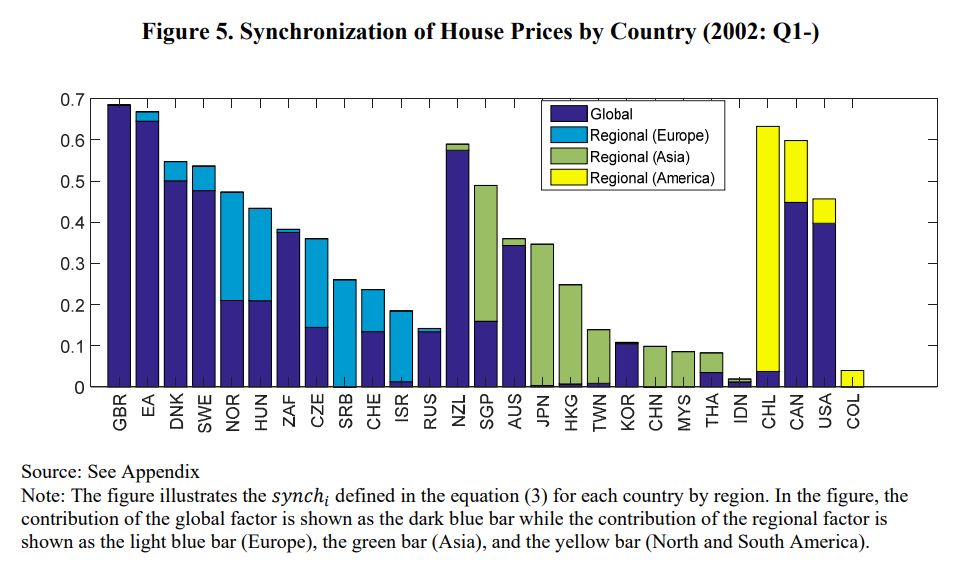
“This paper investigates the developments in house price synchronization across countries by a dynamic factor model using a country- and city-level dataset, and examines what drives the synchronization. The empirical results indicate that: (i) the degree of synchronization has been rising since the 1970s, and (ii) a large heterogeneity in the degree of synchronization exists across countries and cities. A panel and cross-sectional regression analysis show that the heterogeneity of synchronization is partly accounted for by the progress in financial and trade openness. Also, the city-level analysis implies that the international synchronization is mainly driven by the city-level connectivity between large and international cities.”
From a new IMF working paper by Mitsuru Katagiri:
“This paper investigates the developments in house price synchronization across countries by a dynamic factor model using a country- and city-level dataset, and examines what drives the synchronization. The empirical results indicate that: (i) the degree of synchronization has been rising since the 1970s, and (ii) a large heterogeneity in the degree of synchronization exists across countries and cities. A panel and cross-sectional regression analysis show that the heterogeneity of synchronization is partly accounted for by the progress in financial and trade openness.
Posted by at 10:28 AM
Labels: Global Housing Watch
House Prices in Philippines
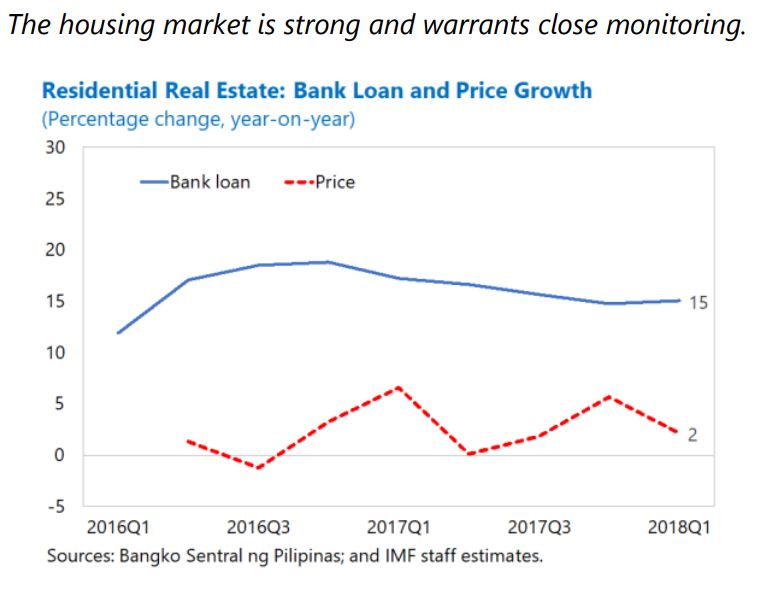
The latest IMF report on Philippines points out that:
Posted by at 10:23 AM
Labels: Global Housing Watch
Subscribe to: Posts