Showing posts with label Global Housing Watch. Show all posts
Friday, December 28, 2018
Housing Market in Bolivia
The IMF’s latest report on Bolivia says:
“Credit quotas should be relaxed to limit poor-quality credit growth. Interest caps should also be removed so that lending decisions better reflect intrinsic risks. This would remove distortions in the allocation of credit and support desirable allocation of resources in support of growth. ASFI is urged to monitor closely capital quality for its ability to absorb potential shocks and to scrutinize possible risks arising from rapid credit growth to housing. In this context, the Fund welcomes the opportunity to assist the authorities to prepare a real estate price index and urges rapid progress.”
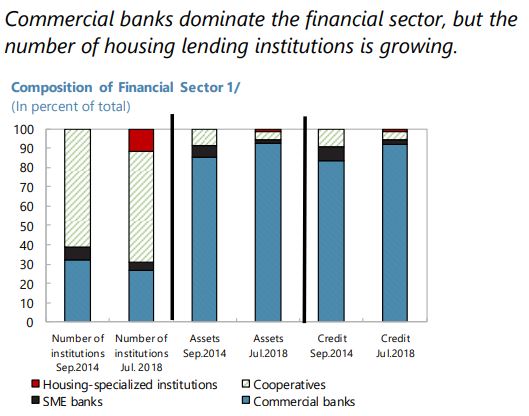
The IMF’s latest report on Bolivia says:
“Credit quotas should be relaxed to limit poor-quality credit growth. Interest caps should also be removed so that lending decisions better reflect intrinsic risks. This would remove distortions in the allocation of credit and support desirable allocation of resources in support of growth. ASFI is urged to monitor closely capital quality for its ability to absorb potential shocks and to scrutinize possible risks arising from rapid credit growth to housing.
Posted by at 10:15 AM
Labels: Global Housing Watch
Friday, December 21, 2018
Housing View – December 21, 2018
On cross-country:
- How consumer behaviour sways the housing market- and the economy – ING
On the US:
- What’s Up With Construction Costs? – BuildZoom
- The Goldilocks problem of housing supply: Too little, too much, or just right? – Brookings
- Gentrification and Fair Housing: Does Gentrification Further Integration? – Furman Center for Real Estate and Urban Policy
- Where Have All The Renters Gone? – Harvard Joint Center for Housing Studies
- Risky Home Loans Are Making a Comeback. Are They Right for You? – New York Times
- California Needs a Housing Revolution – Bloomberg
- Here’s Housing’s Real Threat to the Economy – Bloomberg
On other countries:
- [Australia] Sydney’s house prices face a falling tide – Financial Times
- [Botswana] The housing market’s potential to boost Botswana’s economic growth – Bank of Botswana
- [Mexico] Mexico’s housing market is strengthening – Global Property Guide
- [Netherlands] Short-term rentals and the housing market: Quasi-experimental evidence from Airbnb in Los Angeles – VoxEU
- [Singapore] Can Singapore’s social housing keep up with changing times? – BBC

Photo by Aliis Sinisalu
On cross-country:
- How consumer behaviour sways the housing market- and the economy – ING
On the US:
- What’s Up With Construction Costs? – BuildZoom
- The Goldilocks problem of housing supply: Too little, too much, or just right? – Brookings
- Gentrification and Fair Housing: Does Gentrification Further Integration? – Furman Center for Real Estate and Urban Policy
- Where Have All The Renters Gone?
Posted by at 5:00 AM
Labels: Global Housing Watch
Tuesday, December 18, 2018
Housing Market in Cambodia
The IMF’s latest report on Cambodia says:
“Real-estate sector risks. Capital continues to flow into the construction sector driven by regional investors and strong demand for residential and retail space. Significant data gaps, including on property prices, complicate the assessment of risks. There is anecdotal evidence that growing oversupply is dampening prices of high-end apartments, while, given the segmented nature of the market, property prices for retail and residential properties remain robust. As a result, affordability of residential housing is being eroded. Credit growth to the real estate sector, a key transmission channel linking credit and economic growth, has averaged around 35 percent since 2016, driven by few banks. Further heightening risks, real-estate developers are reportedly offering mortgages with looser lending conditions, an activity that remains unmonitored and unregulated.”
The IMF’s latest report on Cambodia says:
“Real-estate sector risks. Capital continues to flow into the construction sector driven by regional investors and strong demand for residential and retail space. Significant data gaps, including on property prices, complicate the assessment of risks. There is anecdotal evidence that growing oversupply is dampening prices of high-end apartments, while, given the segmented nature of the market, property prices for retail and residential properties remain robust.
Posted by at 9:57 AM
Labels: Global Housing Watch
Housing Market in Kosovo
The IMF’s latest report on Kosovo says:
“With strong growth in property lending (beyond mortgages, this includes commercial and residential construction loans, consumer credit used for housing finance, suppliers’ credit) amid signs of a supply overhang in the capital, the authorities should closely monitor the market and develop a housing price index or create a centralized registry of property valuations to convey the price signal of the property market.”
The IMF’s latest report on Kosovo says:
“With strong growth in property lending (beyond mortgages, this includes commercial and residential construction loans, consumer credit used for housing finance, suppliers’ credit) amid signs of a supply overhang in the capital, the authorities should closely monitor the market and develop a housing price index or create a centralized registry of property valuations to convey the price signal of the property market.”
Posted by at 9:56 AM
Labels: Global Housing Watch
Friday, December 14, 2018
Housing View – December 14, 2018
On cross-country:
- Global House Price Index-Q3 2018 – Knight Frank
- Border Effects in House Prices – Real Estate Economics
On the US:
- Special Issue: The Appropriate Role of Government in U.S. Mortgage Markets – Federal Reserve Bank of New York
- Shiller Hystericizes The US Housing Market – EconoSpeak
- Minneapolis 2040: The most wonderful plan of the year – Brookings Institute
- Minneapolis, Tackling Housing Crisis and Inequity, Votes to End Single-Family Zoning – New York Times
- Income Inequality, Mortgage Debt and House Prices – London School of Economics
- More Than a Third of American Households Were Cost-Burdened Last Year – Harvard Joint Center for Housing Studies
- Risk is building in the housing market – American Enterprise Institute
- Connecting the dots on home builder performance – American Enterprise Institute
- Homelessness Rises More Quickly Where Rent Exceeds a Third of Income – Zillow
- Progressive Minneapolis Just Passed One of the Most Deregulatory Housing Reforms in the Country – Reason
- Housing Sentiment Up Slightly on Reported Household Income Gains – Fannie Mae
On other countries:
- [Australia] The potential of new technologies to disrupt housing policy – AHURI
- [China] House prices and marriage entry in China – Regional Science and Urban Economics
- [Thailand] Thailand’s house prices rising strongly again – Global Property Guide
- [United Kingdom] Property prices where you live compared to where you work – Financial Times
Photo by Aliis Sinisalu
On cross-country:
- Global House Price Index-Q3 2018 – Knight Frank
- Border Effects in House Prices – Real Estate Economics
On the US:
- Special Issue: The Appropriate Role of Government in U.S. Mortgage Markets – Federal Reserve Bank of New York
- Shiller Hystericizes The US Housing Market – EconoSpeak
- Minneapolis 2040: The most wonderful plan of the year – Brookings Institute
- Minneapolis,
Posted by at 5:00 AM
Labels: Global Housing Watch
Subscribe to: Posts