Showing posts with label Global Housing Watch. Show all posts
Monday, September 9, 2019
Housing Market in Saudi Arabia
From the IMF’s latest report on Saudi Arabia:
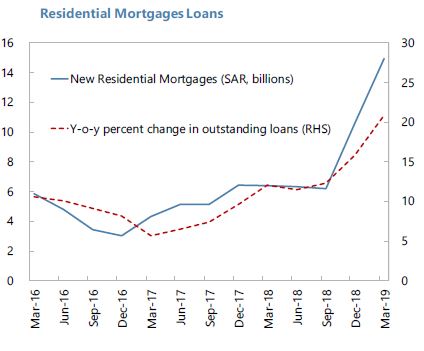
“Mortgage lending is growing strongly, and real estate prices have declined in recent years. Risks at this stage are limited, but policymakers need to keep a close eye on financial and fiscal risks from the housing market.
Real estate prices have fallen by around 20 percent since 2014. Housing rents have also been falling since early 2017. New supply is being driven by government initiatives to build affordable homes while the departure of expatriates may have slowed housing demand.
The government has initiated programs to build affordable housing and raise home ownership. It is providing access to land and financing to developers and encouraging new building technologies to increase the supply of houses. The white land tax announced in 2016 aims to incentivize land development. The approval of real estate investment traded funds (REITs) in 2016 and other reforms are expected to ease financial constraints faced by developers. In February 2018, a SAR 120 billion mortgage market plan was introduced to provide subsidized loans and support for developers. In addition, the developmental housing program partners with NGOs to build affordable houses for low-income households.
Housing demand is being spurred by credit policies and demographic trends. Increasing urbanization and declining household size are increasing housing demand by Saudis, while the departure of expatriates is slowing demand in the rental segment of the market. A new mortgage law was introduced in 2012 that enabled banks and non-bank institutions to lend for residential real estate. A facilitated mortgage program was introduced in 2016 to help Saudi families obtain mortgage loans. The maximum loan-to-value (LTV) ratio for first-time buyers was increased from 85 to 90 percent in January 2018 and risk weights on mortgage loans have been reduced. The PIF has set-up a mortgage refinance company.
Policymakers should remain vigilant about potential fiscal and financial risks as the real estate market develops. Large house price movements may trigger financial and macro instability as highlighted in the April 2019 Global Financial Stability Report (GFSR). Banks’ exposure to the real estate sector is limited—mortgage loans were 17 percent of total bank credit to private sector at end-2018. In addition, mortgage payments are often directly debited from salary, limiting the likelihood of default. Further, many new mortgage loans are guaranteed by the government. Going forward, however, prudential policies should continue to pay close attention to the real estate market and the fiscal impact of housing programs including through PPPs will need to be carefully assessed.”

From the IMF’s latest report on Saudi Arabia:
“Mortgage lending is growing strongly, and real estate prices have declined in recent years. Risks at this stage are limited, but policymakers need to keep a close eye on financial and fiscal risks from the housing market.
Real estate prices have fallen by around 20 percent since 2014. Housing rents have also been falling since early 2017. New supply is being driven by government initiatives to build affordable homes while the departure of expatriates may have slowed housing demand.
Posted by at 2:10 PM
Labels: Global Housing Watch
Tuesday, August 20, 2019
Housing markets and inequality
From a working paper by Dirk Bezemer and Anna Samarina:
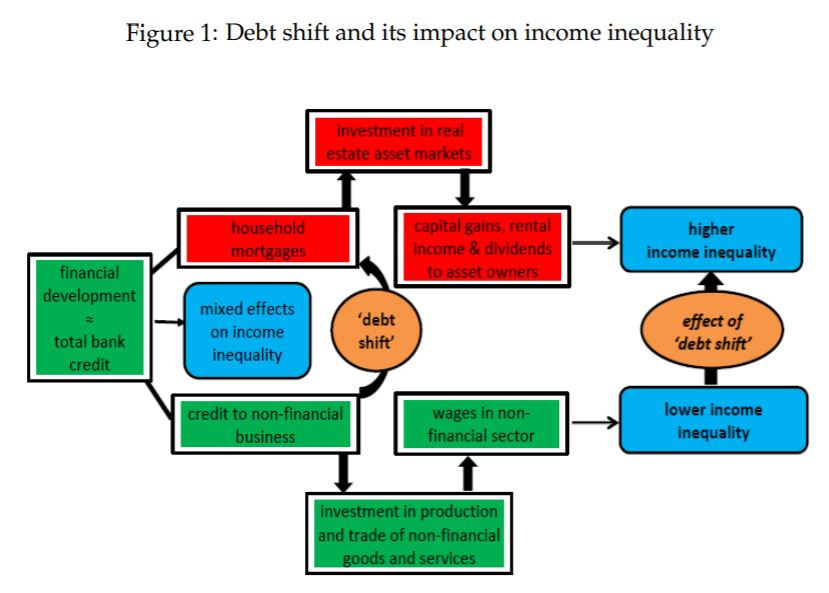
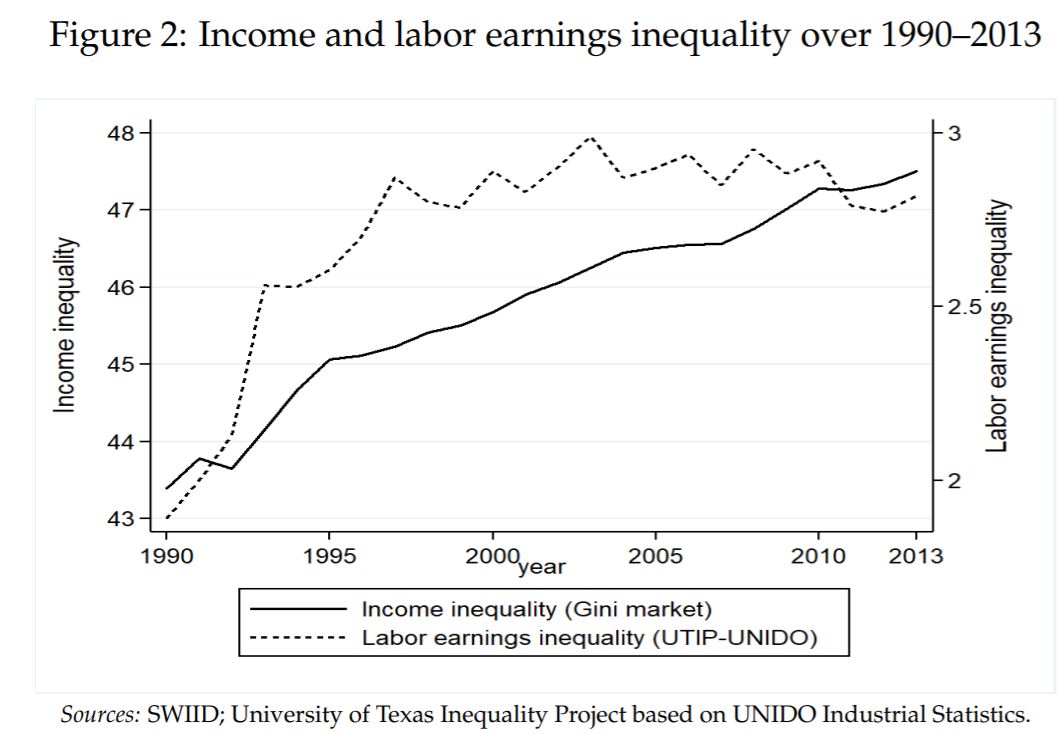
“These results suggest that ‘debt shift’ may be one of the factors explaining recent
trends in income inequality. Credit to real estate asset markets results in rising capital
gains and growth of incomes connected to the real estate sector. Since these incomes
are concentrated among rich households, this widens income disparities. In support,
we find that mortgage credit increases the income share of households in the top 10%
of the income distribution.”Continue reading here.
From a working paper by Dirk Bezemer and Anna Samarina:
“These results suggest that ‘debt shift’ may be one of the factors explaining recent
trends in income inequality. Credit to real estate asset markets results in rising capital
gains and growth of incomes connected to the real estate sector. Since these incomes
are concentrated among rich households, this widens income disparities. In support,
we find that mortgage credit increases the income share of households in the top 10%
of the income distribution.”
Posted by at 8:13 AM
Labels: Global Housing Watch
Monday, August 12, 2019
House Prices in China
From IMF’s latest report on China:
“The property market trended down. Growth in real estate investment (excluding land purchases) was mostly negative in 2018, and both house price growth and sales growth slowed since late 2018. Housing inventories have started to build up in recent months, suggesting the housing cycle may still be in a downturn.”
From IMF’s latest report on China:
“The property market trended down. Growth in real estate investment (excluding land purchases) was mostly negative in 2018, and both house price growth and sales growth slowed since late 2018. Housing inventories have started to build up in recent months, suggesting the housing cycle may still be in a downturn.”
Posted by at 10:58 AM
Labels: Global Housing Watch
Wednesday, August 7, 2019
House Prices in Latvia
From the IMF’s latest report on Latvia:
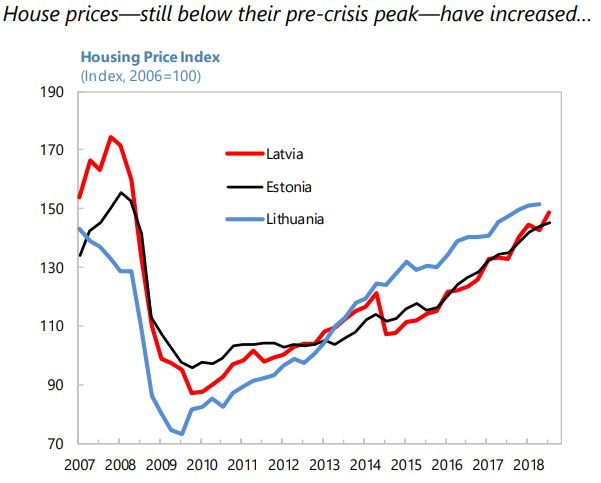
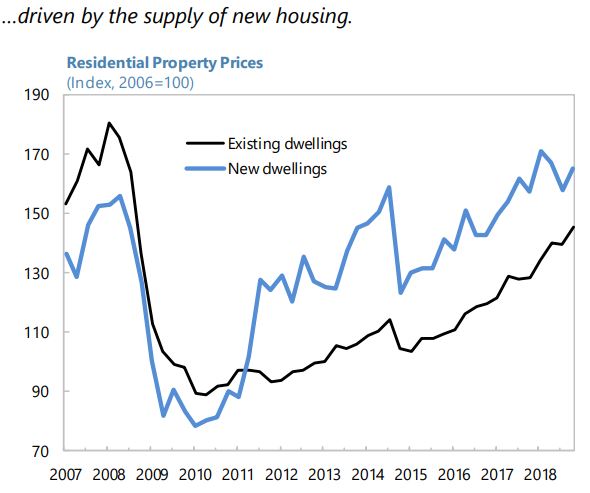
“The rapid rise in property prices merits attention. Despite a shrinking population, real house prices have increased by more than 7 percent per year over the last three years due to a surge in construction costs and prices of new dwellings. Current valuation indicators (price-to-income and price-to-rent ratios and deviations from long-term fundamentals) signal potential vulnerability to overvaluation of housing prices over the medium term. Yet, there are no acute financial imbalances, as the house price index is still about 20 percent below its pre-crisis peak in 2008, and aggregate house price developments have not been spurred by credit growth. Outstanding mortgage loans have dropped below 20 percent of GDP at end-2018, far below the euro area average of about 38 percent of GDP.
Timely adoption of precautionary macroprudential measures can help contain medium-term balance sheet risks. The high share of variable rate mortgages raises the risk to debt service capacity if household leverage increases, while a slowing wage growth could reduce debt affordability. BSFCs’ re-orientation may also result in a deterioration of borrower quality if they loosen credit standards and increase household lending to maintain profitability amid falling margins. Latvia’s macroprudential measures are relatively lenient compared to those in other EU countries and could be preemptively adjusted. Lowering the current LTV ratio limit of 90 percent to 80 percent (closer to other European peers) for residential mortgage lending, imposing restrictions on home refinancing, introducing a debt service-to-income (DSTI) limit, and limiting the maximum maturity of mortgages and consumer loans would mitigate vulnerabilities related to real-estate exposures. Higher provisions for loans with LTV ratios above the limit and regular assessments of collateral valuation standards would prevent excessively risky lending. Finally, macroprudential measures should apply to leasing companies to prevent potential regulatory arbitrage between them and banks.”
From the IMF’s latest report on Latvia:
“The rapid rise in property prices merits attention. Despite a shrinking population, real house prices have increased by more than 7 percent per year over the last three years due to a surge in construction costs and prices of new dwellings. Current valuation indicators (price-to-income and price-to-rent ratios and deviations from long-term fundamentals) signal potential vulnerability to overvaluation of housing prices over the medium term.
Posted by at 9:50 AM
Labels: Global Housing Watch
Monday, August 5, 2019
Monetary Policy, Housing Rents and Inflation Dynamics
From a paper by Daniel A. Dias and João B. Duarte:
“In this paper we study the effect of monetary policy shocks on housing rents. Our main finding is that, in contrast to house prices, housing rents increase in response to contractionary monetary policy shocks. We also find that, after a contractionary monetary policy shock, rental vacancies and the homeownership rate decline. This combination of results suggests that monetary policy may affect housing tenure decisions (own versus rent). In addition, we show that, with the exception of the shelter component, all other main components of the consumer price index (CPI) either decline in response to a contractionary monetary policy shock or are not responsive. These findings motivated us to study the statistical properties of alternative measures of inflation that exclude the shelter component. We find that measures of inflation that exclude shelter have most of the statistical properties of the widely used measures of inflation, such as the CPI and the price index for personal consumption expenditures (PCE), but have higher standard deviations and react more to monetary policy shocks. Finally, we show that the response of housing rents accounts for a large proportion of the “price puzzle” found in the literature.”
From a paper by Daniel A. Dias and João B. Duarte:
“In this paper we study the effect of monetary policy shocks on housing rents. Our main finding is that, in contrast to house prices, housing rents increase in response to contractionary monetary policy shocks. We also find that, after a contractionary monetary policy shock, rental vacancies and the homeownership rate decline. This combination of results suggests that monetary policy may affect housing tenure decisions (own versus rent).
Posted by at 4:39 PM
Labels: Global Housing Watch
Subscribe to: Posts