Showing posts with label Energy & Climate Change. Show all posts
Wednesday, March 27, 2019
Climate Change and the Federal Reserve
From Glenn D. Rudebusch at the Federal Reserve Bank of San Francisco:
“Climate change describes the current trend toward higher average global temperatures and accompanying environmental shifts such as rising sea levels and more severe storms, floods, droughts, and heat waves. In coming decades, climate change—and efforts to limit that change and adapt to it—will have increasingly important effects on the U.S. economy. These effects and their associated risks are relevant considerations for the Federal Reserve in fulfilling its mandate for macroeconomic and financial stability.
To help foster macroeconomic and financial stability, it is essential for Federal Reserve policymakers to understand how the economy operates and evolves over time. In this century, three key forces are transforming the economy: a demographic shift toward an older population, rapid advances in technology, and climate change. Climate change has direct effects on the economy resulting from various environmental shifts, including hotter temperatures, rising sea levels, and more frequent and extreme storms, floods, and droughts. It also has indirect effects resulting from attempts to adapt to these new conditions and from efforts to limit or mitigate climate change through a transition to a low-carbon economy. This Economic Letter describes how the consequences of climate change are relevant for the Fed’s monetary and financial policy.
Climate change and the transition to a low-carbon economy
Surface temperatures were first regularly recorded around the world in the late 1800s. Since then, the global average temperature has risen almost 2°F (Figure 1) with further increases projected (IPCC 2018). Based on extensive scientific theory and evidence, a consensus view among scientists is that global warming is the result of carbon emissions from burning coal, oil, and other fossil fuels. Indeed, as early as 1896, the Swedish chemist Svante Arrhenius showed that carbon emissions from human activities could cause global warming through a greenhouse effect. The underlying science is straightforward: Certain gases in the atmosphere, such as carbon dioxide and methane, capture the sun’s heat that is reflected off the Earth’s surface, thus blocking that heat from escaping into space. These greenhouse gases act like a blanket around the earth holding in heat. As more fossil fuels are burned, the blanket gets thicker, and global average temperatures increase. Other empirical measurements have confirmed many related adverse environmental changes such as rising sea levels and ocean acidity, shrinking glaciers and ice sheets, disappearing species, and more extreme storms (USGCRP 2018).
Continue reading here.

From Glenn D. Rudebusch at the Federal Reserve Bank of San Francisco:
“Climate change describes the current trend toward higher average global temperatures and accompanying environmental shifts such as rising sea levels and more severe storms, floods, droughts, and heat waves. In coming decades, climate change—and efforts to limit that change and adapt to it—will have increasingly important effects on the U.S. economy. These effects and their associated risks are relevant considerations for the Federal Reserve in fulfilling its mandate for macroeconomic and financial stability.
Posted by at 8:12 AM
Labels: Energy & Climate Change
Monday, March 25, 2019
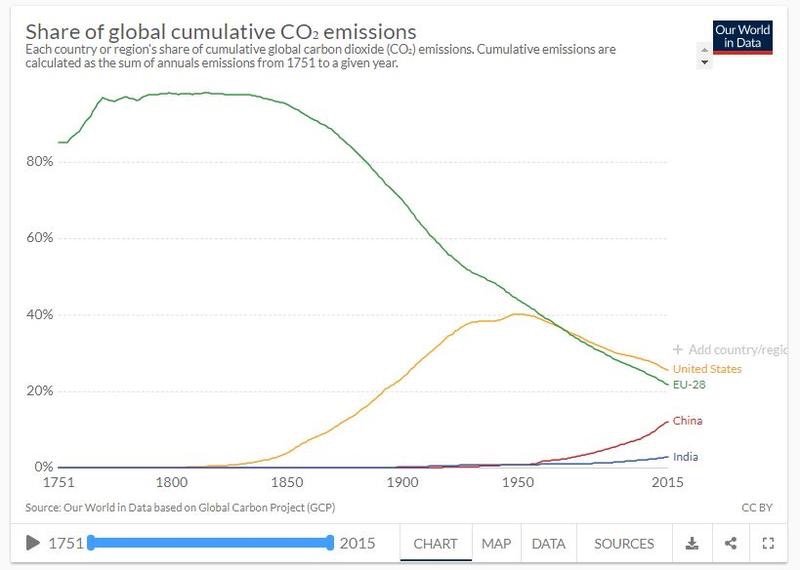
Share of global cumulative CO₂ emissions
From Our World in Data:
Posted by at 9:19 AM
Labels: Energy & Climate Change
Friday, March 22, 2019
The Remarkable Renaissance in US Fossil Fuel Production
From Conversable Economist:
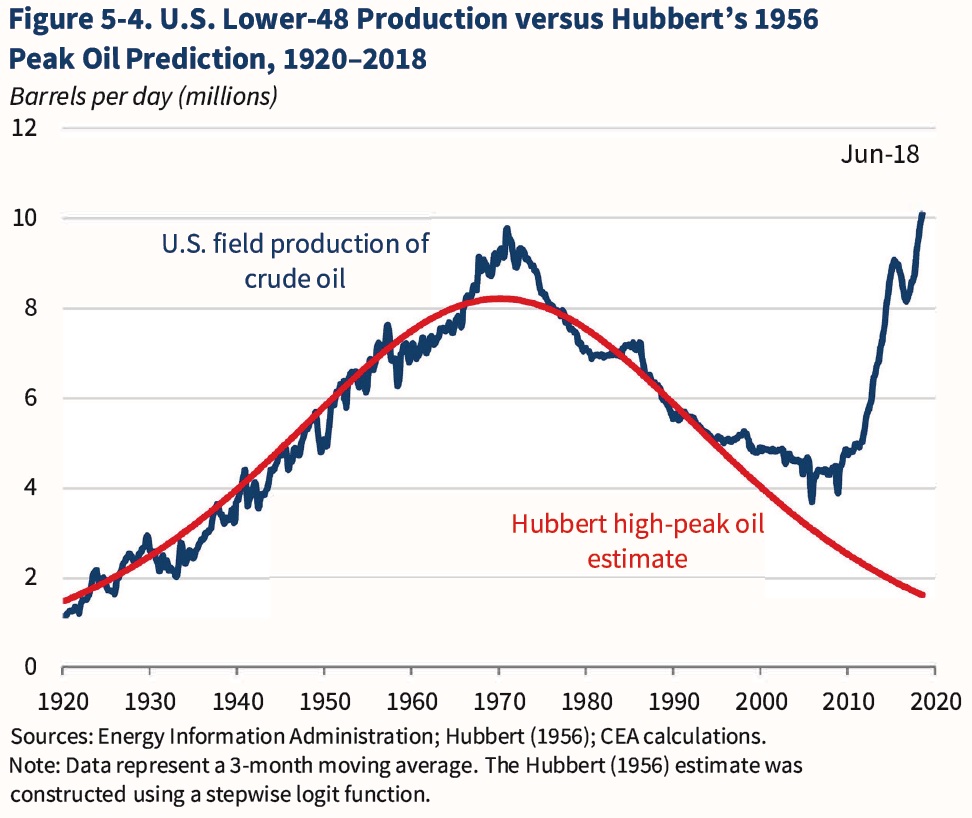
“M. King Hubbert was a big-name geologist who worked much of his career for Shell oil. Back in the 1970s, when OPEC taught the US that the price of oil was set in global markets, discussions of US energy production often began with the “Hubbert curve,” based on a 1956 paper in which Hubbert predicted with considerable accuracy that US oil production would peak around 1970. The 2019 Economic Report of the President devotes a chapter to energy policy, and offers a reminder what happened with Hubbert’s curve.
The red line shows Hubbert’s predicted oil production curve from 1956. The blue line shows actual US oil production in the lower 48 states. At the time of Hubbert’s death in 1989, his forecast looked spot-on. Even by around 2010, his forecast looked pretty good. But for those of us who had built up a habit since the 1970s of looking at US oil production relative to Hubbert’s prediction, the last decade has been a dramatic shock.
Continue reading here.
From Conversable Economist:
“M. King Hubbert was a big-name geologist who worked much of his career for Shell oil. Back in the 1970s, when OPEC taught the US that the price of oil was set in global markets, discussions of US energy production often began with the “Hubbert curve,” based on a 1956 paper in which Hubbert predicted with considerable accuracy that US oil production would peak around 1970. The 2019 Economic Report of the President devotes a chapter to energy policy,
Posted by at 9:29 AM
Labels: Energy & Climate Change
Tuesday, March 19, 2019
China’s investment in coal power
From VoxEU post by Mengjia Ren, Lee Branstetter, Brian Kovak, Daniel Armanios, Jiahai Yuan:
“Despite leading the world in clean energy investment in recent years, China continues to engage in massive expansion of coal power thanks to policies that effectively subsidise and (over)incentivise coal power investment. This column examines the effects of the 2014 devolution of authority from the central government to local governments on approvals for coal power projects. It finds that the approval rate for coal power projects is about three times higher when the approval authority is decentralised, and provinces with larger coal industries tend to approve more coal power.
After three decades of building up its capital stock, China has entered a phase where efficient allocation of capital resources is vitally important for sustained economic growth. However, due to governance problems and market distortions, many key industries in China have experienced serious capital misallocation and overcapacity issues in the past few years, with the energy industry being one of the most salient examples.
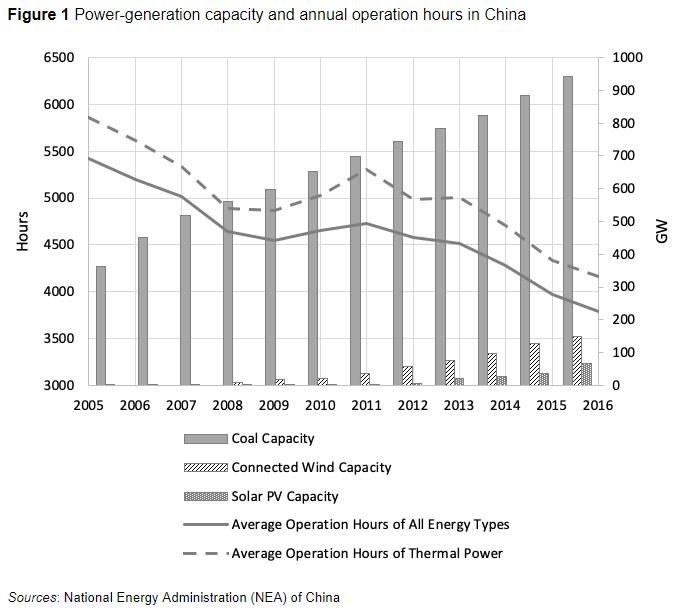
In line with high-profile government pledges to transform China’s energy system, China has led the world in investment in clean energy. In 2015 alone, China built a soccer field of solar panels every hour and one large wind turbine every hour (Carbon Tracker Initiative 2016), easily outpacing green energy investment in any other country. However, at the same time, China was building two coal plants per week. China approved nearly 200 gigawatts of new coal power capacity in 2015, even though the total capacity of the existing coal plants was 884 gigawatts (Ren et al. 2019). Competition from coal power has led to massive curtailment of wind and solar power generation because power grids were obligated to purchase a certain amount of coal power and thus had to reject much of the energy generated by China’s wind and solar power plants.
In the past five years, utilisation levels of all energy types fell sharply as growth in energy supply shot past energy demand (Figure 1 and Table 1). Nearly 50% of China’s coal power plants faced net financial loss in 2018 (Ji 2018). While policy efforts1 have been made to contain the coal overcapacity crisis, under the existing governance structure and market rules, coal power investment in China is unlikely to return in the near future to an equilibrium where plants can still profit under a competitive market price of electricity. It also seems likely that coal power will continue to crowd out solar and wind power for the foreseeable future, raising concerns that China’s vaunted transition to a less carbon-intensive economy will not be managed efficiently.
Continue reading here.
From VoxEU post by Mengjia Ren, Lee Branstetter, Brian Kovak, Daniel Armanios, Jiahai Yuan:
“Despite leading the world in clean energy investment in recent years, China continues to engage in massive expansion of coal power thanks to policies that effectively subsidise and (over)incentivise coal power investment. This column examines the effects of the 2014 devolution of authority from the central government to local governments on approvals for coal power projects.
Posted by at 8:55 AM
Labels: Energy & Climate Change
Wednesday, February 27, 2019
Macroeconomic Gains from Reforming the Agri-Food Sector: The Case of France
From an IMF working paper by Nicoletta Batini:
“France is the top agricultural producer in the European Union (EU), and agriculture plays a prominent role in the country’s foreign trade and intermediate exchanges. Reflecting production volumes and methods, the sector, however, also generates significant negative environmental and public health externalities. Recent model simulations show that a well-designed shift in production and consumption to make the former sustainable and align the latter with recommended values can curb these considerably and generate large macroeconomic gains. I propose a policy toolkit in line with the government’s existing sectoral policies that can support this transition.”
From an IMF working paper by Nicoletta Batini:
“France is the top agricultural producer in the European Union (EU), and agriculture plays a prominent role in the country’s foreign trade and intermediate exchanges. Reflecting production volumes and methods, the sector, however, also generates significant negative environmental and public health externalities. Recent model simulations show that a well-designed shift in production and consumption to make the former sustainable and align the latter with recommended values can curb these considerably and generate large macroeconomic gains.
Posted by at 10:15 AM
Labels: Energy & Climate Change
Subscribe to: Posts