Showing posts with label Inclusive Growth. Show all posts
Monday, May 7, 2012
Why’s austerity so unpopular in Europe? Because it’s not working.
Europeans are rebelling against austerity. That’s the read on Sunday’s elections in Greece and France. But why do voters loathe austerity so much? Perhaps because, as economists have found, efforts to rein in budget deficits can take a wrenching toll on living standards, especially in a recession.
In a recent paper for the International Monetary Fund, Laurence Ball, Daniel Leigh and Prakash Loungani looked at 173 episodes of fiscal austerity over the past 30 years. These were countries that, for one reason or another, cut spending and hiked taxes in order to shrink their budget deficits. And the results were typically painful: Austerity, the IMF found, “lowers incomes in the short term, with wage-earners taking more of a hit than others; it also raises unemployment, particularly long-term unemployment.” Read the full story on the Washington Post.
Europeans are rebelling against austerity. That’s the read on Sunday’s elections in Greece and France. But why do voters loathe austerity so much? Perhaps because, as economists have found, efforts to rein in budget deficits can take a wrenching toll on living standards, especially in a recession.
In a recent paper for the International Monetary Fund, Laurence Ball, Daniel Leigh and Prakash Loungani looked at 173 episodes of fiscal austerity over the past 30 years.
Posted by at 4:14 PM
Labels: Inclusive Growth
Monday, April 30, 2012
Jobs and Growth: Can’t Have One Without the Other?
IMF Deputy Managing Director Min Zhu wrote today in imfdirect:
As Frank Sinatra crooned about love and marriage, so it seems about jobs and growth:
“This I tell ya, brother, you can’t have one without the other.”
The IMF’s latest World Economic Outlook projects global growth of 3 ½ percent this year. To the person on the street, what matters is how this growth translates into jobs and wages. The news on the jobs front, unfortunately, remains grim.
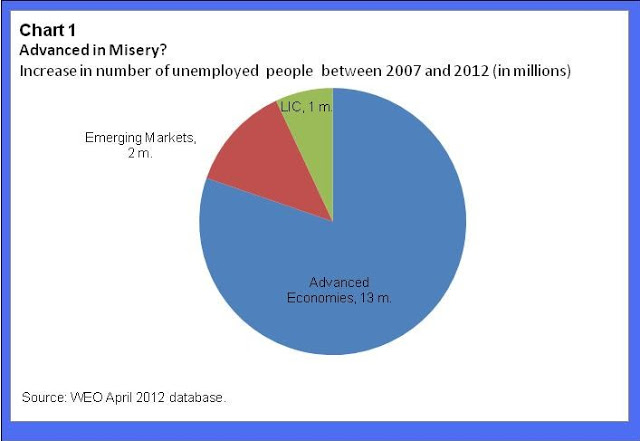
Five years after the onset of the Great Recession, 16 million more people are likely to remain unemployed this year than in 2007. This estimate is for a set of countries for which the IMF forecasts unemployment rates; adding in some countries for which the International Labour Organization provides forecasts only boosts the number.
The bulk of this increase in unemployed people has been in the so-called advanced economies (the IMF’s term for countries with high per capita incomes), as shown in the chart below.
Why isn’t the jobs picture better? Quite simply, it’s because the growth picture isn’t very good.
Consider Chart 2, which shows how for advanced economies the change in unemployment rates expected between 2011 and 2012 correlates with the IMF’s forecasts for growth this year.
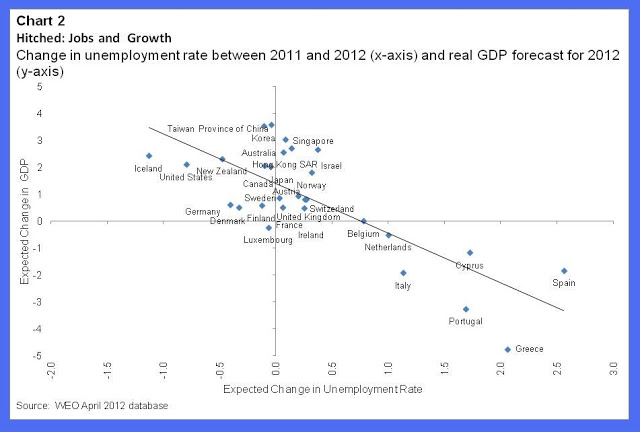
Countries such as Cyprus, Greece, Italy, the Netherlands, and Spain, where GDP is expected to decline in 2012 are the ones where unemployment is expected to increase this year.
In Iceland, New Zealand, and the United States, where GDP is expected to grow, unemployment rates are expected to decline.
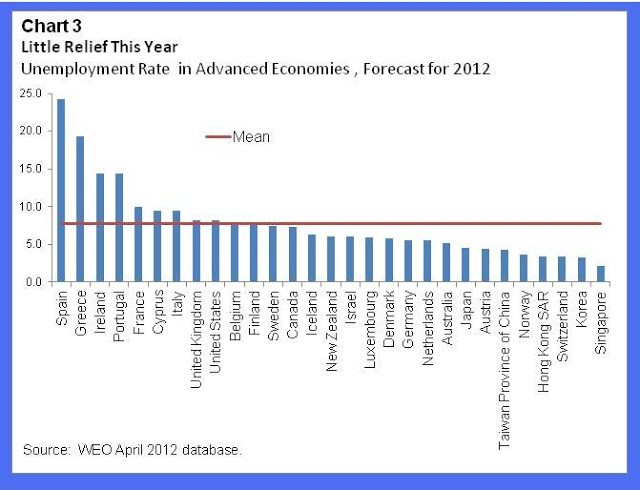
While these declines are welcome, unemployment rates are still expected to remain high in most advanced economies this year.
The average unemployment rate in these economies is expected to 7 ¾ percent, with several populous economies such as the United States, France, the United Kingdom at or above this average.
Policy response
The need to bring down these high unemployment rates is paramount.
That’s why the IMF stated in its recent World Economic Outlook that “the highest priority, but also the most difficult to achieve, is to durably increase growth in advanced economies, and especially in Europe.”
Specifically, policies must be strengthened to solidify the weak recovery and contain the many downside risks.
In the short term this will require:
- more efforts to address the euro crisis;
- a temperate approach to fiscal restraint in response to weaker activity;
- a continuation of the very accommodative monetary policies; and
- ample liquidity to the financial sector.
IMF Deputy Managing Director Min Zhu wrote today in imfdirect:
As Frank Sinatra crooned about love and marriage, so it seems about jobs and growth:
“This I tell ya, brother, you can’t have one without the other.”
The IMF’s latest World Economic Outlook projects global growth of 3 ½ percent this year. To the person on the street, what matters is how this growth translates into jobs and wages.
Posted by at 1:46 PM
Labels: Inclusive Growth
Thursday, April 5, 2012
Is U.S. Long-Term Unemployment Set to Decline?

Is U.S. long term unemployment set to decline? That’s what an updated version of my paper on cyclical versus structural unemployment predicts. The data in recent quarters have shown an even faster pace of decline than the prediction. Tomorrow’s unemployment number will tell if this trend continues. The paper was presented at the San Francisco Fed Conference (see my presentation). Here’s what Valerie Ramey and Steve Davis said about the paper.
Is U.S. long term unemployment set to decline? That’s what an updated version of my paper on cyclical versus structural unemployment predicts. The data in recent quarters have shown an even faster pace of decline than the prediction. Tomorrow’s unemployment number will tell if this trend continues. The paper was presented at the San Francisco Fed Conference (see my presentation). Here’s what Valerie Ramey and Steve Davis said about the paper.
Posted by at 7:51 PM
Labels: Inclusive Growth
Friday, March 30, 2012
Seven Questions: Unemployment through the Prism of the Great Recession
The Great Recession of 2007–09 led to a worldwide increase of 30 million in the number of people unemployed, with about half of that increase among advanced countries. This article discusses the factors behind this rise in unemployment, the reasons why countries such as Germany experienced little increase in unemployment while others were hit hard, whether policies were able to stave off an even worse outcome, and what the prospects are for labor markets in advanced countries. Here is a link to the full article.
The Great Recession of 2007–09 led to a worldwide increase of 30 million in the number of people unemployed, with about half of that increase among advanced countries. This article discusses the factors behind this rise in unemployment, the reasons why countries such as Germany experienced little increase in unemployment while others were hit hard, whether policies were able to stave off an even worse outcome, and what the prospects are for labor markets in advanced countries.
Posted by at 1:31 PM
Labels: Inclusive Growth
Friday, January 27, 2012
Davos told that stimulus and social protection vital for growth
Owen Tudor at Touch Stone reports:
The World Economic Forum (best known for hosting this week’s Davos conference) plays host to a number of Global Agenda Councils which bring together experts in a particular field to produce reports summing up the best available wisdom on what to do next. There’s a GAC on Employment and Social Protection which has produced a report for Davos 2012 snappily titled “The Case for an Integrated Model of Growth, Employment and Social Protection“. But it makes some very pertinent recommendations for the global leaders gathered in Davos, and is part and parcel of the growing intellectual argument for growth and jobs to have a higher priority than debt and deficit reduction (see recent posts on ILO, IMF and OECD reports).
The GAC on Employment and Social Protection includes people you would expect to make these arguments – like Vice-Chair TUAC General Secretary John Evans, ITUCGeneral Secretary Sharan Burrow and AFLCIO chief economist Ron Blackwell – as well as people who work in the global institutions already leaning this way like Stephen Pursey of the ILO and Prakash Loungani of the IMF. But it also includes academics like Zhang Xiulan from Beijing Normal University and Jose Antonio Ocampo from Columbia University in the US; and business representatives like Premkumar Seshadri of India’s HCL Technologies and Thero Setiloane from Business Leadership South Africa. So it’s a broad-based group.
Their five recommendations are, very briefly:
- a coordinated growth stimulus to ensure employment remains a top priority, including slowing the pace of deficit reduction in countries with the fiscal space to do so (which would certainly include the UK);
- immediate boosts to job creation and retention, such as youth employment promises and short-time working schemes;
- using social protection to help stimulate growth;
- establishing a social protection floor in developing countries, including cash transfers like Brazil’s Bolsa Familia; and
- governments working on growth and social protection with other stakeholders such as unions, business and NGOs.
Owen Tudor at Touch Stone reports:
The World Economic Forum (best known for hosting this week’s Davos conference) plays host to a number of Global Agenda Councils which bring together experts in a particular field to produce reports summing up the best available wisdom on what to do next. There’s a GAC on Employment and Social Protection which has produced a report for Davos 2012 snappily titled “The Case for an Integrated Model of Growth,
Posted by at 1:00 AM
Labels: Inclusive Growth
Subscribe to: Posts