Showing posts with label Inclusive Growth. Show all posts
Wednesday, December 19, 2012
How the IMF and the World Bank contribute to a job-rich global recovery?
Posted by at 1:23 PM
Labels: Inclusive Growth
Friday, November 2, 2012
Okun’s Law: Fit at 50?
This paper investigates how well Okun’s Law explains short-run unemployment movements in the United States since 1948 and in a sample of 20 advanced economies since 1980. Our principal conclusion is that Okun’s Law is a strong and stable relationship in most countries. Also, the coefficient in the relationship—the effect of a one percent change in output on the unemployment rate—varies substantially across countries. We take a first look at the sources of these differences; one finding is that they are not explained by differences in employment protection laws. Finally, we find that Okun’s Law held up well during the Great Recession and that recoveries have not become “jobless” in the sense of a breakdown in Okun’s Law. The paper is available here.
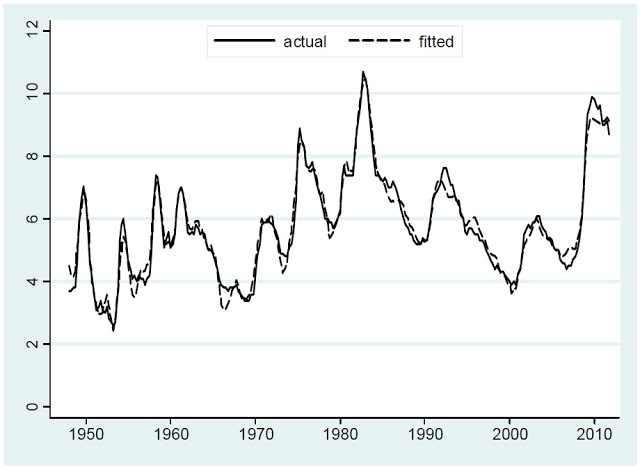
This paper investigates how well Okun’s Law explains short-run unemployment movements in the United States since 1948 and in a sample of 20 advanced economies since 1980. Our principal conclusion is that Okun’s Law is a strong and stable relationship in most countries. Also, the coefficient in the relationship—the effect of a one percent change in output on the unemployment rate—varies substantially across countries. We take a first look at the sources of these differences;
Posted by at 8:22 AM
Labels: Inclusive Growth
Tuesday, October 16, 2012
Restoring Hope: Policy Options for Jobs & Growth
Sara Eisen of Bloomberg TV moderated a discussion on jobs and growth at the Tokyo annual meetings of the IMF and the World Bank. IMF Deputy Managing Director Zhu said that “in the near term, a growth strategy is the best jobs strategy”. Read his views here.



Sara Eisen of Bloomberg TV moderated a discussion on jobs and growth at the Tokyo annual meetings of the IMF and the World Bank. IMF Deputy Managing Director Zhu said that “in the near term, a growth strategy is the best jobs strategy”. Read his views here.
Posted by at 6:45 PM
Labels: Inclusive Growth
Wednesday, October 10, 2012
State of Global Labor Markets
My regular look at the global employment picture is available here.
My regular look at the global employment picture is available here.
Posted by at 1:32 AM
Labels: Inclusive Growth
Tuesday, October 2, 2012
Jobs and Growth: Can’t Have One Without the Other?
Emerging market and developing economies have enjoyed robust growth during the past decade and bounced back quickly from the Great Recession, in marked contrast to the more tepid recovery—and even renewed recession—in advanced economies. Similarly, although unemployment in emerging market and developing economies did go up during the Great Recession, by 2011 it was essentially back to precrisis levels.Is the observed correspondence between jobs and growth a surprise, or does it represent a systemic feature of emerging market and developing economies? In a joint work with Davide Furceri, we show that the short-term relationship between labor market developments and output growth has been fairly strong in many of these economies for the past 30 years. This is particularly the case in many emerging markets. Hence, although the emphasis on structural policies to lower long term unemployment and raise labor force participation remains appropriate, cyclical developments deserve adequate consideration as well. The short term relationship between jobs and growth suggests that macroeconomic policies to maintain aggregate demand also likely play an important role in labor market outcomes in many of these economies.
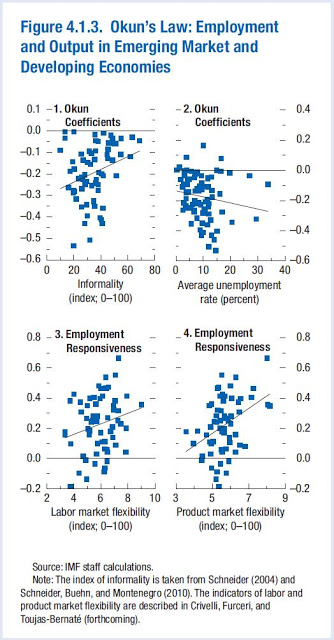
Preliminary work on Okun’s Law in advanced economies is available here.
Emerging market and developing economies have enjoyed robust growth during the past decade and bounced back quickly from the Great Recession, in marked contrast to the more tepid recovery—and even renewed recession—in advanced economies. Similarly, although unemployment in emerging market and developing economies did go up during the Great Recession, by 2011 it was essentially back to precrisis levels.Is the observed correspondence between jobs and growth a surprise, or does it represent a systemic feature of emerging market and developing economies?
Posted by at 6:04 PM
Labels: Inclusive Growth
Subscribe to: Posts