Showing posts with label Inclusive Growth. Show all posts
Tuesday, October 11, 2011
A golden oldie: Nobel Prize winner Tom Sargent on Unemployment
In a seminar at the IMF, Tom Sargent said that when he was in graduate school at Harvard in the 1960s, low European unemployment rates “were viewed as a great success and envied” by Americans. John Kennedy’s May 1961 speech to the U.S. Congress, famous today for its rhetoric about the space race (“this nation should commit itself to . . . launching a man on the moon and returning him safely to earth”), was in fact concerned largely with matters much closer to home. First and foremost on the U.S. president’s mind was his country’s high unemployment: “Large-scale unemployment during a recession is bad enough, but large-scale unemployment during a period of prosperity would be intolerable.” The 1970’s and 1980’s, however, saw a reversal in fortunes as European unemployment rates shot up dramatically. Sargent’s seminar examined why this reversal in fortunes came about. Today, as fears are being expressed about America’s labor market becoming Euro-scelerotic, Sargent’s work on unemployment remains highly relevant.

In a seminar at the IMF, Tom Sargent said that when he was in graduate school at Harvard in the 1960s, low European unemployment rates “were viewed as a great success and envied” by Americans. John Kennedy’s May 1961 speech to the U.S. Congress, famous today for its rhetoric about the space race (“this nation should commit itself to . . . launching a man on the moon and returning him safely to earth”),
Posted by at 3:10 PM
Labels: Inclusive Growth, Profiles of Economists
Sunday, October 2, 2011
De-Mythologizing Fiscal Consolidation
In Lost Decades, Jeffry Frieden and Menzie Chinn argue that fiscal consolidation is a necessary prerequisite for long term recovery; however, “fiscal consolidation too soon can derail the recovery, and plunge us further into debt. In contrast, some commentators have asserted that fiscal consolidation can be accomplished painlessly, or even with immediate benefits (e.g., JEC-Republicans, Rep. Paul Ryan/Heritage Foundation). Recent empirical work which carefully identifies the relevant episodes concludes that such instances of expansionary fiscal contraction are rare, and usually conducted near full employment.” Ball, Leigh and Loungani review the effects of fiscal contraction in “Painful Medicine“.
Read the rest of the story on Econbrowser.


In Lost Decades, Jeffry Frieden and Menzie Chinn argue that fiscal consolidation is a necessary prerequisite for long term recovery; however, “fiscal consolidation too soon can derail the recovery, and plunge us further into debt. In contrast, some commentators have asserted that fiscal consolidation can be accomplished painlessly, or even with immediate benefits (e.g., JEC-Republicans, Rep. Paul Ryan/Heritage Foundation). Recent empirical work which carefully identifies the relevant episodes concludes that such instances of expansionary fiscal contraction are rare,
Posted by at 12:36 AM
Labels: Inclusive Growth
Thursday, September 22, 2011
As World Leaders Meet, Global Unemployment Is Topic No. 1
The ultimate measure of economic success is not whether the stock or bond markets go up … but rather whether a society can provide decent jobs for its citizens, writes Jack Ewing in the NYT (the global edition of the New York Times).
He concludes: Mr. Loungani worries about the corrosive effects of unemployment on people and societies. “I know from my own experience the loss of confidence in your own skills that comes with the 200th job rejection letter,” he said. “That’s why it’s so important to get people back soon. You risk making a cyclical problem into a structural problem.”
Read the full article here.

The ultimate measure of economic success is not whether the stock or bond markets go up … but rather whether a society can provide decent jobs for its citizens, writes Jack Ewing in the NYT (the global edition of the New York Times).
He concludes: Mr. Loungani worries about the corrosive effects of unemployment on people and societies. “I know from my own experience the loss of confidence in your own skills that comes with the 200th job rejection letter,” he said.
Posted by at 2:12 PM
Labels: Inclusive Growth
Wednesday, September 14, 2011
New York Times, Huffington Post and the Washington Post on the recent F&D article
In the New York Times, Paul Krugman writes that “In the first half of last year a strange delusion swept much of the policy elite on both sides of the Atlantic — the belief that cutting spending in the face of high unemployment would actually create jobs. I went after this stuff early and hard (I suspect that the confidence fairy will be one of my lasting contributions to economic discourse); still, it’s good to have a steadily mounting weight of evidence about just how wrong that view was. The latest entry is a comprehensive review of past episodes of austerity by economists at the IMF, from which the figure above [below, Chart 3] is taken. Yes, contractionary policy is contractionary.”

Alexander EIchler of the Huffington Post summarizes the article: “The report, published in the new issue of Finance & Development, the IMF’s quarterly magazine, argues that moving too rapidly to enact so-called austerity measures — in other words, taking steps to shore up national finances and bring down debt by cutting spending and raising taxes — will hurt income in the short term and worsen unemployment in the long term.”
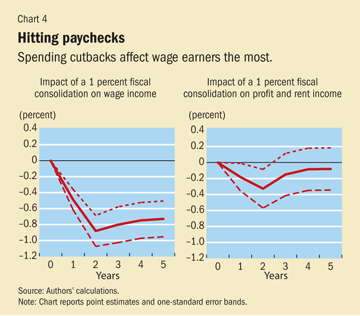
And, Brad Plumer of the Washington Post writes that “More specifically, an austerity program that curbs the deficit by 1 percent of GDP reduces real incomes by about 0.6 percent and raises unemployment by almost 0.5 percentage points. What’s more, the IMF notes, the losses are twice as big when the central bank can’t cut rates (a good description of the present.) Typically, income and employment don’t fully recover even five years after the austerity program is put in place. There’s also a class dimension here: A deficit cut of that size tends to cause real wage income, where lower-income folks get their money, to shrink by 0.9 percent, whereas rents and profits, which higher-income folks depend on, decline by just 0.3 percent. And, as the chart on the right shows [below, Chart 4], profits tend to bounce back faster than wages.”
In the New York Times, Paul Krugman writes that “In the first half of last year a strange delusion swept much of the policy elite on both sides of the Atlantic — the belief that cutting spending in the face of high unemployment would actually create jobs. I went after this stuff early and hard (I suspect that the confidence fairy will be one of my lasting contributions to economic discourse); still, it’s good to have a steadily mounting weight of evidence about just how wrong that view was.
Posted by at 12:46 AM
Labels: Inclusive Growth
Monday, September 12, 2011
Whom Will it Hurt? The Short-Run Impacts of Fiscal Consolidation
WHEN British Prime Minister David Cameron announced his government’s deficit reduction plans earlier this year he said, “Those who argue that dealing with our deficit and promoting growth are somehow alternatives are wrong. You cannot put off the first in order to promote the second” (Cameron, 2011).
The challenge facing the United Kingdom and many advanced economies is how to bring debt down to safer levels in the face of a weak recovery. Will deficit reduction lead to stronger growth and job creation in the short run?
Recent IMF research provides an answer to this question. Evidence from data over the past 30 years shows that consolidation lowers incomes in the short term, with wage-earners taking more of a hit than others; it also raises unemployment, particularly long-term unemployment.
For the advanced economies, there is an unmistakable need to restore fiscal sustainability through credible consolidation plans. At the same time, we know that slamming on the brakes too quickly will hurt the recovery and worsen job prospects. Hence the potential longer-run benefits of fiscal consolidation must be balanced against the short- and medium-run adverse impacts on growth and jobs.
Read full article on the IMF website.

WHEN British Prime Minister David Cameron announced his government’s deficit reduction plans earlier this year he said, “Those who argue that dealing with our deficit and promoting growth are somehow alternatives are wrong. You cannot put off the first in order to promote the second” (Cameron, 2011).
The challenge facing the United Kingdom and many advanced economies is how to bring debt down to safer levels in the face of a weak recovery.
Posted by at 10:42 PM
Labels: Inclusive Growth
Subscribe to: Posts