Showing posts with label Inclusive Growth. Show all posts
Friday, February 14, 2014
Does Debt Hurt Growth? Revisiting Reinhart and Rogoff
Is there a debt threshold that impairs medium term economic growth? The answer is no, according to a research paper by Andrea Pescatori, Damiano Sandri, and John Simon. They say that “Our analysis of historical data has highlighted that there is no simple threshold for debt ratios above which medium-term growth prospects are severely undermined. On the contrary, the association between debt and growth at high levels of debt becomes rather weak when one focuses on any but the shortest-term relationship, especially when controlling for the average growth performance of country peers. Furthermore, we find evidence that the relation between the level of debt and growth is importantly influenced by the trajectory of debt: countries with high but declining levels of debt have historically grown just as fast as their peers. The fact that there is no clear debt threshold that severely impairs medium term growth should not, however, be interpreted as a conclusion that debt does not matter. For example, we have found some evidence that higher debt appears to be associated with more volatile growth. And volatile growth can still be damaging to economic welfare.
As in previous empirical studies, our analysis is still subject to potential endogeneity concerns that should caution against drawing strong policy implications. However, by mitigating the short-term and mechanical reverse causality problems whereby low growth leads to higher debt, we show that the prima facie case for debt thresholds is substantially weakened. We find no evidence of threshold effects over any but the shortest-term horizons. Furthermore, the remaining relationship between debt and growth is relatively muted and the magnitude is much smaller than the dramatic figures suggested in earlier studies. Notwithstanding this, because of residual issues that confound the interpretation of the medium-term relationship between debt and growth, we emphasize that this does not establish what the underlying structural relationship is. That must wait for more sophisticated work that can properly address the complex identification issues that characterized this area of research.”
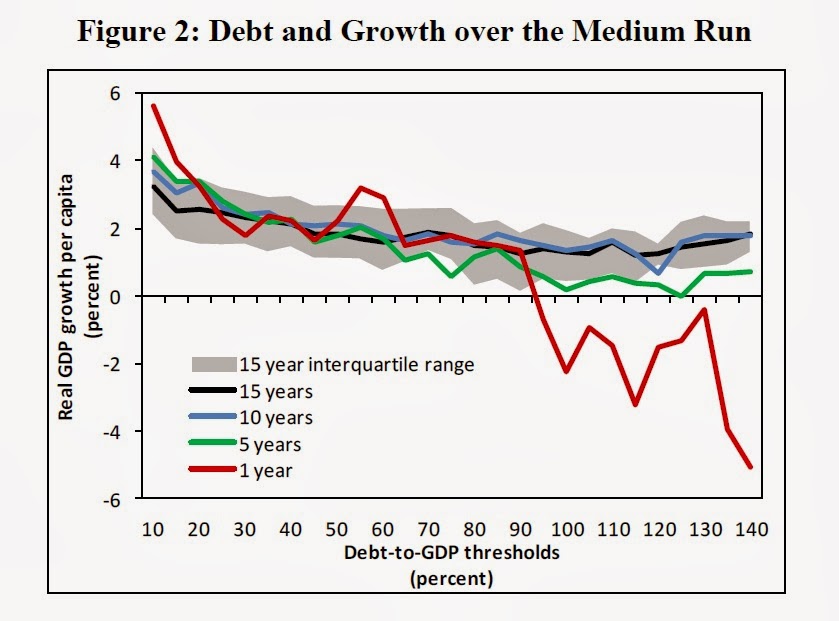
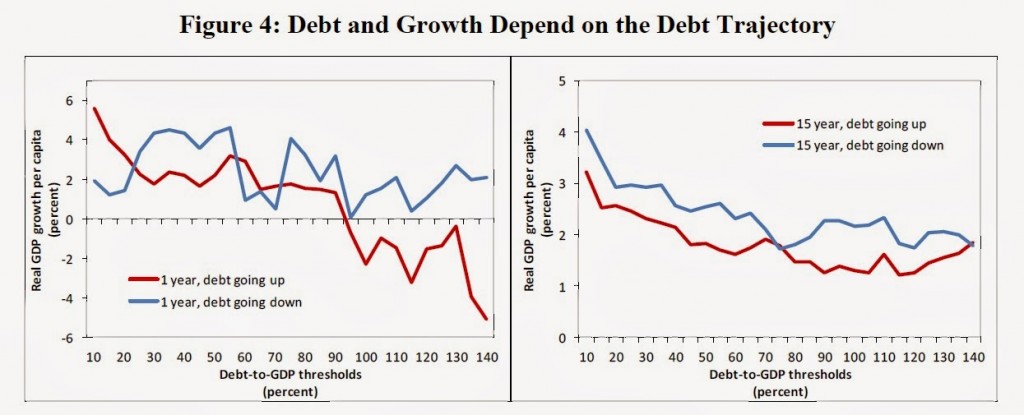
Is there a debt threshold that impairs medium term economic growth? The answer is no, according to a research paper by Andrea Pescatori, Damiano Sandri, and John Simon. They say that “Our analysis of historical data has highlighted that there is no simple threshold for debt ratios above which medium-term growth prospects are severely undermined. On the contrary, the association between debt and growth at high levels of debt becomes rather weak when one focuses on any but the shortest-term relationship,
Posted by at 10:31 PM
Labels: Inclusive Growth
Thursday, February 13, 2014
Okun’s Not Brokun’: Jobs and Growth are Still Linked
In an update of our work, Laurence Ball, Daniel Leigh and I find that the link between output growth and employment growth holds strongly in most advanced economies. We find no evidence that this link—which goes by the wonkish name of Okun’s Law—broke down during 2008 to 2013, including in high unemployment countries like Ireland and Spain. On average across the 20 advanced economies we study, a 1 percentage point increase in output growth leads to a ½ percentage point increase in employment growth. We find that Okun’s Law survived the stress test of the Great Recession: there is little evidence that the link between growth and jobs changed appreciably over the course of the Great Recession. The alleged breakdown of Okun’s Law is often a jumping-off point for arguing that structural reforms are needed to make a major dent in unemployment. Our results suggest that while there may be good reasons to recommend structural reforms to boost employment, proposing them in the belief that Okun’s Law has broken down should not be one of them.
In related work, Laurence Ball, Joao Jalles and I find that forecasters believe in Okun’s Law. For the nine advanced economies we study, the estimates of the Okun’s coefficients from forecasts is fairly similar to that in the data for various countries.

In an update of our work, Laurence Ball, Daniel Leigh and I find that the link between output growth and employment growth holds strongly in most advanced economies. We find no evidence that this link—which goes by the wonkish name of Okun’s Law—broke down during 2008 to 2013, including in high unemployment countries like Ireland and Spain. On average across the 20 advanced economies we study, a 1 percentage point increase in output growth leads to a ½ percentage point increase in employment growth.
Posted by at 7:06 PM
Labels: Inclusive Growth
Monday, January 20, 2014
Davos council recommends “two-handed” approach to tackling unemployment
The World Economic Forum (WEF) just released new reports on how to tackle the unemployment crisis. One report says that “contrary to what some commentators believe, current record-high unemployment rates cannot be attributed to skills mismatch. Indeed, there is no evidence that skill levels have collapsed during the crisis.”
The reports were produced by WEF’s council on employment. The first report is a short overview that lays out the council’s recommendations for tackling unemployment. It says that “Policy should act on both the supply and demand sides. A “two-handed” approach is needed.” The paper then lists specific recommendations on the demand side and the supply side also provides recommendations for employers and trade unions. The second report goes into greater detail on each of these recommendations.
The third report is a detailed study of the extent of various kinds of skill mismatches in OECD countries and what can be done about them. Some key points:
- Skills mismatch has become more prominent in the global economic crisis. However, it is primarily a structural issue and as such existed prior to the recent global economic slowdown. For the same reason, contrary to what some commentators believe, current record-high unemployment rates cannot be attributed to skills mismatch. Indeed, there is no evidence that skill levels have collapsed during the crisis.
- The economic crisis has caused a large increase in unemployment and underemployment in many advanced, emerging and developing countries. Yet, many employers still report difficulties in finding the required talent. Although employers tend to attribute these perceived shortages to skill deficits among job applicants, they are often explained by other factors, such as geographical mismatch between skill supply and demand, poor working conditions and inefficient or stringent human-resource practices. In the short term, a key driver of skills mismatch is the limited job opportunities available in many (especially advanced) economies, which are pushing many individuals to accept mismatched and lower-quality jobs. With weak demand, employers may become more particular when recruiting, as they can afford to wait for the perfect candidate or hire over-skilled workers. At the same time, firms facing difficult economic conditions may be required to reduce training and recruitment expenditures, which can exacerbate skills shortages and mismatch within the workplace. The underutilization of the skills of mismatched workers is an important policy concern, as it entails scarring effects on their future careers and may contribute to depreciation of their unused skills.
The World Economic Forum (WEF) just released new reports on how to tackle the unemployment crisis. One report says that “contrary to what some commentators believe, current record-high unemployment rates cannot be attributed to skills mismatch. Indeed, there is no evidence that skill levels have collapsed during the crisis.”
The reports were produced by WEF’s council on employment. The first report is a short overview that lays out the council’s recommendations for tackling unemployment.
Posted by at 3:56 PM
Labels: Inclusive Growth
Saturday, December 21, 2013
Reforming Dual Labor Markets In Advanced Economies
Labor market duality has increased dramatically in many advanced countries in recent years. While duality has some positive aspects, microeconomic and cross-country studies suggest that an excessive reliance on “non-regular” employment has a negative impact on total factor productivity (TFP) and growth, according to Giovanni Ganelli. His excellent article summarizes recent research on this topic, and draws some policy implications for reforms aimed at reducing duality and creating more inclusive labor markets in advanced economies.
Labor market duality has increased dramatically in many advanced countries in recent years. While duality has some positive aspects, microeconomic and cross-country studies suggest that an excessive reliance on “non-regular” employment has a negative impact on total factor productivity (TFP) and growth, according to Giovanni Ganelli. His excellent article summarizes recent research on this topic, and draws some policy implications for reforms aimed at reducing duality and creating more inclusive labor markets in advanced economies.
Posted by at 1:47 PM
Labels: Inclusive Growth
Monday, December 2, 2013
Moving closer? Changing patterns of labour mobility in Europe and the US
Labour mobility is one of the keys to a successful currency union – be it within or across nations. This column discusses new evidence showing that the shock-absorbing role of migration has increased in Europe and declined in the US. During the Great Recession, European migration remained high – although not high enough given the vast differences across the Eurozone. Overall, Europe has strengthened this essential adjustment mechanism. Read the full column here.

Labour mobility is one of the keys to a successful currency union – be it within or across nations. This column discusses new evidence showing that the shock-absorbing role of migration has increased in Europe and declined in the US. During the Great Recession, European migration remained high – although not high enough given the vast differences across the Eurozone. Overall, Europe has strengthened this essential adjustment mechanism. Read the full column here.
Posted by at 10:28 PM
Labels: Inclusive Growth
Subscribe to: Posts