Showing posts with label Inclusive Growth. Show all posts
Tuesday, April 22, 2014
Minimum Wages and Employment
Do minimum wages lower or raise employment in China? Yes. That’s the answer from the paper my co-author Yi Huang presented at the University of Zurich’s Macro-Finance-Labor Seminar.

Do minimum wages lower or raise employment in China? Yes. That’s the answer from the paper my co-author Yi Huang presented at the University of Zurich’s Macro-Finance-Labor Seminar.
Posted by at 8:00 PM
Labels: Inclusive Growth
Okun Isn’t Brokun’: Sorry to Sound like a Brokun’ Record
Over the past few years, the IMF has argued that Okun isn’t brokun’—the relationship between output growth and unemployment remains tight. We’ve done so here, here, here, here, here, and here. Hear! Hear! Finally it seems we’re being heard.
An independent study by the San Francisco Fed—independent in the sense that it seems unaware of any of the 6 links given above—finds that rumors of the demise of Okun’s Law may have been exaggerated; see the WSJ story on the study.
For those tempted to say, “yes, that’s the U.S. but my country is different,” see the evidence we provide in one of the six links above on how well Okun’s Law fits for advanced economies, including high unemployment countries like Spain.
Why does it matter whether Okun’s Law holds? It’s because the alleged demise of Okun’s Law is often used as a jumping-off point to argue that the link between jobs and growth is broken, so structural reforms are needed to restore job creation. The stability of Okun’s Law, combined with evidence that the Beveridge Curve is looping back to normality, as noted by Krugman, suggests that cyclical factors may still be behind the weakness in labor markets.
Over the past few years, the IMF has argued that Okun isn’t brokun’—the relationship between output growth and unemployment remains tight. We’ve done so here, here, here, here, here, and here. Hear! Hear! Finally it seems we’re being heard.
An independent study by the San Francisco Fed—independent in the sense that it seems unaware of any of the 6 links given above—finds that rumors of the demise of Okun’s Law may have been exaggerated;
Posted by at 1:53 AM
Labels: Inclusive Growth
Tuesday, April 15, 2014
The taxman cometh: IMF Book Forum on Piketty’s Capital
The sales of Piketty’s book threaten to put him into the top 1% of earners. On tax day in the US, Piketty presented his book the IMF Book Forum (and Jobs & Growth Seminar). The event was chaired by George Akerlof and Martin Ravallion was the discussant. Here are the links to the slides by Ravallion and Piketty.
Piketty said “we live in a world where we have to rely on Forbes to know the wealth of billionaires. I would prefer to get these statistics from the IMF but apparently there isn’t a publication on the distribution on income. Perhaps one day there will be.”
The sales of Piketty’s book threaten to put him into the top 1% of earners. On tax day in the US, Piketty presented his book the IMF Book Forum (and Jobs & Growth Seminar). The event was chaired by George Akerlof and Martin Ravallion was the discussant. Here are the links to the slides by Ravallion and Piketty.
Piketty said “we live in a world where we have to rely on Forbes to know the wealth of billionaires.
Posted by at 8:39 PM
Labels: Events, Inclusive Growth
Thursday, March 13, 2014
Lipton Releases IMF Paper on Fiscal Policy and Inequality
IMF First Deputy Managing Director David Lipton released a new paper on fiscal policy and inequality, adding to the stock of IMF work on this issue. Here are links and a cheat sheet to the key papers:
1) Painful Medicine: This (non-wonkish) paper documented that fiscal consolidations not only lower aggregate incomes but have distributional consequences—wage incomes fall more than profits; and the long-term unemployed are affected more than short-term unemployed.
2) The Distributional Effects of Fiscal Consolidation: A wonkish version of the “Painful Medicine” article, with the additional result that, between 1978 and 2009, fiscal consolidations in advanced economies increased the Gini measure on income inequality.
3) Distributional Consequences of Fiscal Consolidation and the Role of Fiscal Policy: In addition to confirming the results in the previous papers, this paper brings in evidence from emerging markets. It also discusses how policies can be designed to mitigate the impacts of fiscal policy on inequality.
4) Who Let the Gini Out? A (non-wonkish) summary of some of the previous papers.
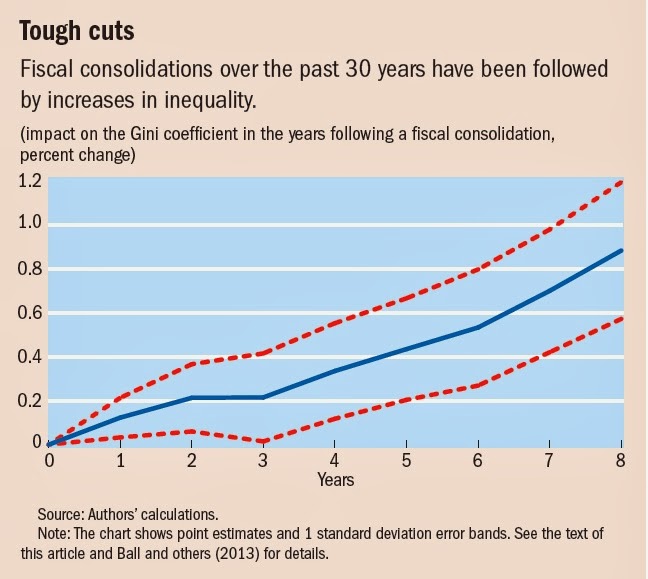
5) Fiscal Policy and Inequality: A key finding of the paper is that fiscal consolidations during the Great Recession did not lead to increases in inequality.
IMF First Deputy Managing Director David Lipton released a new paper on fiscal policy and inequality, adding to the stock of IMF work on this issue. Here are links and a cheat sheet to the key papers:
1) Painful Medicine: This (non-wonkish) paper documented that fiscal consolidations not only lower aggregate incomes but have distributional consequences—wage incomes fall more than profits; and the long-term unemployed are affected more than short-term unemployed.
Posted by at 5:49 PM
Labels: Inclusive Growth
Wednesday, February 26, 2014
The IMF on Inequality: New Ostry-Berg Paper on Redistribution
A new paper by Andrew Berg and Jonathan Ostry (along with Haris Tsangarides) adds to the growing stock on IMF work on inequality.
In the recent past, the IMF has released papers on the impacts of fiscal tightening on inequality — see a summary here and to the research on which it is based here and here.
The IMF has also looked at the impact of capital account liberalization on inequality — see this article and Vox post.
The Berg-Ostry paper showed that inequality lowers the duration of growth spells. The new paper makes the case that redistribution efforts to lower inequality are not harmful to growth.
A new paper by Andrew Berg and Jonathan Ostry (along with Haris Tsangarides) adds to the growing stock on IMF work on inequality.
In the recent past, the IMF has released papers on the impacts of fiscal tightening on inequality — see a summary here and to the research on which it is based here and here.
The IMF has also looked at the impact of capital account liberalization on inequality —
Posted by at 4:04 PM
Labels: Inclusive Growth
Subscribe to: Posts