Showing posts with label Inclusive Growth. Show all posts
Thursday, November 20, 2014
Does Growth Lower Unemployment? (Was Krugman Right Yet Again)?
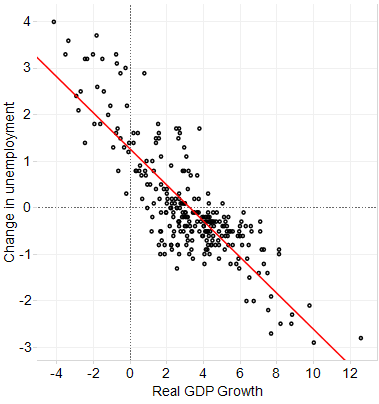
On July 9, 2011 when U.S. unemployment was at record highs, Paul Krugman wrote: “Why is unemployment remaining high? Because growth is weak — period, full stop, end of story.” Krugman went on to appeal to an old relationship known as Okun’s Law: “Historically, low or negative growth has meant rising unemployment, fast growth falling unemployment (Okun’s Law).”
How well has Okun’s Law held up in the 3 ½ years since Krugman wrote? The evidence for the period 1947 to the present is shown below. It is evident that, for the U.S., Okun’s Law has held up quite well, as I have noted before.
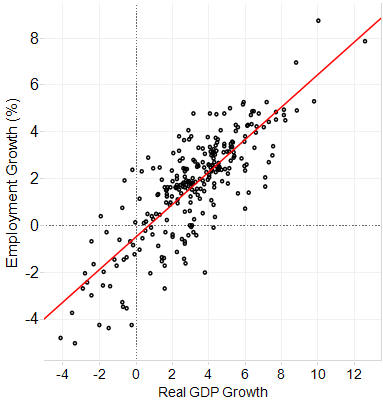
In a recent presentation at Oberlin College, I also looked at how well Okun’s Law holds across the world. If you don’t want to flip through the (fascinating) 100-slide presentation, I did a short summary this week for the IMF’s blog.
On July 9, 2011 when U.S. unemployment was at record highs, Paul Krugman wrote: “Why is unemployment remaining high? Because growth is weak — period, full stop, end of story.” Krugman went on to appeal to an old relationship known as Okun’s Law: “Historically, low or negative growth has meant rising unemployment, fast growth falling unemployment (Okun’s Law).”
How well has Okun’s Law held up in the 3 ½ years since Krugman wrote? Read the full article…
Posted by at 5:36 PM
Labels: Inclusive Growth
Wednesday, October 8, 2014
Is Unemployment Inevitable?
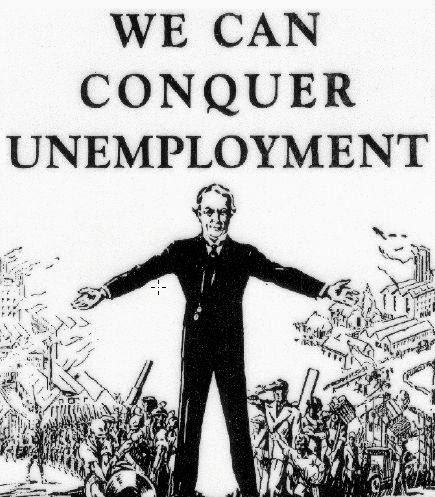
My answer: “No”. For details, see my presentation at the European Trade Union Institute conference.
Posted by at 2:37 PM
Labels: Inclusive Growth
Tuesday, September 23, 2014
Moving on: Labor mobility in the United States
There is an old quip about a guy who hears on the local news that most accidents happen within five miles of home. “Darn, I’ve got to move,” he says to himself. Moving wouldn’t solve this guy’s problem, but moving on has generally been an important means of responding to bad news about regional prospects. For the United States, the importance of labor mobility as an adjustment mechanism in the face of adverse regional shocks was shown in a classic paper by Blanchard and Katz (1992). Over 20 years later, how have the Blanchard-Katz findings held up?
Mai Dao, Davide Furceri and I have updated and extended the Blanchard-Katz findings in a new paper. What do we find?
- Labor mobility remains an important adjustment mechanism in the United States. The use of direct migration data and of instrumental variables estimation, however, suggests that the response of mobility is weaker than in the original Blanchard-Katz paper.
- There are larger mobility responses to regional shocks in recessions than in good times. This seems counter-intuitive: is it really worth moving during a recession from a place with 12 percent unemployment to a place with 7 percent unemployment?. We try to understand why this might be the case and suggest that the answer could lie in cyclical variation in the ability to smooth consumption. Using standard tests, we show that the ability to insure consumption against idiosyncratic risk is pro-cyclical, rising in booms while being almost absent in recessions. Hence it appears that the increased migration during recessions comes out of the desperation of people who have run out of other options.
- Some suggestive evidence in support of this view comes from micro data: we show that it is mostly the long-term unemployed and labor market entrants who undertake the bulk of increased migration during recessions. The long-term unemployed tend to experience larger and more persistent income losses and labor market entrants have the least savings to tap into and less collateral to obtain loans. Therefore one would also expect these groups to have the lowest ability to smooth consumption over the downturn.
In an earlier version of the paper we also compared labor mobility in Europe and the US; these findings were summarized by Krugman.
There is an old quip about a guy who hears on the local news that most accidents happen within five miles of home. “Darn, I’ve got to move,” he says to himself. Moving wouldn’t solve this guy’s problem, but moving on has generally been an important means of responding to bad news about regional prospects. For the United States, the importance of labor mobility as an adjustment mechanism in the face of adverse regional shocks was shown in a classic paper by Blanchard and Katz (1992).
Posted by at 11:16 AM
Labels: Inclusive Growth
What Lies Beneath: A Sub-National Look at Okun’s Law
Saurabh Mishra and I have been estimating Okun’s Law for U.S. states. It seems to hold quite well in most states. Judge for yourself:
http://murmuring-harbor-6048.herokuapp.com/index.html
Saurabh Mishra and I have been estimating Okun’s Law for U.S. states. It seems to hold quite well in most states. Judge for yourself:
http://murmuring-harbor-6048.herokuapp.com/index.html
Posted by at 11:12 AM
Labels: Inclusive Growth
Wednesday, August 27, 2014
Are You Cut Out To Be A Macroeconomist? A Simple Test
Try this at home. The chart below shows you the relationship between unemployment and output (to be precise, it is the relationship between the change in unemployment and output growth). The chart is automatically updated, starting with the relationship as it appeared in 1948 to 1963, and then adding 10 additional years at a time to bring it all the way to the present. (You can also click on this link to see these charts: Okun’s Law Over Time.) Now here’s the first question on the test: Do you think the relationship shown in these charts has remained strong and stable over time?
Here’s the link to another macroeconomic relationship, this one between unemployment and inflation. Same deal: first you see the relationship over the 1948 to 1963 period and the charts that follow add 10 years at a time. (You can also click on this link to see these charts: Phillips Curve Over Time.) Second question on the test: Do you think the relationship shown in these charts has remained strong and stable over time?
If you are suspecting a trick you are right. To the lay person, it probably seems that the first relationship, known as Okun’s Law, is strong and stable and the second relationship, known as the Phillips Curve, is weak and unstable. But macroeconomists actually worry a lot that Okun’s Law is dead. And—using special goggles known as ‘econometrics’—they are able to see the Phillips Curve where the lay person may just see a cloud.
Robert Gordon, a renowned macroeconomist, for example has proclaimed the demise of Okun’s Law and noted that, in contrast, the Phillips Curve is ‘alive and well’. This is what keeps macroeconomics interesting: things may not be what they seem. (For what it’s worth, I think that Okun’s Law is alive and well and that the Phillips Curve is being kept alive with artificial resuscitation—but then I’m closer to a lay person than to a renowned macroeconomist.)
Try this at home. The chart below shows you the relationship between unemployment and output (to be precise, it is the relationship between the change in unemployment and output growth). The chart is automatically updated, starting with the relationship as it appeared in 1948 to 1963, and then adding 10 additional years at a time to bring it all the way to the present. (You can also click on this link to see these charts: Okun’s Law Over Time.) Now here’s the first question on the test: Do you think the relationship shown in these charts has remained strong and stable over time?
Posted by at 6:13 PM
Labels: Inclusive Growth, Macro Demystified
Subscribe to: Posts