Showing posts with label Inclusive Growth. Show all posts
Wednesday, February 11, 2015
Is Manufacturing Still a Key to Growth?
In a new OCP Policy Center paper, Uri Dadush of Carnegie and OCP writes: “The paper has shown that, over the last thirty years, many economies have been able to double their per capita income and achieve large improvement in other development indicators without relying principally on manufacturing. The main policy implication is not that the manufacturing sector should be shunned or ignored, but that the view that a large manufacturing sector oriented towards world markets is essential to a rapid advance in living standards is mistaken. Read the full article…
Posted by at 12:41 PM
Labels: Inclusive Growth
Friday, February 6, 2015
International Jobs Report: It’s Not Just About US

The U.S jobs report to be released today is expected to show strong job creation. How do things look outside the U.S.? The new International Jobs Report shows that the global unemployment rate has returned to its pre-crisis level. But emerging economies are doing better than advanced economies; and within advanced economies, the U.S is doing better than the rest.
Posted by at 11:40 AM
Labels: Inclusive Growth
Wednesday, February 4, 2015
The Secret of the (Economic) Universe
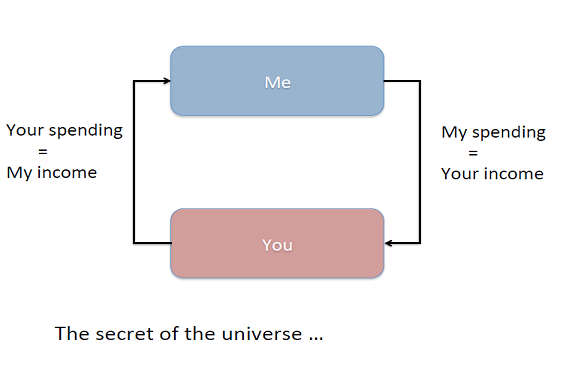
It’s like the sign you see outside some restaurants: “Come in and eat or we’ll both starve”

According to Krugman, the secret of the universe is:
It’s like the sign you see outside some restaurants: “Come in and eat or we’ll both starve”
Posted by at 4:45 PM
Labels: Inclusive Growth
Labour mobility in the EU: dynamics and policies

See my presentation here that gives some background on this discussion.
“Labour mobility between countries within the European Union, and within the euro area, is relatively low, especially compared to mobility between States in the United States. Nevertheless, the enlargement of the EU over the previous decade led to substantial migration from new Member States of Eastern Europe to Member States in the west. Furthermore, since the crisis, there have been significant migration flows, as unemployment rose in the hardest hit countries and unemployment rates diverged widely within the euro area.” Read the full article…
Posted by at 2:45 AM
Labels: Inclusive Growth
Wednesday, January 14, 2015
Global Joblessness Returns To Precrisis Levels In New IMF Employment Gauge
Global unemployment is finally back to levels seen before the global financial crisis. But the recession has left a sharp divergence between advanced and emerging economies, according to a new gauge unveiled by the International Monetary Fund.
The world’s jobless rate ended 2014 at 5.6%, where it stood in 2007. But global employment is growing at just 1.5% a year, far slower than the 2% to 2.5% growth rate seen before the crisis.
The figures are from a new Global Jobs Index by the IMF and the Economist Intelligence Unit. The index, the first worldwide gauge of its kind, will offer quarterly estimates based on employment in 64 economies that represent about 95% of the world’s economic output and 80% of its labor force. (Some jobs numbers are drawn from historical relationships between jobs and economic growth.)
The world’s top policy makers, convening through the G-20 and the IMF, have long used overall economic growth measures to assess their progress. But they often note that jobs are the key measure of their success. The latest gauge shows one way they’re struggling. Top-line measures such as unemployment are returning to normal levels in many nations, including the U.S., but overall employment growth remains sluggish.
“The index can be used to take the pulse of global labor markets at more regular intervals than has been done before,” IMF economist Prakash Loungani wrote. “While financial markets are monitored second-by-second, data on jobs—which matters more to most people—are often not available every quarter because many countries do not report employment numbers in a timely manner.”
The new report shows a striking divergence between advanced and emerging economies. Unemployment in advanced economies–members of the Organization for Economic Cooperation and Development–stood at 7.4% in 2014, far higher than the 5.7% seen in 2007. The eurozone is largely responsible for that elevated level, with most economies other than Germany struggling to regain ground.
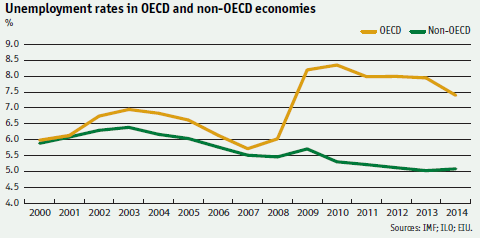
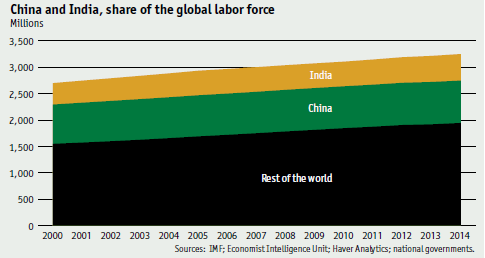
Emerging markets have generally fared better on the employment front, at least according to official measures. But the report notes that official gauges for China and India, which together account for 40% of the global labor force, are widely seen as too low. Substituting a measure of joblessness for those countries from the private Economist Intelligence Unit would put the global unemployment rate in 2014 just above 7%.
From the Wall Street Journal:
Global unemployment is finally back to levels seen before the global financial crisis. But the recession has left a sharp divergence between advanced and emerging economies, according to a new gauge unveiled by the International Monetary Fund.
The world’s jobless rate ended 2014 at 5.6%, where it stood in 2007. But global employment is growing at just 1.5% a year, far slower than the 2% to 2.5% growth rate seen before the crisis.
Posted by at 9:58 PM
Labels: Inclusive Growth
Subscribe to: Posts