Showing posts with label Inclusive Growth. Show all posts
Tuesday, November 17, 2015
Effects of Wage Moderation in the Euro Area
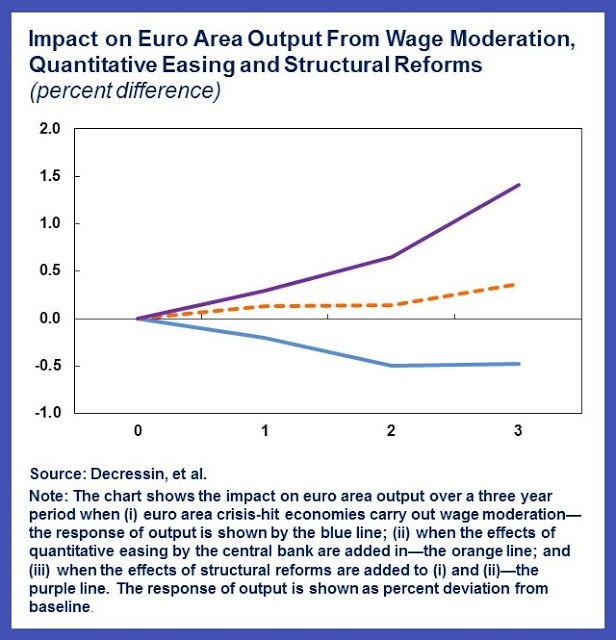
A devaluation is often a way out of financial trouble for a country. But for many crisis-hit countries in the euro area, devaluation is not an option. ‘Internal’ devaluation—through wage moderation, for instance—is often discussed as an alternative solution for these countries to try to mimic the outcomes of an external devaluation. When does such internal devaluation work? My new IMF paper provides evidence on this using the euro area countries as an illustration. The main finding is that for wage moderation to work when a number of countries are undertaking it at the same time, Read the full article…
Posted by at 9:51 PM
Labels: Inclusive Growth
Thursday, November 5, 2015
International Jobs Report
Read the latest International Jobs Report here. Read the full article…
Posted by at 2:58 PM
Labels: Inclusive Growth
Tuesday, October 27, 2015
On U.S. Labor Market Slack: Updated Estimates of the Impact of Uncertainty on Unemployment
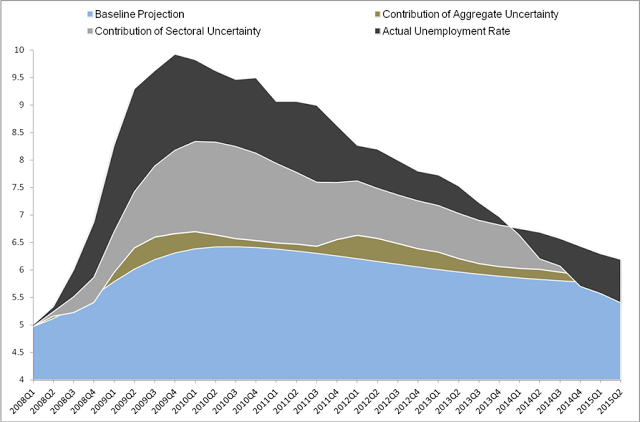
We find that aggregate uncertainty contributed a bit to unemployment in 2009 and again in 2012 (this is the portion of the chart shown in brown). Our aggregate uncertainty measure is the realized volatility of S&P 500 index returns, similar to Bloom (2009).
Our sectoral uncertainty measure is the cross-section dispersion in excess returns across various industries. We show in our paper that this measure of uncertainty tends to have more persistent impacts on unemployment than aggregate uncertainty. The contribution of sectoral uncertainty to U.S. unemployment was important in mid-2010—this was the result that Bob Samuelson cited in his column at the time. But the contribution of sectoral uncertainty has declined steadily ever since and is essentially zero at present. (This is the portion of the chart shown in grey.)
The main reason for the decline in unemployment is the resumption of growth and unemployment’s own dynamics; their contribution is shown as part of the other factors in the chart above (the portion shown in black).
Details are provided in our paper. Please note that as in other IMF working papers, the views expressed in this paper are those of the authors and should not be ascribed to the IMF.
Is uncertainty contributing to U.S. unemployment at present? Based on updated estimates of my work with Sam Choi the answer is “no”. Our measures of aggregate uncertainty and sectoral uncertainty are both back to pre-crisis levels and their contribution to unemployment has dwindled to zero. The chart below shows a baseline projection for unemployment (the portion shown in blue) and then adds on the contribution of other factors to get to the actual unemployment rate.
We find that aggregate uncertainty contributed a bit to unemployment in 2009 and again in 2012 (this is the portion of the chart shown in brown).
Posted by at 12:00 PM
Labels: Inclusive Growth
Thursday, October 22, 2015
Union power and inequality
Inequality in advanced economies has risen considerably since the 1980s, largely driven by the increase of top earners’ income shares. This column [by Florence Jaumotte and Carolina Osorio Buitron (both at the IMF)] revisits the drivers of inequality, emphasising the role played by changes in labour market institutions. It argues that the decline in union density has been strongly associated with the rise of top income inequality and discusses the multiple channels through which unionisation matters for income distribution.
Revisiting the drivers of inequality: The role of labour market institutions
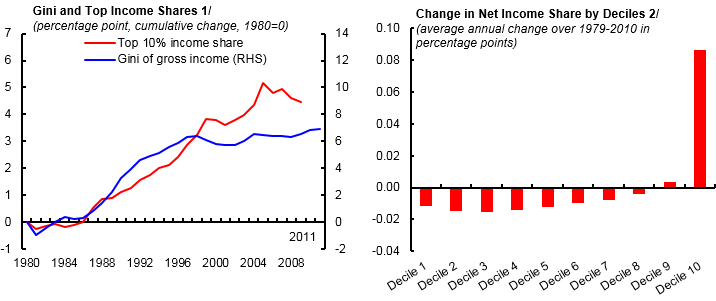
Rising inequality in advanced economies, in particular at the top of the distribution, has become a great focus of attention for economists and policymakers. In most advanced economies, the share of income accruing to the top 10% earners has increased at the expense of all other income groups (Figure 1). While some inequality can increase efficiency by strengthening incentives to work and invest, recent research suggests that high inequality is associated with lower and less sustainable growth in the medium run (Berg and Ostry 2011, Dabla-Norris et al. 2015). Moreover, a rising concentration of income at the top of the distribution can also reduce welfare by allowing top earners to manipulate the economic and political system in their favour (Stiglitz 2012).
Traditional explanations for the rise of inequality in advanced economies have been skill-biased technological change and globalisation, which increase the relative demand for skilled workers. However, these forces foster economic growth, and there is little policymakers are able or willing to do to reverse these trends. Moreover, while high income countries have been similarly affected by technological change and globalisation, inequality in these economies has risen at different speeds and magnitudes.
Figure 1. Evolution of inequality measures in advanced economies
Continue reading here.
Inequality in advanced economies has risen considerably since the 1980s, largely driven by the increase of top earners’ income shares. This column [by Florence Jaumotte and Carolina Osorio Buitron (both at the IMF)] revisits the drivers of inequality, emphasising the role played by changes in labour market institutions. It argues that the decline in union density has been strongly associated with the rise of top income inequality and discusses the multiple channels through which unionisation matters for income distribution. Read the full article…
Posted by at 10:29 AM
Labels: Inclusive Growth
Wednesday, September 16, 2015
Israel’s Labor Market: High Inequality, Low Productivity
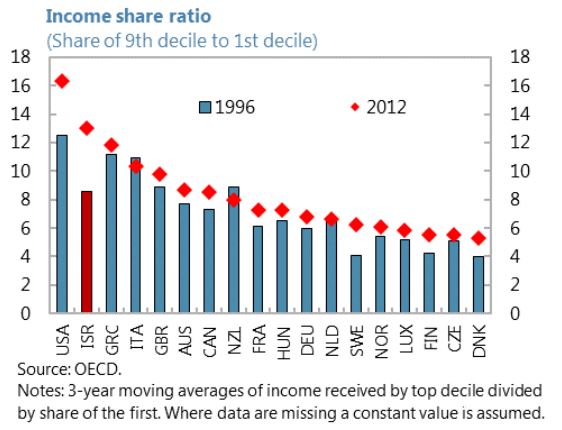
- Inequality in Israel is among the highest in the OECD (this refers to net income inequality, that is, inequality of income after tax and transfers). The income share of the richest 10 percent of people is 13 times the share of the bottom 10 percent, a ratio that is exceeded only by the United States. Real disposable incomes of the top decile have increased since the 1980s, while incomes of the bottom decile have stagnated. Israel’s Gini coefficient of disposable income is among the highest in the OECD.
- Average incomes in Israel are similar to those in Korea and New Zealand but well below the level in richer Western European countries and the United States. There was rapid catch-up toward U.S. incomes between 1950 and the mid- 1970s, but since then Israel’s average income has stagnated at around 60 percent of US average incomes.
- Part of this stagnation is due to low productivity growth. One reason may be that Israel is the most restrictive amongst advanced economies in terms of product market regulations—state control, barriers to entrepreneurship, and barriers to trade and investment all rank amongst the highest across its peers.. In terms of sectors, Israel ranks amongst the highest in regulation of network sectors, retail trade and professional services.
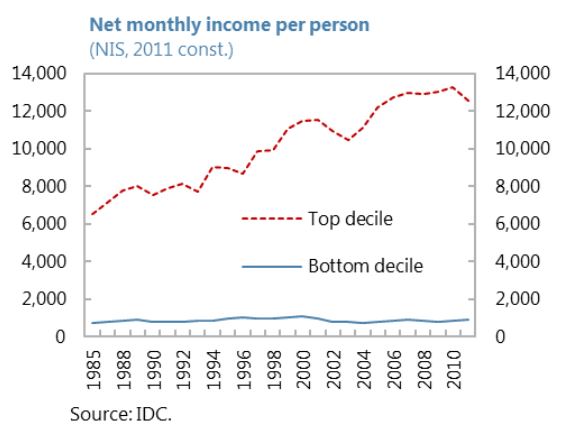
A new IMF report provides an in-depth look at Israel’s labor market:
- Inequality in Israel is among the highest in the OECD (this refers to net income inequality, that is, inequality of income after tax and transfers). The income share of the richest 10 percent of people is 13 times the share of the bottom 10 percent, a ratio that is exceeded only by the United States. Real disposable incomes of the top decile have increased since the 1980s,
Posted by at 5:58 PM
Labels: Inclusive Growth
Subscribe to: Posts