Showing posts with label Inclusive Growth. Show all posts
Tuesday, October 11, 2016
Does Growth Create Jobs? Evidence for Advanced and Developing Economies
Global job creation remains sluggish, prompting calls for policy actions to raise economic growth. Will growth create jobs? Recent IMF research documents a striking variation among countries in the extent to which employment responds to GDP growth over the course of a year. In some countries, labor markets are quite responsive: when growth picks up, employment goes up and unemployment falls; in other countries the response is quite muted. Thus, a pick-up in growth— through aggregate demand stimulus for instance—will result in more jobs, but the extent of job creation in the short run could vary sharply across countries. Some structural measures can thus serve as useful complementary policies, as also discussed in IMF research.
Continue reading IMF Research Bulletin.
Global job creation remains sluggish, prompting calls for policy actions to raise economic growth. Will growth create jobs? Recent IMF research documents a striking variation among countries in the extent to which employment responds to GDP growth over the course of a year. In some countries, labor markets are quite responsive: when growth picks up, employment goes up and unemployment falls; in other countries the response is quite muted. Thus, a pick-up in growth— through aggregate demand stimulus for instance—will result in more jobs,
Posted by at 9:14 PM
Labels: Inclusive Growth
Verdict on Greenspan: Mallaby’s New Biography Delivers
Former Fed Chair Alan Greenspan is considered by many to be guilty of refusing to regulate financial markets because of an ideological bias; but Sebastian Mallaby’s new biography exonerates him of that charge. The more serious error was on monetary policy, where Greenspan is considered the maestro: Mallaby says Greenspan should have raised interest rates to battle asset bubbles. The more formal commitment to inflation targeting since Greenspan’s retirement has “compounded this problem.”
“With great power comes great responsibility”: Greenspan’s great error
Sebastian Mallaby’s brilliant new book says that the Fed under Greenspan “brilliantly limited fluctuations in inflation” and deserves credit for this achievement. But, “Greenspan utterly failed to limit leverage and bubbles, and this failure magnified financial fragility. Because he conducted monetary policy with a view to ensuring price stability, not financial stability, Greenspan allowed this fragility to grow and grow.”
Specifically, Mallaby thinks Greenspan should have raised rates in 2004-05. He does not buy what he calls the “three-part mantra” by Greenspan and his sympathizers that the Fed cannot identify bubbles in real time; that the mess could be better cleaned up when the bubbles went bust; that interest rates would have to be raised by so much that the rest of the economy would have gone bust. He argues that there was enough information to make the judgment that a bubble had developed in housing markets and the cost of clean-up has vastly exceeded the likely damage to the economy from raising rates in 2004-05.
Mallaby concludes that “Greenspan knew that financial stability mattered. But he focused instead on inflation for a simple and not entirely good reason. Controlling asset prices and leverage was hard; fighting inflation was easier … Greenspan choose the path of least resistance.” He says that “as inflation abated and financial excesses started to build up, the chairman should have pivoted to face the new challenge—he should have conducted monetary policy with an eye to stabilizing finance. Failing to execute that pivot was Greenspan’s most consequential error, one that he did not have to make” (my emphasis).
“With limited power comes limited responsibility”: Greenspan and Regulation
In contrast to his harsh judgment on Greenspan’s monetary policy, Mallaby exonerates Greenspan on the charge of failing to push regulation of the new financial markets (derivatives, megabanks, shadow banks and leverage) and moreover for failing to do so for ideological reasons.
By the time Greenspan became Fed chair, “his ideology was mostly gone,” says Mallaby. “The real reasons for Greenspan’s tolerance of the new finance” were two-fold. First, Mallaby writes, Greenspan, like many others of both sides of the ideological spectrum, made the “pragmatic judgment that megabanks, derivatives and securitization might be stabilizing, seeing in them risk-spreading advantages as well as evident pitfalls.” Second, he made the “equally pragmatic judgment that fighting for the new regulation would be politically impossible. It would mean forging a united front among multiple regulatory bodies, and it would involve battling powerful lobbies that had the ear of Congress. With his reflexive passivity, Greenspan had no stomach for this fight.”
Mallaby says Greenspan should not be judged too harshly for this course of action. Would he have made a real difference if he had acted more boldly? “The best guess is that he would not … He was maneuvering in cramped political terrain, boxed in by a clamorous multitude of turf fighters and string pullers and influence peddlers … He should not be condemned, for with limited power comes limited responsibility.”
Implications for the future
Mallaby’s version of events has some somber implications: “Greenspan’s monetary policy, entailing a single-minded focus on inflation is commonly lauded. And yet, as I have argued, focusing on inflation distracted the Fed from the perils of finance. By committing itself more formally to inflation targeting after Greenspan’s retirement, the Fed has unfortunately compounded this problem.”
Former Fed Chair Alan Greenspan is considered by many to be guilty of refusing to regulate financial markets because of an ideological bias; but Sebastian Mallaby’s new biography exonerates him of that charge. The more serious error was on monetary policy, where Greenspan is considered the maestro: Mallaby says Greenspan should have raised interest rates to battle asset bubbles. The more formal commitment to inflation targeting since Greenspan’s retirement has “compounded this problem.”
“With great power comes great responsibility”: Greenspan’s great error
Sebastian Mallaby’s brilliant new book says that the Fed under Greenspan “brilliantly limited fluctuations in inflation” and deserves credit for this achievement.
Posted by at 7:59 AM
Labels: Inclusive Growth
Tuesday, October 4, 2016
Jobs and Growth: Outlook and Policy Response
My talk today to the Parliamentary Network of the IMF and the World Bank, a group I always enjoy talking to. This time they had really good questions on the IMF position on public infrastructure. And many of them even asked me why the Okun elasticity differs across countries – what more could a nerd ask for?
My talk today to the Parliamentary Network of the IMF and the World Bank, a group I always enjoy talking to. This time they had really good questions on the IMF position on public infrastructure. And many of them even asked me why the Okun elasticity differs across countries – what more could a nerd ask for?
Posted by at 11:14 AM
Labels: Inclusive Growth
Monday, October 3, 2016
Financial Globalization, Inequality and the Top 1%
Davide Furceri and I have revised our IMF Working Paper on the impacts of financial globalization—specifically, the elimination of restrictions on the capital account—on inequality. We find that episodes of capital account liberalization are followed by an increase in the share of income going to the top 1% (the chart below shows the impact). Our previous work had already shown that the Gini coefficient increases following capital account liberalization. The details, and several other new results, are given in the revised paper.
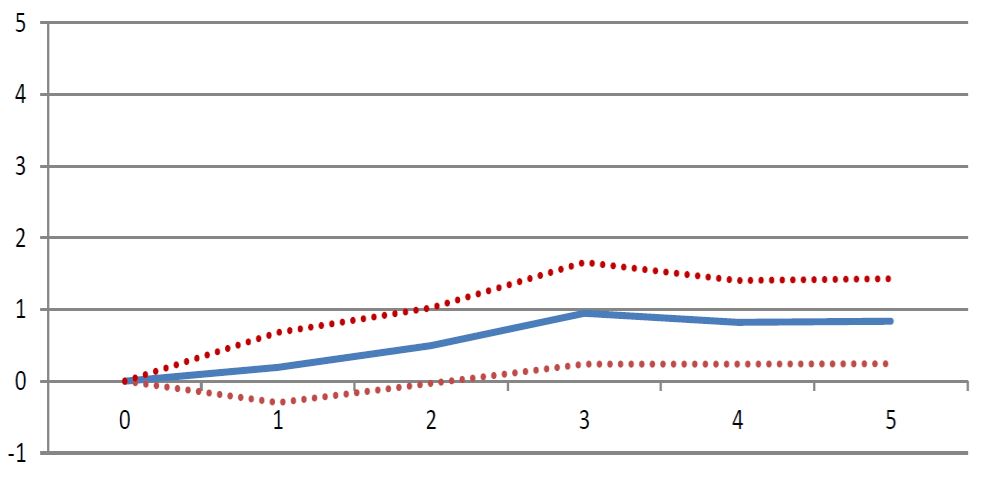
Davide Furceri and I have revised our IMF Working Paper on the impacts of financial globalization—specifically, the elimination of restrictions on the capital account—on inequality. We find that episodes of capital account liberalization are followed by an increase in the share of income going to the top 1% (the chart below shows the impact). Our previous work had already shown that the Gini coefficient increases following capital account liberalization. The details, and several other new results,
Posted by at 1:28 PM
Labels: Inclusive Growth
IMF Research on Inequality: A Primer
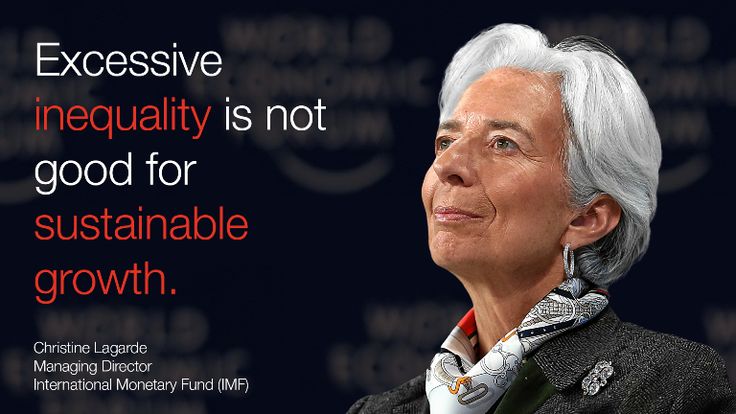
The IMF’s recent research on inequality has attracted a lot of (mostly favorable) attention. My talk to CSOs today describes the main findings of this research. Focusing on within-country inequality, I classify the work into three categories: causes, consequences, cures.
- On causes, the main finding is that—in addition to broad trends like trade, technology and demographics—inequality is driven by economic policies. This is not an earth-shattering finding but it is an important one. The policies that turn out to drive inequality include fiscal policies, capital account liberalization (i.e. policies to foster mobility of capital across national boundaries) and labor market policies. Many of these are ‘bread-and-butter’ issues for the IMF, ones on which it routinely gives advice to its member countries.
- On consequences, there has been a novel research finding: inequality lowers the durability of growth spells. This result also puts inequality squarely with the remit of the IMF’s work: fostering sustained growth, a goal of IMF advice, requires some attention to inequality.
- As it should, the work on cures follows from what has been learnt about the causes and consequences. To take an example: if fiscal policies are a cause of inequality, the IMF’s advice on the design of these polices needs to account for this fact. This is both because the distributional consequences may be important in their own right to some governments and because—as noted—they can have an adverse effect on the sustainability of growth. One new research finding, which has implications for the design of many policies, is that redistribution, unless extreme, does not have an adverse impact on growth; hence redistribution need not be feared as a cure.
Details and links to the underlying papers are given in this PPT.
The IMF’s recent research on inequality has attracted a lot of (mostly favorable) attention. My talk to CSOs today describes the main findings of this research. Focusing on within-country inequality, I classify the work into three categories: causes, consequences, cures.
- On causes, the main finding is that—in addition to broad trends like trade, technology and demographics—inequality is driven by economic policies. This is not an earth-shattering finding but it is an important one.
Posted by at 1:02 PM
Labels: Inclusive Growth
Subscribe to: Posts