Showing posts with label Inclusive Growth. Show all posts
Tuesday, October 4, 2016
Jobs and Growth: Outlook and Policy Response
My talk today to the Parliamentary Network of the IMF and the World Bank, a group I always enjoy talking to. This time they had really good questions on the IMF position on public infrastructure. And many of them even asked me why the Okun elasticity differs across countries – what more could a nerd ask for?
My talk today to the Parliamentary Network of the IMF and the World Bank, a group I always enjoy talking to. This time they had really good questions on the IMF position on public infrastructure. And many of them even asked me why the Okun elasticity differs across countries – what more could a nerd ask for?
Posted by at 11:14 AM
Labels: Inclusive Growth
Monday, October 3, 2016
Financial Globalization, Inequality and the Top 1%
Davide Furceri and I have revised our IMF Working Paper on the impacts of financial globalization—specifically, the elimination of restrictions on the capital account—on inequality. We find that episodes of capital account liberalization are followed by an increase in the share of income going to the top 1% (the chart below shows the impact). Our previous work had already shown that the Gini coefficient increases following capital account liberalization. The details, and several other new results, are given in the revised paper.
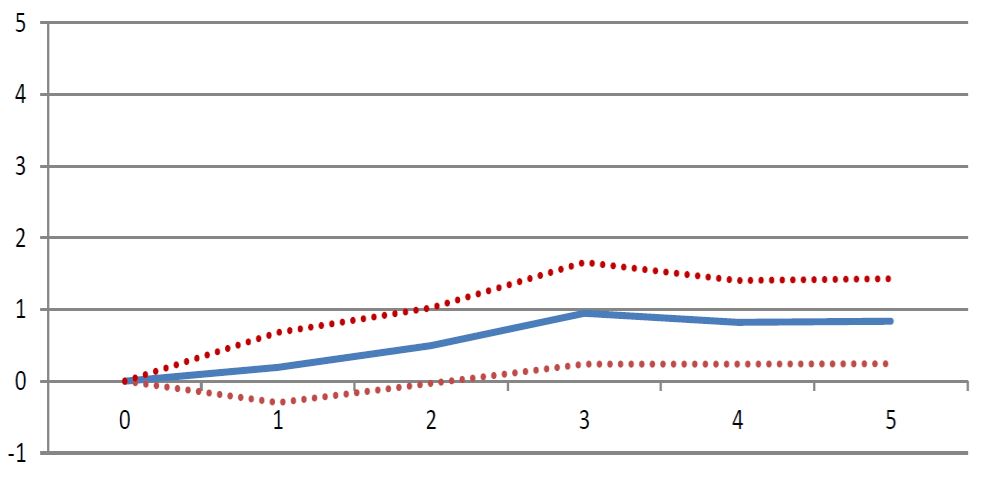
Davide Furceri and I have revised our IMF Working Paper on the impacts of financial globalization—specifically, the elimination of restrictions on the capital account—on inequality. We find that episodes of capital account liberalization are followed by an increase in the share of income going to the top 1% (the chart below shows the impact). Our previous work had already shown that the Gini coefficient increases following capital account liberalization. The details, and several other new results,
Posted by at 1:28 PM
Labels: Inclusive Growth
IMF Research on Inequality: A Primer
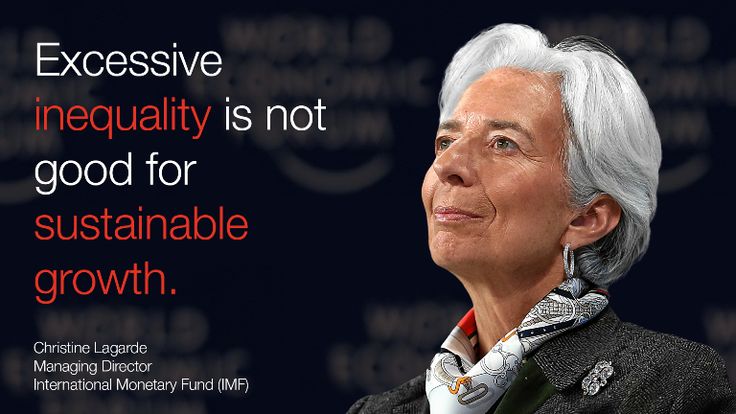
The IMF’s recent research on inequality has attracted a lot of (mostly favorable) attention. My talk to CSOs today describes the main findings of this research. Focusing on within-country inequality, I classify the work into three categories: causes, consequences, cures.
- On causes, the main finding is that—in addition to broad trends like trade, technology and demographics—inequality is driven by economic policies. This is not an earth-shattering finding but it is an important one. The policies that turn out to drive inequality include fiscal policies, capital account liberalization (i.e. policies to foster mobility of capital across national boundaries) and labor market policies. Many of these are ‘bread-and-butter’ issues for the IMF, ones on which it routinely gives advice to its member countries.
- On consequences, there has been a novel research finding: inequality lowers the durability of growth spells. This result also puts inequality squarely with the remit of the IMF’s work: fostering sustained growth, a goal of IMF advice, requires some attention to inequality.
- As it should, the work on cures follows from what has been learnt about the causes and consequences. To take an example: if fiscal policies are a cause of inequality, the IMF’s advice on the design of these polices needs to account for this fact. This is both because the distributional consequences may be important in their own right to some governments and because—as noted—they can have an adverse effect on the sustainability of growth. One new research finding, which has implications for the design of many policies, is that redistribution, unless extreme, does not have an adverse impact on growth; hence redistribution need not be feared as a cure.
Details and links to the underlying papers are given in this PPT.
The IMF’s recent research on inequality has attracted a lot of (mostly favorable) attention. My talk to CSOs today describes the main findings of this research. Focusing on within-country inequality, I classify the work into three categories: causes, consequences, cures.
- On causes, the main finding is that—in addition to broad trends like trade, technology and demographics—inequality is driven by economic policies. This is not an earth-shattering finding but it is an important one.
Posted by at 1:02 PM
Labels: Inclusive Growth
Tuesday, August 23, 2016
Growing Apart, Losing Trust? The Impact of Inequality on Social Capital
There is a widespread perception that trust and social capital have declined in United States as well as other advanced economies, while income inequality has tended to increase. While previous research has noted that measured trust declines as individuals become less similar to one another, this paper examines whether the downward trend in social capital is responding to the increasing gaps in income. The analysis uses data from the American National Election Survey (ANES) for the United States, and the European Social Survey (ESS) for Europe. Our analysis for the United States exploits variation across states and over time (1980-2010), while our analysis of the ESS utilizes variation across European countries and over time (2002-2012). The results provide robust evidence that overall inequality lowers an individual’s sense of trust in others in the United States as well as in other advanced economies. These effects mainly stem from residual inequality, which may be more closely associated with the notion of fairness, as well as inequality in the bottom of the distribution. Since trust has been linked to economic growth and development in the existing literature, these findings suggest an important, indirect way through which inequality affects macro-economic performance.
For details, see the new IMF Working Paper.
There is a widespread perception that trust and social capital have declined in United States as well as other advanced economies, while income inequality has tended to increase. While previous research has noted that measured trust declines as individuals become less similar to one another, this paper examines whether the downward trend in social capital is responding to the increasing gaps in income. The analysis uses data from the American National Election Survey (ANES) for the United States,
Posted by at 6:42 PM
Labels: Inclusive Growth
Tuesday, August 16, 2016
Is Uncertainty Hurting Productivity?
Since the global financial crisis, productivity growth has been weak and there have been bouts of heightened uncertainty. My new paper shows that, historically, increases in aggregate uncertainty have reduced productivity growth in industries. The impact is stronger in industries that depend heavily on external finance. This effect is also larger during recessions, when financing constraints are more likely to be binding. These findings suggest that counter-cyclical macro policies can have beneficial impacts on productivity growth during uncertain times (which corroborates conclusions reached by Philippe Aghion and co-authors in a recent set of papers) as well as policies aimed at addressing weak corporate balance sheets. My paper is co-authored with Sam Choi, Davide Furceri and Yi Huang and is available here.
Since the global financial crisis, productivity growth has been weak and there have been bouts of heightened uncertainty. My new paper shows that, historically, increases in aggregate uncertainty have reduced productivity growth in industries. The impact is stronger in industries that depend heavily on external finance. This effect is also larger during recessions, when financing constraints are more likely to be binding. These findings suggest that counter-cyclical macro policies can have beneficial impacts on productivity growth during uncertain times (which corroborates conclusions reached by Philippe Aghion and co-authors in a recent set of papers) as well as policies aimed at addressing weak corporate balance sheets.
Posted by at 6:18 PM
Labels: Inclusive Growth
Subscribe to: Posts