Showing posts with label Inclusive Growth. Show all posts
Thursday, June 1, 2017
Colombia’s Peace Agreement Can Give Fillip to Inclusive Growth
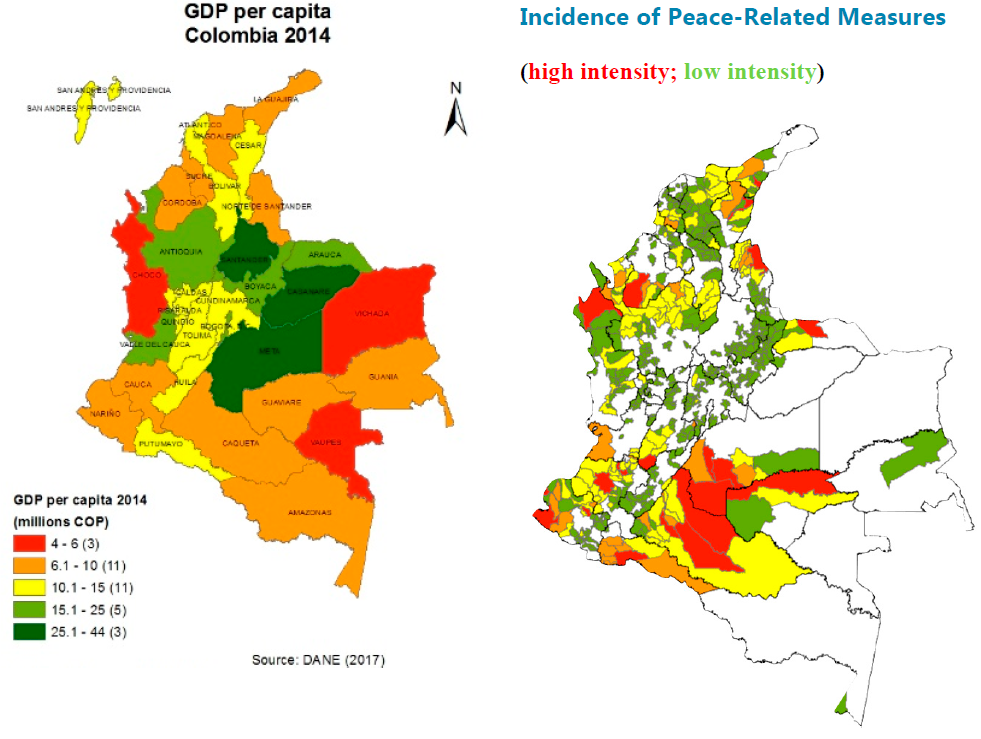
A new IMF annual assessment of the Colombian economy says that “The peace agreement will cement security gains achieved over the last decade and continue to bring more investment to the country. The implementation of the peace agreement will also focus on the regions where income per capita is relatively lower. The delivery of basic public goods and services to remote, poor, and conflict-ridden regions of the country—in addition to Colombia’s improved security conditions—will certainly make growth more inclusive over time.”
Continue reading here.
A new IMF annual assessment of the Colombian economy says that “The peace agreement will cement security gains achieved over the last decade and continue to bring more investment to the country. The implementation of the peace agreement will also focus on the regions where income per capita is relatively lower. The delivery of basic public goods and services to remote, poor, and conflict-ridden regions of the country—in addition to Colombia’s improved security conditions—will certainly make growth more inclusive over time.”
Posted by at 9:08 AM
Labels: Inclusive Growth
Wednesday, May 31, 2017
Inclusive Growth Framework
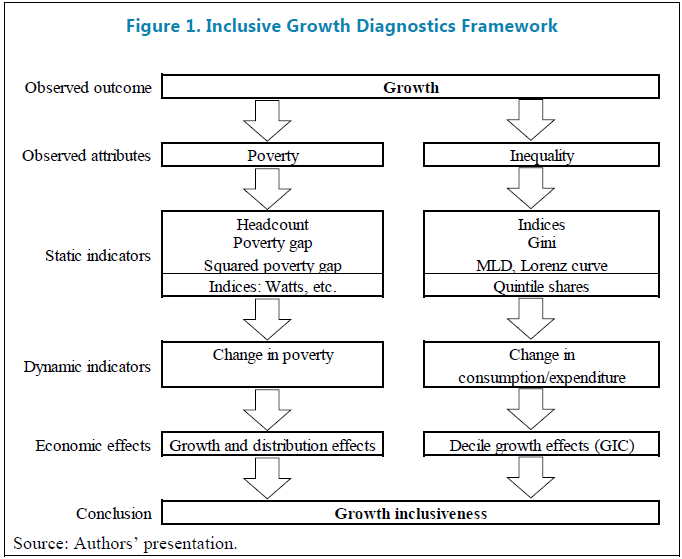
A new IMF working paper by Alexei Kireyev and Jingyang Chen suggests “an operationally usable framework for the evaluation of growth inclusiveness—the inclusive growth framework (IGF). Based on the data on growth, poverty, and inequality, the framework allows for the quantitative assessment of growth inclusiveness. The assessment relies on the decomposition of the change in poverty into growth, distribution, and decile effects, which can be calculated using the Distributive Analysis Stata Package (DASP). Availability of at least two household surveys is the main precondition for the use of the IGF. The application of the IGF is illustrated with two country cases of Senegal and Djibouti.”
Continue reading here.
A new IMF working paper by Alexei Kireyev and Jingyang Chen suggests “an operationally usable framework for the evaluation of growth inclusiveness—the inclusive growth framework (IGF). Based on the data on growth, poverty, and inequality, the framework allows for the quantitative assessment of growth inclusiveness. The assessment relies on the decomposition of the change in poverty into growth, distribution, and decile effects, which can be calculated using the Distributive Analysis Stata Package (DASP).
Posted by at 9:31 AM
Labels: Inclusive Growth
Wednesday, May 24, 2017
Trading with China : Productivity Gains, Job Losses
From a new IMF working paper by JaeBin Ahn and Romain Duval:
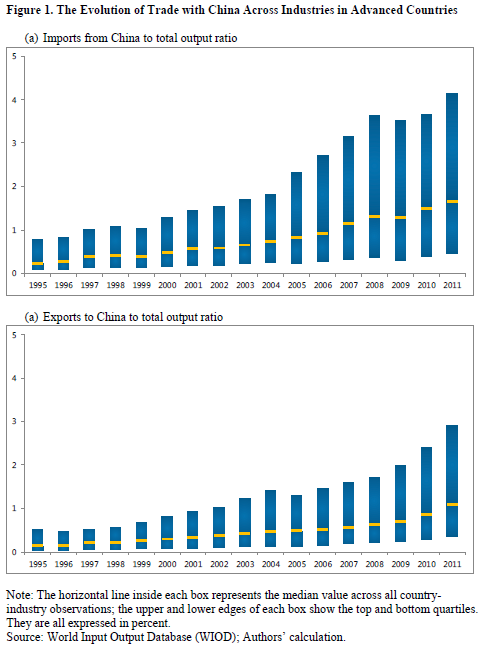
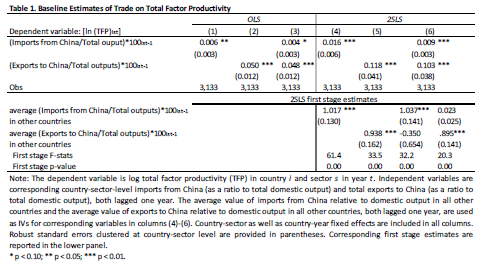
“We analyze the impact on productivity in advanced economies of fast-growing trade with China between the mid-1990s and late-2000s, separately identifying the export and import channels. We use country-sector-level data for 18 advanced economies and, similar to Autor, Dorn, and Hanson (2013), exploit exogenous variation in trade with China in a given country-sector by instrumenting imports from (exports to) China in a given country-sector with the average imports from (exports to) China in the same sector in other advanced economies. Our estimates point to large productivity gains from trading with China—the (exogenous) rise of China in global trade may have increased the level of total factor productivity by about 1.9 percent, or 12.3 percent of the overall increase over the sample period, in the median country-sector. By contrast, using a similar empirical strategy, we find adverse employment effects of Chinese imports in exposed country-industries, consistent with previous studies. Taken together, these findings point to large gains from free trade, while underscoring the scope for a more active policy role in redistributing them, particularly by easing workers’ transition between jobs and industries.”
Continue reading here.
From a new IMF working paper by JaeBin Ahn and Romain Duval:
“We analyze the impact on productivity in advanced economies of fast-growing trade with China between the mid-1990s and late-2000s, separately identifying the export and import channels. We use country-sector-level data for 18 advanced economies and, similar to Autor, Dorn, and Hanson (2013), exploit exogenous variation in trade with China in a given country-sector by instrumenting imports from (exports to) China in a given country-sector with the average imports from (exports to) China in the same sector in other advanced economies.
Posted by at 4:24 PM
Labels: Inclusive Growth, Macro Demystified
Wednesday, May 17, 2017
Every Woman Counts: Gender Budgeting in G7 Countries
From IMF direct by Managing Director Christine Lagarde:
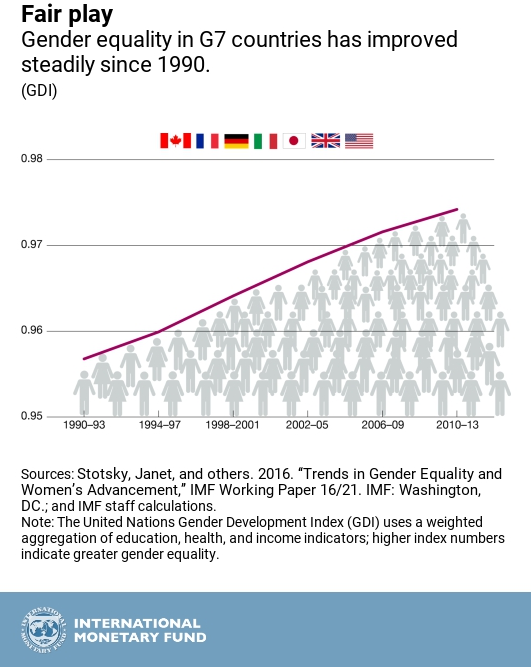
“(…) despite progress made by most G7 countries in improving gender equality (see chart below), there is still a large unfinished agenda. For example, in advanced industrial countries, women’s labor market participation rate is about 17 percentage points lower than men’s. The wage gap between women and men amounts to roughly 14 percent. The share of male managers is almost double that of women, and almost 70 percent of unpaid work is performed by women.
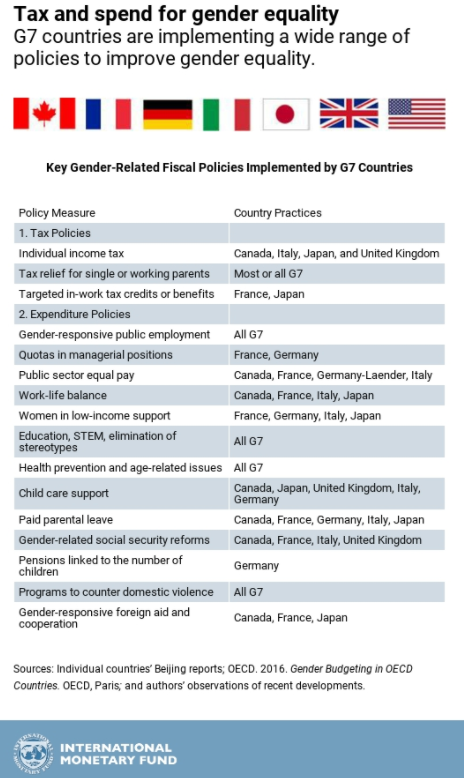
The point I was making to the G7 countries is that, to make further progress, national budgets can be used more actively as a tool to support gender equality. For example, in advanced economies, tax policies play an important role in addressing disincentives for secondary earners to work. Spending policies can help too, for instance by supporting childcare facilities. One example is the Canadian child benefit scheme, which helps families with the cost of childcare through a tax-free, income-tested benefit. This and other examples are listed in the table below.”
Continue reading here.
From IMF direct by Managing Director Christine Lagarde:
“(…) despite progress made by most G7 countries in improving gender equality (see chart below), there is still a large unfinished agenda. For example, in advanced industrial countries, women’s labor market participation rate is about 17 percentage points lower than men’s. The wage gap between women and men amounts to roughly 14 percent. The share of male managers is almost double that of women,
Posted by at 6:36 PM
Labels: Inclusive Growth
Monday, May 15, 2017
Belt and Road Initiative: Strengthening Financial Connectivity
IMF Managing Director Christine Lagarde quoted my research with Davide Furceri during her speech: “IMF analysis shows that having a more inclusive financial system makes it safer—and more beneficial—to relax restrictions on capital flows across borders . By liberalizing their capital account over time, countries can attract more foreign investment, increase the liquidity of local financial markets, and reduce their cost of capital. In other words, by developing deep, well-regulated financial markets, countries can better mobilize domestic and international resources for investment—while reducing the financial stability risks that come with large capital inflows.”
IMF Managing Director Christine Lagarde quoted my research with Davide Furceri during her speech: “IMF analysis shows that having a more inclusive financial system makes it safer—and more beneficial—to relax restrictions on capital flows across borders . By liberalizing their capital account over time, countries can attract more foreign investment, increase the liquidity of local financial markets, and reduce their cost of capital. In other words, by developing deep, well-regulated financial markets, countries can better mobilize domestic and international resources for investment—while reducing the financial stability risks that come with large capital inflows.”
Posted by at 9:22 AM
Labels: Inclusive Growth
Subscribe to: Posts