Showing posts with label Inclusive Growth. Show all posts
Tuesday, November 21, 2017
Korea’s Paradigm Shift for Sustainable and Inclusive Growth: A Proposal
From a new IMF working paper:
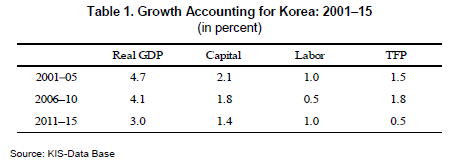
“Korea is facing mounting economic challenges. Productivity growth has been on a trend decline amid demographic headwinds, while the societal demand for inclusive growth has been on a steep rise. Furthermore, the government-led unbalanced growth model—which served Korea well in the past—has become less effective and politically palatable in recent years. As such, Korea needs a major paradigm shift to embark on a new sustainable and inclusive growth path. But policy response has been modest at best with no major reforms being implemented over the past two decades. We propose a paradigm shift in Korea’s economic framework, involving a simultaneous big push for greater economic freedom and stronger social protection within the parameters set by long-run fiscal sustainability. We also provide a detailed account of structural reforms to boost economic freedom and sustainable funding plans for stronger social protection.”
From a new IMF working paper:
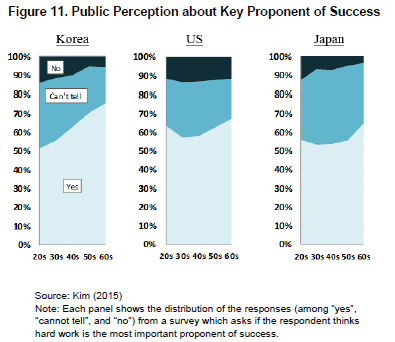
“Korea is facing mounting economic challenges. Productivity growth has been on a trend decline amid demographic headwinds, while the societal demand for inclusive growth has been on a steep rise. Furthermore, the government-led unbalanced growth model—which served Korea well in the past—has become less effective and politically palatable in recent years. As such, Korea needs a major paradigm shift to embark on a new sustainable and inclusive growth path.
Posted by at 4:50 PM
Labels: Inclusive Growth
Mexico’s Structural Reform Agenda”: Early Signs of Success”
A new IMF country report finds:
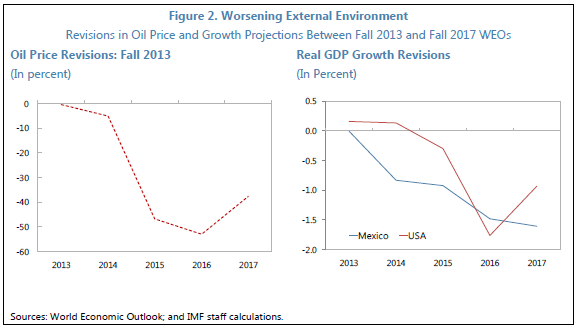
“The implementation of the Pacto por México has already led to important transformations in the Mexican economy. While initial estimates of potential growth payoffs may have been optimistic, external headwinds have masked important signals that the reforms are working. From a macroeconomic perspective, the reforms have already contributed to increasing investment, falling prices and more widespread access to services.
The reforms will take more time to fully feed through to the broader macro economy and lift growth. The delayed impact of the reforms owes to their complexity as well as some important short-term costs. At the same time, weaknesses in the rule of law will have weakened their impacts. Nevertheless, the transformations have highlighted the positive synergies associated with a broad approach to structural reform that exploits complementarities between different sectors.
Building on existing reforms will be key, and priority should be given to reforms targeting the rule of law. Continued weaknesses related to informality, corruption and crime would stifle private investment and would likely impede the broader reform effort from exerting its full impact on the economy. Improving the efficiency and quality of law enforcement and judicial institutions would be critical in this regard.”
A new IMF country report finds:
“The implementation of the Pacto por México has already led to important transformations in the Mexican economy. While initial estimates of potential growth payoffs may have been optimistic, external headwinds have masked important signals that the reforms are working. From a macroeconomic perspective, the reforms have already contributed to increasing investment, falling prices and more widespread access to services.
The reforms will take more time to fully feed through to the broader macro economy and lift growth.
Posted by at 3:17 PM
Labels: Inclusive Growth
Friday, November 17, 2017
Growth and Jobs in Developing Economies: Trends and Cycles
A new IMF working paper investigates the relationship between economic growth and job creation in developing economies with a focus on low and lower middle-income countries along two dimensions: growth patterns and short-run correlations. Analysis on growth patterns shows that regime changes are quite common in both economic growth and employment growth, yet they are not synchronized with each other. Okun’s Law—the short-run relationship between output and labor market—holds in half of the countries in our sample and shows considerable cross-country heterogeneity.
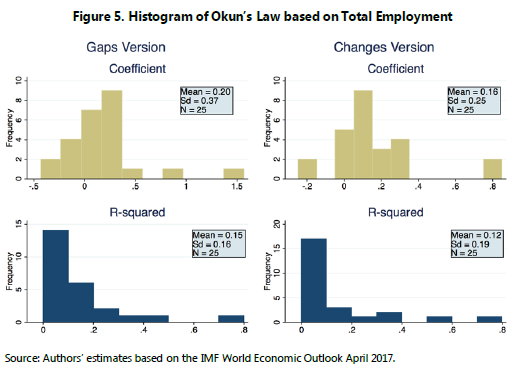
A new IMF working paper investigates the relationship between economic growth and job creation in developing economies with a focus on low and lower middle-income countries along two dimensions: growth patterns and short-run correlations. Analysis on growth patterns shows that regime changes are quite common in both economic growth and employment growth, yet they are not synchronized with each other. Okun’s Law—the short-run relationship between output and labor market—holds in half of the countries in our sample and shows considerable cross-country heterogeneity.
Posted by at 5:20 PM
Labels: Inclusive Growth
Thursday, November 16, 2017
Inequality in Financial Inclusion, Gender Gaps, and Income Inequality
From a new IMF working paper:
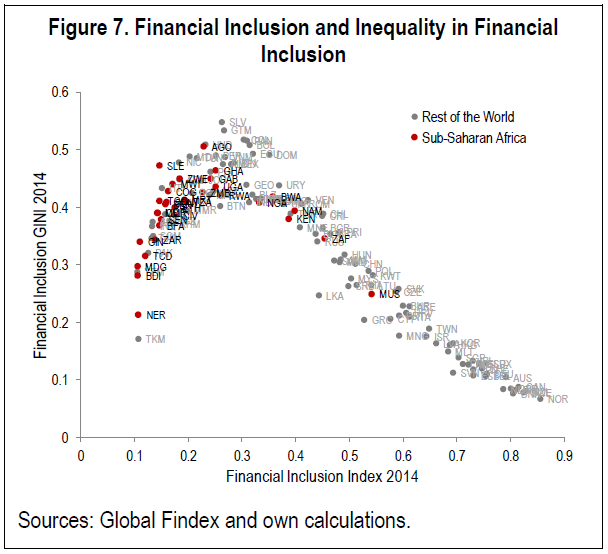
“We investigate the link between gender inequality in financial inclusion and income inequality, with three contributions to the recent literature. First, using a micro-dataset covering 146,000 individuals in over 140 countries, we construct novel, synthetic indices of the intensity of financial inclusion at the individual and country level. Second, we derive the distribution of individual financial access “scores” across countries to document a “Kuznets”-curve in financial inclusion. Third, cross-country regressions confirm that our measure of inequality in financial access is significantly related to income inequality, above and beyond other factors previously highlighted in the literature.”
From a new IMF working paper:
“We investigate the link between gender inequality in financial inclusion and income inequality, with three contributions to the recent literature. First, using a micro-dataset covering 146,000 individuals in over 140 countries, we construct novel, synthetic indices of the intensity of financial inclusion at the individual and country level. Second, we derive the distribution of individual financial access “scores” across countries to document a “Kuznets”-curve in financial inclusion.
Posted by at 10:32 PM
Labels: Inclusive Growth
Hollowing Out: The Channels of Income Polarization in the United States
From a new IMF working paper:
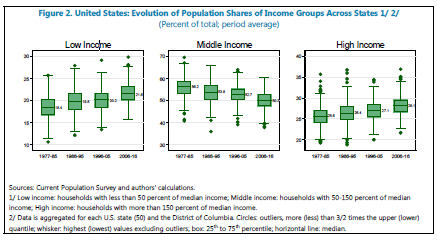
“Data show that middle-income households have continued to move down, and less so up, the income distribution in the United States since the 1970s—a phenomenon that is often referred to as the polarization or “hollowing out” of the income distribution. While the level of income polarization is generally lower in the richer states (defined as those with higher median household income levels), there have been wide variations in income polarization over time and across states. We develop two indices to measure income polarization, including a novel hollowing-out index. We also examine the proximate causes of income polarization, using an econometric analysis at both state and household levels. The results suggest that technology, measured by job routinization, and international trade, measured by job offshoring, can explain more than half of the rise in income polarization, with broadly equal contributions. Household characteristics, particularly better education, have had important countervailing effects on income polarization. Policies should continue promoting technological progress and international trade, but also recognize that these positive forces have important side-effects on the income distribution and household welfare that need to be understood and mitigated.”
From a new IMF working paper:
“Data show that middle-income households have continued to move down, and less so up, the income distribution in the United States since the 1970s—a phenomenon that is often referred to as the polarization or “hollowing out” of the income distribution. While the level of income polarization is generally lower in the richer states (defined as those with higher median household income levels), there have been wide variations in income polarization over time and across states.
Posted by at 11:04 AM
Labels: Inclusive Growth
Subscribe to: Posts