Showing posts with label Global Housing Watch. Show all posts
Thursday, September 5, 2013
House Prices in Norway
“House prices continue to rise in Norway. There was only a brief correction at the time of the global financial crisis. Real house prices increased by nearly 30 percent from its lowest level in 2008. Standard affordability indicators are also worsening. Price-to-income and price-to-rent ratios increased by 14 percent and 23 percent, respectively, from their lowest levels in 2008. Several factors have been identified to explain the upward trend of house prices, including robust income growth and high population growth due to immigration (see Box 2.1). While these factors may partly explain recent house price developments, there are also risks associated with a house price reversal, and household would be vulnerable to house price corrections given the high levels of household debt,” according to a new report by the IMF.

“House prices continue to rise in Norway. There was only a brief correction at the time of the global financial crisis. Real house prices increased by nearly 30 percent from its lowest level in 2008. Standard affordability indicators are also worsening. Price-to-income and price-to-rent ratios increased by 14 percent and 23 percent, respectively, from their lowest levels in 2008. Several factors have been identified to explain the upward trend of house prices, including robust income growth and high population growth due to immigration (see Box 2.1).
Posted by at 7:39 PM
Labels: Global Housing Watch
House Prices in Sweden
“Swedish house prices are potentially overvalued by more than 15 percent. House prices have more than doubled since the mid-1990s, increasing by about 140 percent in real terms between 1995 and 2007 and remaining broadly stable since then. Current estimates suggest that house prices are overvalued by 15 to 18 percent, accounting for rental regulations,” the IMF said in its latest annual report on Sweden.
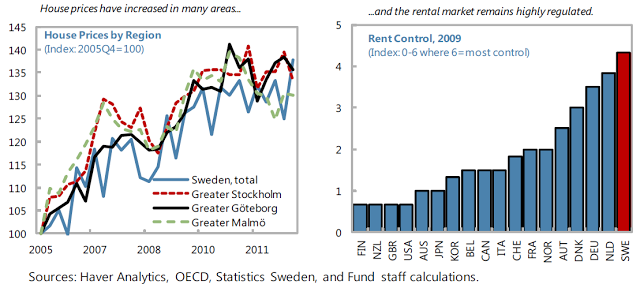
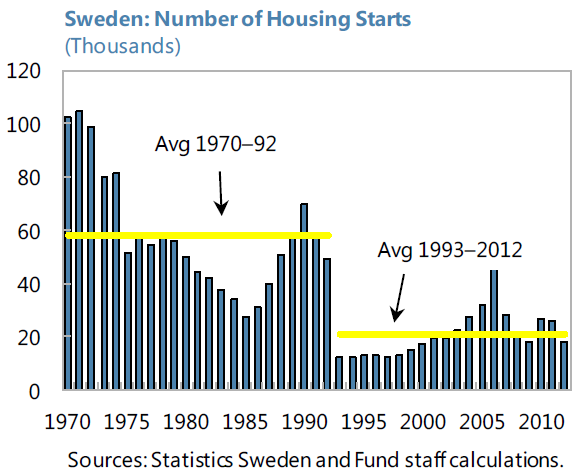
“Swedish house prices are potentially overvalued by more than 15 percent. House prices have more than doubled since the mid-1990s, increasing by about 140 percent in real terms between 1995 and 2007 and remaining broadly stable since then. Current estimates suggest that house prices are overvalued by 15 to 18 percent, accounting for rental regulations,” the IMF said in its latest annual report on Sweden.
Posted by at 7:39 PM
Labels: Global Housing Watch
Thursday, August 22, 2013
The Driving Force behind Construction in Europe
A new IMF working paper finds that a country’s geography, demographics, and economic conditions (e.g. income level, credit conditions, and stock market performance) are the driving forces behind the changes in construction shares. The results of the paper show that “During the boom, many countries overshoot the norm. After the crisis, the process has reversed and many countries have undershoot the norm. But for some countries, the adjustment has fallen short of the model’s predictions.” So, “when economic conditions normalize over the medium term, Greece, Iceland, and Ireland in advanced Europe, and Latvia, Lithuania, Hungary, and Ukraine in emerging Europe may see a recovery in their construction shares. But construction shares could decline further in Spain, the United Kingdom, Romania, and the Slovak Republic.”
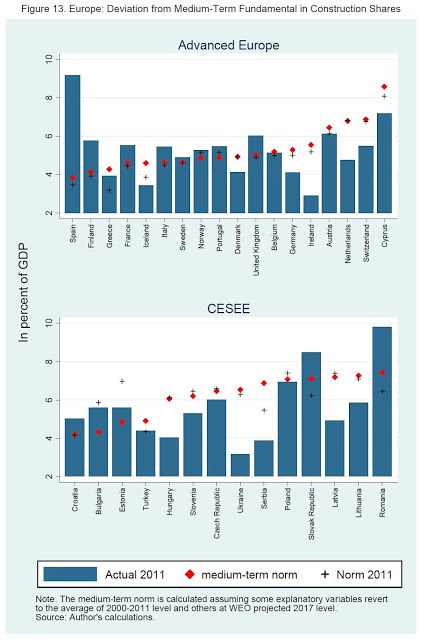
A new IMF working paper finds that a country’s geography, demographics, and economic conditions (e.g. income level, credit conditions, and stock market performance) are the driving forces behind the changes in construction shares. The results of the paper show that “During the boom, many countries overshoot the norm. After the crisis, the process has reversed and many countries have undershoot the norm. But for some countries, the adjustment has fallen short of the model’s predictions.” So,
Posted by at 5:49 PM
Labels: Global Housing Watch
Tuesday, August 6, 2013
House Prices in Germany
In Germany, “Nationwide property prices have continued to rise, driven mainly by stronger increases in apartment prices in some major cities. However, these prices remain below historical averages and do not appear excessive.”
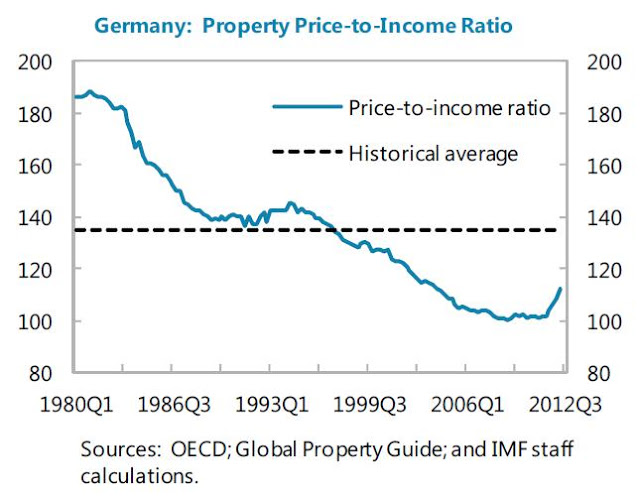
In Germany, “Nationwide property prices have continued to rise, driven mainly by stronger increases in apartment prices in some major cities. However, these prices remain below historical averages and do not appear excessive.”
Posted by at 2:38 PM
Labels: Global Housing Watch
Monday, August 5, 2013
House Prices in France
In France, “(…) prices have been declining: housing activity has slowed markedly and prices have fallen by 1.9 percent in 2013 Q1 from their peak in 2011 Q3,” according to the latest IMF economic report on France. To read more click here.
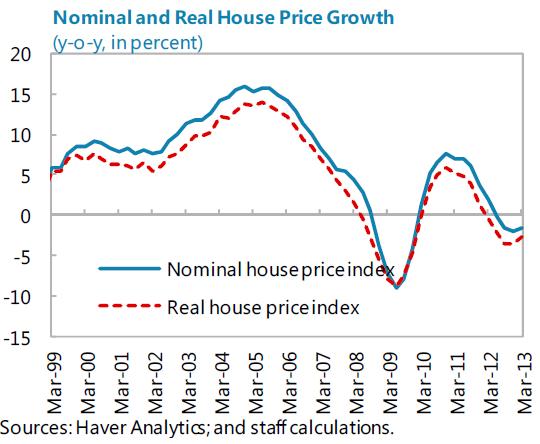
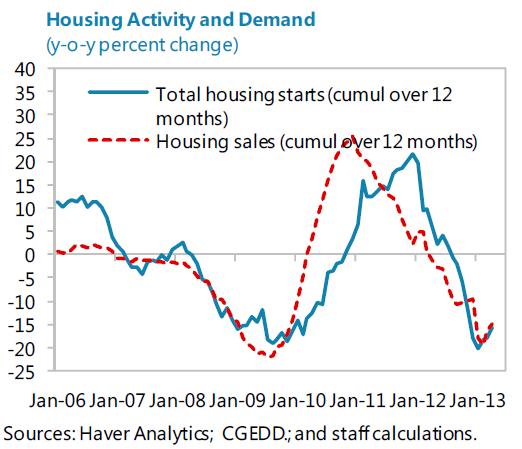
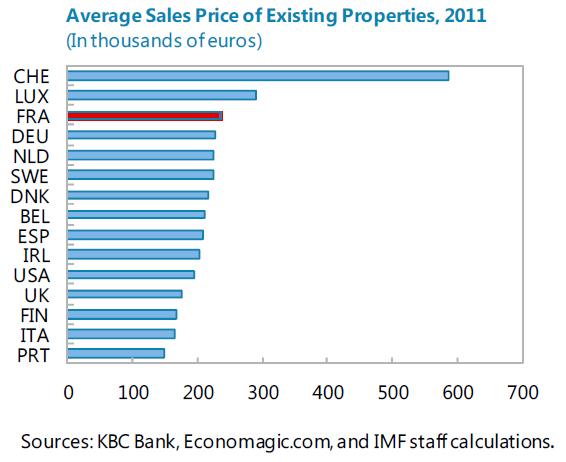
In France, “(…) prices have been declining: housing activity has slowed markedly and prices have fallen by 1.9 percent in 2013 Q1 from their peak in 2011 Q3,” according to the latest IMF economic report on France. To read more click here.
Posted by at 5:06 PM
Labels: Global Housing Watch
Subscribe to: Posts