Showing posts with label Global Housing Watch. Show all posts
Monday, February 29, 2016
Housing Market in the United Kingdom

A separate IMF paper examines how tax reforms could help ease structural supply constraints in the UK’s housing market. “Property taxation in the UK delivers larger revenue as a percent of GDP than any other OECD country. (…) However, a closer look at the UK’s property tax system suggests that some areas could be reformed to reduce constraints on housing supply and thereby reduce risks stemming from high house prices. In particular, deducing council tax discounts [and (…)] reducing reliance on the stamp duty land tax.”
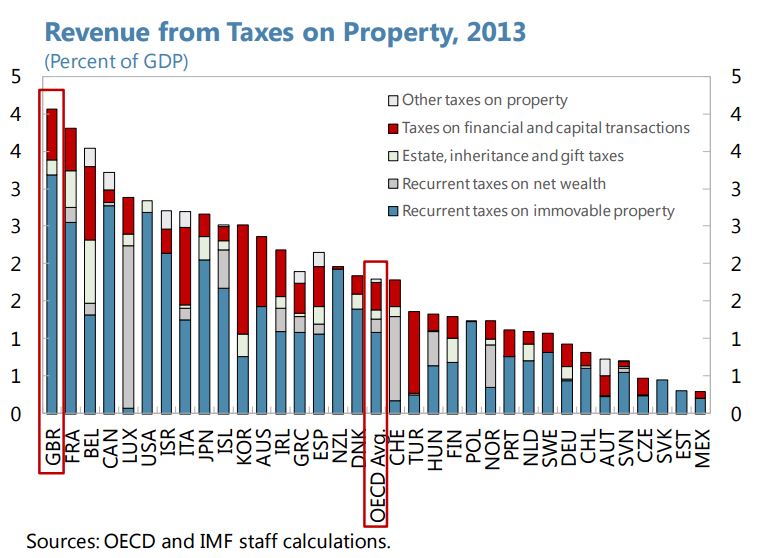
“Housing markets have decelerated somewhat since mid-2014, but significant pressures remain. (…) Persistent upward pressure on house prices partly reflects supply constraints. (…) High house prices result in some households taking on high leverage, posing financial stability risks. (…) Further macroprudential tightening may thus be needed if the reduction in high leverage mortgages does not continue”, says the IMF’s new report on the United Kingdom.
A separate IMF paper examines how tax reforms could help ease structural supply constraints in the UK’s housing market.
Posted by at 10:00 AM
Labels: Global Housing Watch
Wednesday, February 24, 2016
Experts Weigh in on the State of the Global Housing Market
“Global house price boom accelerates further, led by Europe, North America, and some parts of Asia Pacific”, according to the Q3 2015 quarterly note from the Global Property Guide. This house price boom is reflected in two measures. First, real house prices rose in 28 out of a sample of 41 countries. Second, there is stronger upward momentum—in 22 countries house prices have risen faster compared to the previous quarter. These results are also in line with the Q3 2015 data reported by Knight Frank. Of the 55 housing markets tracked by Knight Frank, 82 percent recorded positive annual price growth, up from 75 percent. However, FITCH notes that even though the housing and mortgage outlook for the 22 countries remain stable/positive, divergence is increasing.
Looking at global house price developments in more detail, the Bank for International Settlement (BIS) says that real house prices increased by 4.3 percent year-on-year in advanced economies vs. a decline of 1.0 percent in emerging market economies. Within emerging market economies, the BIS notes that “there were significant disparities across countries: while prices continued to rise strongly in Hong Kong SAR, India and Turkey, they kept falling in Brazil, China and Russia.” Going forward, “the EM house price boom will be curbed by slowing income growth and weaker economic prospects”, says Oxford Analytica.
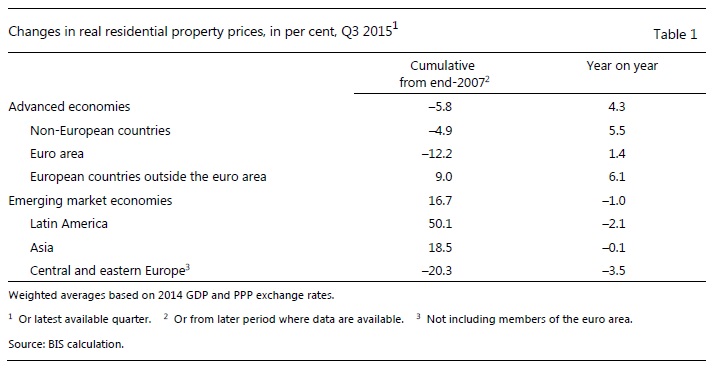
In the Euro area—where house price data coverage is higher compared to other regions—house prices rose by 2.3 percent in the third quarter of 2015 compared with the same quarter of the previous year, according to Eurostat. On the outlook for Europe, FITCH says that “Rising GDP, low rates, recovering credit flows, and improving labour markets will support the bounce-back in the eurozone periphery.” Moreover, according to Urban Land Institute’s Emerging Trends Europe, the five leading cities for investment prospects in 2016 are Berlin at Number 1, followed by Hamburg, Dublin, Madrid and Copenhagen.
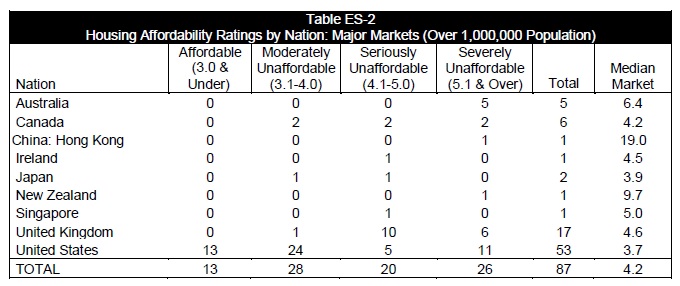
Finally, the latest survey from Demographia International Housing Affordability Survey finds that “The most affordable major metropolitan markets in 2015 were in the United States, which had a moderately unaffordable rating of 3.7, followed by Japan, with a Median Multiple of 3.9. Major metropolitan markets were rated “seriously unaffordable,” in Canada (4.2), Ireland (4.5), the United Kingdom (4.6) and Singapore (5.0). The major markets of Australia (6.4), New Zealand (9.7) and Hong Kong (19.0) were severely unaffordable.”
From the Global Housing Watch Newsletter: February 2016
“Global house price boom accelerates further, led by Europe, North America, and some parts of Asia Pacific”, according to the Q3 2015 quarterly note from the Global Property Guide. This house price boom is reflected in two measures. First, real house prices rose in 28 out of a sample of 41 countries. Second, there is stronger upward momentum—in 22 countries house prices have risen faster compared to the previous quarter.
Posted by at 10:00 AM
Labels: Global Housing Watch
Thursday, February 18, 2016
House Prices in Austria
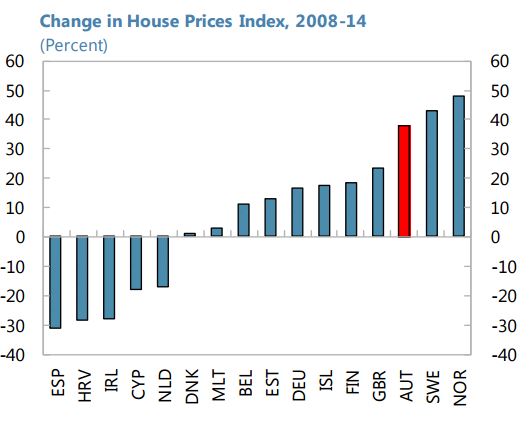
“House price growth was strong over recent years but has moderated recently”, says IMF’s report on Austria.
Posted by at 4:05 PM
Labels: Global Housing Watch
Thursday, February 11, 2016
House Prices in the Netherlands
Moreover, the report notes that “House prices have started to recover. However, they remain well below peak levels. Prices have risen by more than 5 percent since the 2013 trough, but they are still 17 percent below their 2008 peak in 2015:Q3. More than a quarter of Dutch households have mortgage debt in excess of the house value, primarily among younger households. The recovery in housing prices is uneven. The market is buoyant in Amsterdam, where house prices are less than 4 percent below the 2008 peak, and to a lesser extent in other major cities. However, house price increases are more subdued in outlying areas.”
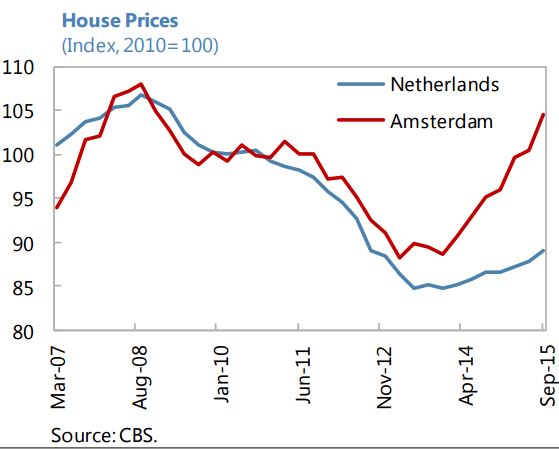
“The turnaround in house prices presents an opportunity to implement policies to better insulate Dutch households and the overall economy from the effect of future house price declines and remove some of the incentives for excessive leverage—thereby reducing the likelihood and intensity of boom-bust cycles”, according to the IMF’s report on the Netherlands.
Moreover, the report notes that “House prices have started to recover. However, they remain well below peak levels. Prices have risen by more than 5 percent since the 2013 trough,
Posted by at 6:57 PM
Labels: Global Housing Watch
House Prices in New Zealand

A separate IMF paper “analyzes long-run trends in house prices and household debt in New Zealand. The key findings are that economic fundamentals such as financial liberalization, lower interest rates, demographics and supply constraints are important factors in the large run up in house prices. Although higher house price and household debt can largely be explained, it still has implications for financial stability.”
“House price inflation in Auckland has remained high. House prices in Auckland (where about one-third of the population lives) have continued their strong upward trend, rising by 22.5 percent (y/y) in December 2015, and the housing inventory available for sale remains low. Moreover, prices in neighboring areas are beginning to accelerate as buyers are priced out of the Auckland market. Supply shortages are a fundamental driver of house price inflation, exacerbated by high net immigration. On the demand side, Read the full article…
Posted by at 6:45 PM
Labels: Global Housing Watch
Subscribe to: Posts