Showing posts with label Events. Show all posts
Tuesday, October 4, 2011
Invitation to an Event. Lost Decades: The Making of America’s Debt Crisis and the Long Recovery
Featuring the authors:
Menzie Chinn (University of Wisconsin, Madison; Econbrowser blog)
Jeffry Frieden (Harvard University)
Chinn and Frieden explore the origins and long-term effects of the financial crisis in historical and comparative perspective. By 2008 the United States had become the biggest international borrower in world history, with almost half of its 6.4 trillion dollar federal debt in foreign hands. The massive inflow of foreign funds financed the booms in housing prices and consumer spending that fueled the economy until the collapse of late 2008. The authors explore the political and economic roots of this crisis as well as its long-term effects. “The book is capable of dealing with some of the most complicated economic arguments about the crisis in a way that is straightforward and capable of being understood by its audience, says Mike Konczal of the Roosevelt Institute. “If you have time to read only one book on the crisis, read this,” says acclaimed economic historian Barry Eichengreen, University of California Berkeley.
Discussants:
Gail Cohen (Joint Economic Committee of the U.S. Congress)
Diane Lim Rogers (Concord Coalition)
Closing Remarks:
Simon Johnson (MIT and Peterson Institute; co-author of 13 Bankers)
Moderated by:
George Akerlof (Senior Resident Scholar, Research Department, IMF; Winner of the
2001 Nobel Prize for Economics)
IMF Book Forum
Lost Decades: The Making of America’s Debt Crisis and the Long Recovery
Friday, October 14, 1:30 to 3 pm
Events Hall, IMF, HQ1-01-704 (700 19th Street, NW, Washington, DC)
This event is open to the public and to Bank/Fund staff. RSVP here.
Featuring the authors:
Menzie Chinn (University of Wisconsin, Madison; Econbrowser blog)
Jeffry Frieden (Harvard University)
Monday, November 22, 2010
Gloom & Doom … or Boom? The Movie
Here’s the video from a talk at the IMF at which economists Nouriel Roubini (a.k.a. Dr. Doom) and Mark Zandi were pessimistic about the near-term economic outlook but split on how things might look a couple of years from now. Zandi said we might get 5% growth in the US in 2012. Read the full article…
Posted by at 2:42 PM
Labels: Events, Profiles of Economists
Monday, September 20, 2010
Gloom & Doom … or Boom?
In some countries, it was not just the household sector but governments that needed a debt write-down, Roubini said. While the situation in Greece and other economies was being patched together for the time being with the help of the European Union and the IMF, he worried that in the event of further shocks, “there won’t be someone from Mars coming to bail out the IMF or the EU.”
If U.S. growth in 2012 turns out to be 5%, Zandi will surely be invited back to the IMF to do a victory lap (see his presentation).
To see the video of the event, click here.
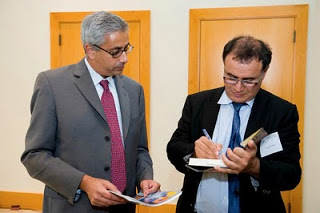
In a talk at the IMF, economists Nouriel Roubini (a.k.a. Dr. Doom) and Mark Zandi were pessimistic about the near-term economic outlook but split on how things might look a couple of years from now.
There is a 40 percent chance of a double dip recession in the United States and some other advanced countries, according to Nouriel Roubini, chairman of Roubini Global Economics and a New York University professor. He cautioned against reading too much into recent improvements in economic indicators for Eurozone countries, Read the full article…
Posted by at 11:46 PM
Labels: Events, Profiles of Economists
Wednesday, September 1, 2010
The Return of Dr. Doom

Nouriel Roubini predicted gloom and doom in a now famous but often misreported speech at the IMF on Sept. 7, 2006. Here’s what he really said:
“my view is that the risk of a hard landing is very high for the U.S. economy. I see essentially a recession coming by next year. I give it a very high likelihood. I argue that housing today, like the tech bust in 2000-2001 will have a macro effect; it is not going to be just a sectoral effect. I argue that U.S. consumers are now close to a ‘tipping over’ point given all the vulnerabilities I have discussed. I argue that the Fed easing will occur, so the next move is going to be a cut, but it is not going to prevent a recession. And, finally, I argue that the rest of the world is not going to be able to decouple from the U.S. even if it is not going to experience an outright recession like the United States. So on that cheerful note, I will stop.”
Read the full transcript here.
Nouriel Roubini predicted gloom and doom in a now famous but often misreported speech at the IMF on Sept. 7, 2006. Here’s what he really said:
“my view is that the risk of a hard landing is very high for the U.S. economy. I see essentially a recession coming by next year. I give it a very high likelihood. I argue that housing today, like the tech bust in 2000-2001 will have a macro effect;
Posted by at 8:48 PM
Labels: Events, Profiles of Economists
Subscribe to: Posts