Showing posts with label Energy & Climate Change. Show all posts
Monday, October 10, 2016
Rethinking the Oil Market
by Rabah Arezki
From Project Syndicate
Oil prices have plummeted by about 65% from their peak in June 2014 (see chart below), and there is now intense debate about why. One thing we know for sure is that the oil market has undergone structural changes, thus making this latest episode different from previous dramatic price fluctuations.
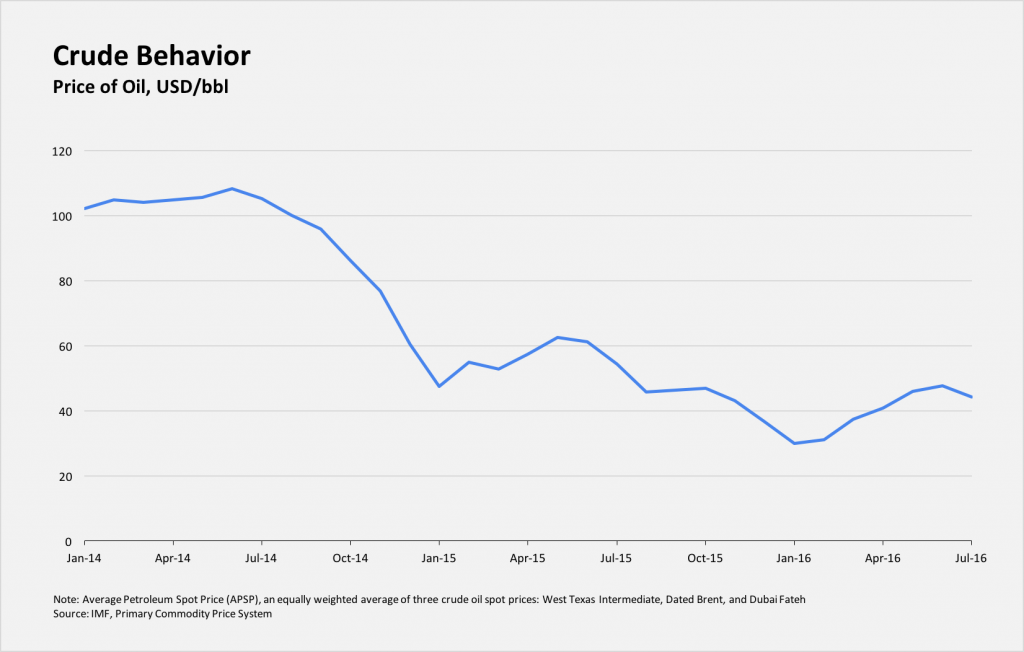
The collapse in prices has been driven in part by supply-side factors. These include the United States’ rapid increase in shale-energy production in recent years, and the US government’s decision to end a 40-year crude-oil export ban. Moreover, oil output from war-torn countries such as Libya and Iraq has exceeded expectations, and Iran has returned to world oil markets following its nuclear agreement with the world’s major powers. And Saudi Arabia, the largest member of the Organization of the Petroleum Exporting Countries (OPEC), has increased production to defend its market share.
With this glut in oil, many commentators are now asking if OPEC still matters. High demand for oil since 2000 gave OPEC, and Saudi Arabia in particular, significant influence over prices, but it also spurred investments in higher-cost production methods in other locales, such as oil sands mining in Canada and ultra-deepwater oil extraction in Brazil.
Because of the delay between investment and production for conventional oil production, these projects in non-OPEC countries peaked around the same time the oil market began to slow down, and when expectations about future demand for oil started to falter.
This dynamic prompted OPEC to change its response to price fluctuations. In the past, OPEC, and Saudi Arabia in particular, would stabilize the oil market by cutting production when prices fell too low and increasing output when prices rose too high, relative to OPEC’s price target. This time around, however, at a November 2014 OPEC meeting, Saudi Arabia blocked a motion by other members to reduce production in response to falling prices.
The Saudis have instead boosted output, resulting in immense pressure on higher-cost non-OPEC producers. Saudi Arabia seems to be taking a lesson from a 1986 price-fluctuation event, when massive, unprecedented production cuts in response to increased production by non-OPEC countries failed to stabilize oil prices.
Another factor keeping prices down is that non-OPEC producers have significantly reduced their costs. But this is likely a one-time event. In theory, as the chart below shows, the cost of producing oil is usually assumed to be constant and determined by immutable factors such as the type of oil and the geographical conditions where it is extracted.
Continue reading here.
by Rabah Arezki
From Project Syndicate
Oil prices have plummeted by about 65% from their peak in June 2014 (see chart below), and there is now intense debate about why. One thing we know for sure is that the oil market has undergone structural changes, thus making this latest episode different from previous dramatic price fluctuations.
The collapse in prices has been driven in part by supply-side factors.
Posted by at 1:32 PM
Labels: Energy & Climate Change
Friday, August 12, 2016
Climate Mitigation Policy in China: The Many Attractions of Carbon or Coal Taxes
“A carbon or coal tax can effectively address domestic China’s environmental challenges,” according to an IMF report. “Given that sectors most dependent on coal and energy are heavy industries associated with the ‘old growth’ model, these taxes will support China’s effort to rebalance its economy towards high value-added services and consumption-led growth. Moreover, by contributing to coordinated efforts from the international community to slow global warming, these taxes will also reduce the negative impacts climate change will have in China, such as higher occurrence of natural disasters to which coastal areas are particularly vulnerable. Although the government is committed to introducing an Emissions Trading System in 2017, this should not preclude the simultaneous introduction of an upstream carbon or coal tax. This could be facilitated by providing some tax rebates for firms required to obtain emissions allowances to ensure all emitters pay the same unit price of carbon. Given the very large domestic benefits from these policies, China can move ahead unilaterally on its pledges for Paris and make itself better off, without waiting for others to act.”
“A carbon or coal tax can effectively address domestic China’s environmental challenges,” according to an IMF report. “Given that sectors most dependent on coal and energy are heavy industries associated with the ‘old growth’ model, these taxes will support China’s effort to rebalance its economy towards high value-added services and consumption-led growth. Moreover, by contributing to coordinated efforts from the international community to slow global warming, these taxes will also reduce the negative impacts climate change will have in China,
Posted by at 9:33 AM
Labels: Energy & Climate Change
Friday, July 8, 2016
OPEC’s Strategic Actions and the 2014 Oil Price Crash
A new IMF working paper notes: “In November 2014, OPEC announced a new strategy geared towards improving its market share. Oil-market analysts interpreted this as an attempt to squeeze higher-cost producers including US shale oil out of the market. Over the next year, crude oil prices crashed, with large repercussions for the global economy. We present a simple equilibrium model that explains the fundamental market factors that can rationalize such a “regime switch” by OPEC. These include: (i) the growth of US shale oil production; (ii) the slowdown of global oil demand; (iii) reduced cohesiveness of the OPEC cartel; (iv) production ramp-ups in other non-OPEC countries. We show that these qualitative predictions are broadly consistent with oil market developments during 2014-15. The model is calibrated to oil market data; it predicts accommodation up to 2014 and a market-share strategy thereafter, and explains large oil-price swings as well as realistically high levels of OPEC output.”
A new IMF working paper notes: “In November 2014, OPEC announced a new strategy geared towards improving its market share. Oil-market analysts interpreted this as an attempt to squeeze higher-cost producers including US shale oil out of the market. Over the next year, crude oil prices crashed, with large repercussions for the global economy. We present a simple equilibrium model that explains the fundamental market factors that can rationalize such a “regime switch”
Posted by at 6:06 AM
Labels: Energy & Climate Change
Wednesday, July 6, 2016
Norway: The Transition from Oil and Gas
By IMF colleague: Giang Ho
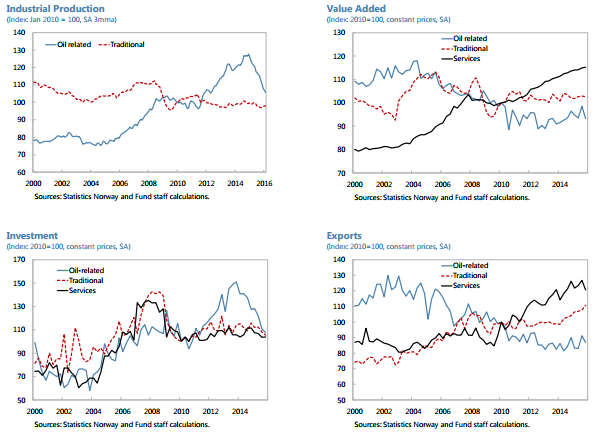
“As offshore investment drops from its peak and oil prices retreat from their high in 2014, the Norwegian economy is going through a transition away from oil dependence,” according to an IMF report. “The transition from oil and gas is a gradual process, and more time would be required before a credible assessment can be made of its progress. The preliminary data show an ongoing marked decline in oil-related production and investment, whereas activity in the traditional goods sector is holding up but not sufficiently to pick up the slack. The divergent performance is perhaps most pronounced within manufacturing between oil-related industries (i.e. machinery and equipment, ships, boats and oil platforms) and nonoil industries. Overall, although the real value added share of the oil-related sector has shrunk from over 36 percent on average during 2000–13 to about 29 percent during 2014–15, much of this appears to have been picked up by the business services sector. The traditional goods producing sector remains a relatively small part of the economy, with value added share at a little over 7 percent and hours worked share declining to 11 percent.”
By IMF colleague: Giang Ho
“As offshore investment drops from its peak and oil prices retreat from their high in 2014, the Norwegian economy is going through a transition away from oil dependence,” according to an IMF report. “The transition from oil and gas is a gradual process, and more time would be required before a credible assessment can be made of its progress. The preliminary data show an ongoing marked decline in oil-related production and investment,
Posted by at 9:02 AM
Labels: Energy & Climate Change
Thursday, March 24, 2016
Oil Prices and the Global Economy: It’s Complicated
Oil prices have been persistently low for well over a year and a half now, but as the April 2016 World Economic Outlook will document, the widely anticipated “shot in the arm” for the global economy has yet to materialize. We argue that, paradoxically, global benefits from low prices will likely appear only after prices have recovered somewhat, and advanced economies have made more progress surmounting the current low interest rate environment.
Since June 2014 oil prices have dropped about 65 percent in U.S. dollar terms (about $70) as growth has progressively slowed across a broad range of countries. Even taking into account the 20 percent dollar appreciation during this period (in nominal effective terms), the decline in oil prices in local currency has been on average over $60. This outcome has puzzled many observers including us at the Fund, who had believed that oil-price declines would be a net plus for the world economy, obviously hurting exporters but delivering more-than-offsetting gains to importers. The key assumption behind that belief is a specific difference in saving behavior between oil importers and oil exporters: consumers in oil importing regions such as Europe have a higher marginal propensity to consume out of income than those in exporters such as Saudi Arabia.
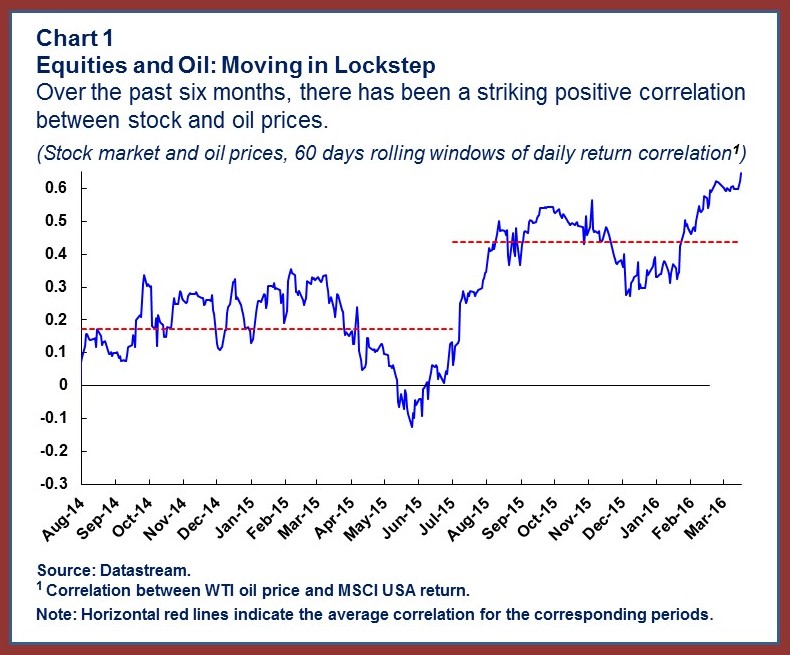
World equity markets have clearly not subscribed to this theory. Over the past six months or more, equity markets have tended to fall when oil prices fall—not what we would expect if lower oil prices help the world economy on balance. Indeed, since August 2015 the simple correlation between equity and oil prices has not only been positive (Chart 1), it has doubled in comparison to an earlier period starting in August 2014 (though not to an unprecedented level).
Past episodes of sharp changes in oil prices have tended to have visible countercyclical effects—for example, slower world growth after big increases. Is this time different? Several factors affect the relation between oil prices and growth, but we will argue that a big difference from previous episodes is that many advanced economies have nominal interest rates at or near zero.
Supply versus demand
One obvious problem in predicting the effects of oil-price movements is that a fall in the world price can result either from an increase in global supply or a decrease in global demand. But in the latter case, we would expect to see exactly the same pattern as in recent quarters—falling prices accompanied by slowing global growth, with lower oil prices cushioning, but likely not reversing, the growth slowdown.
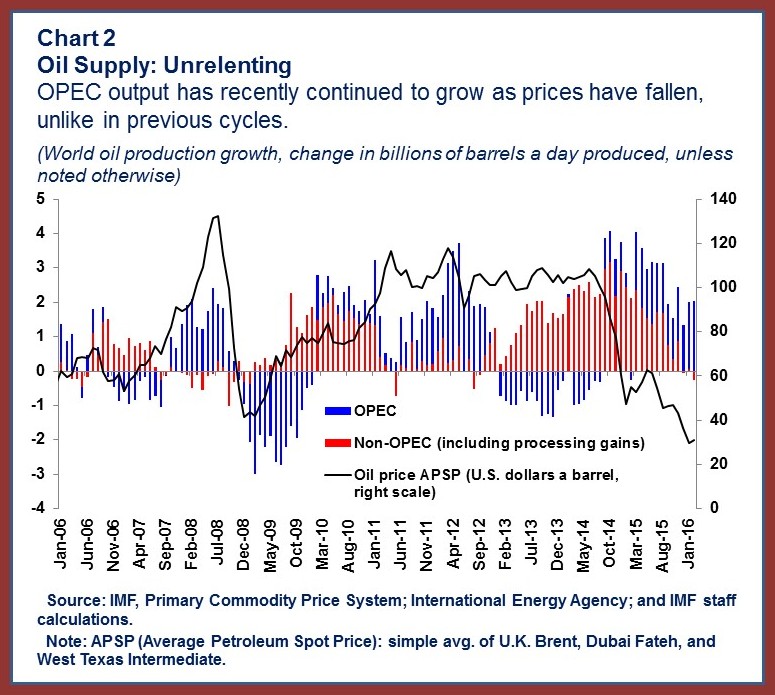
Slowing demand is no doubt part of the story, but the evidence suggests that increased supply is at least as important. More generally, oil supply has been strong owing to record high output from members of the Organization of the Petroleum Exporting Countries (OPEC) including, now, exports from Iran, as well as from some non-OPEC countries. In addition, the U.S. supply of shale oil initially proved surprisingly resilient in the face of lower prices. Chart 2 shows how OPEC output has recently continued to grow as prices have fallen, unlike in some previous cycles.
Continue reading here.
Below is an iMFdirect post by Maurice Obstfeld, Gian Maria Milesi-Ferretti, and Rabah Arezki:
Oil prices have been persistently low for well over a year and a half now, but as the April 2016 World Economic Outlook will document, the widely anticipated “shot in the arm” for the global economy has yet to materialize. We argue that, paradoxically, global benefits from low prices will likely appear only after prices have recovered somewhat,
Posted by at 12:07 PM
Labels: Energy & Climate Change
Subscribe to: Posts